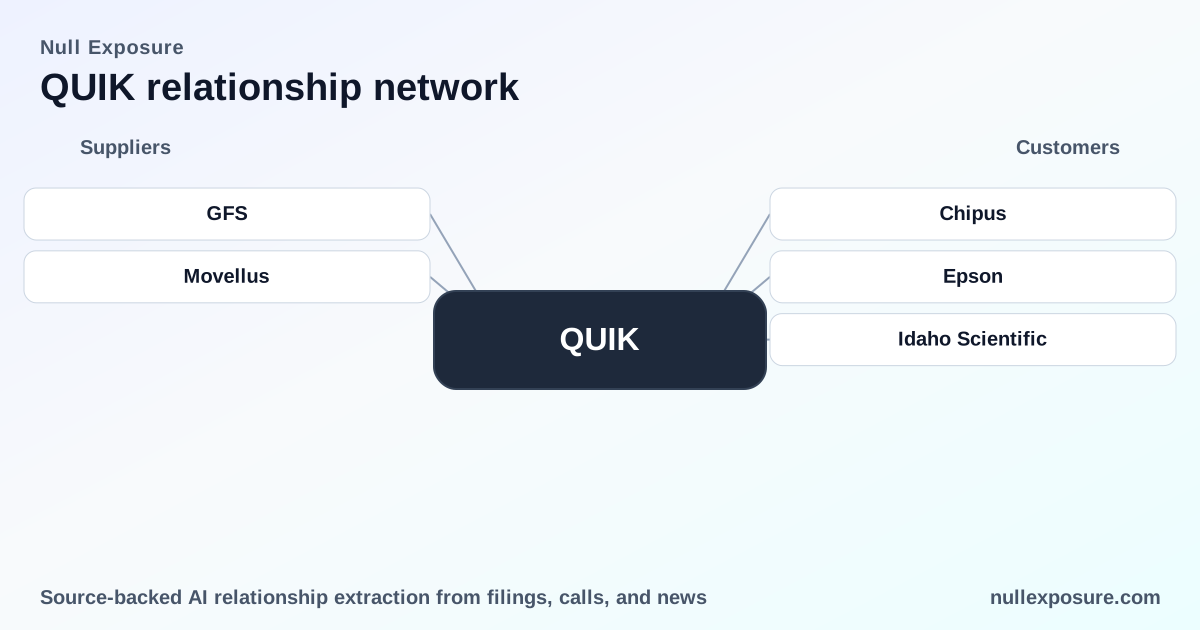
QuickLogic (QUIK): Customer Relationships Drive an eFPGA-Centric Revenue Profile
QuickLogic is a small-cap semiconductor specialist that monetizes through eFPGA intellectual property licensing, hardware product sales, professional engineering services, and SaaS from its SensiML subsidiary; its commercial model blends upfront IP/license economics with recurring SaaS/license recognition and per-unit royalties tied to silicon production. eFPGA IP is the dominant revenue stream, and recent press coverage confirms commercial traction with datacenter, cryptography, and imaging OEMs. For investors, the critical questions are concentration, contract structure, and the balance between one-off engineering revenue and growing subscription or per-unit royalty streams. Learn more at https://nullexposure.com/.
How QuickLogic sells and why that matters to investors
QuickLogic’s go-to-market combines three monetization levers: licensing of eFPGA hard IP, hardware product sales, and software/SaaS subscriptions delivered via SensiML. Corporate disclosures and the constraints extracted from filings show a mixed contracting posture: licenses and per-unit royalties for IP, subscription recognition for SaaS, and multiyear professional services engagements. Revenue geography is skewed to North America, with meaningful activity in Asia Pacific and EMEA, and eFPGA IP accounted for a material share of revenue in recent fiscal years.
- Contracting posture: Sales cycle often includes licensing agreements and professional integration work; SaaS is recognized ratably over subscription terms. The company also operates multi-phase, multi-year professional services arrangements when required.
- Concentration and criticality: QuickLogic reports single-customer concentration that has historically represented a majority of revenue, indicating high customer concentration risk despite a diversified product set.
- Maturity and spend profile: eFPGA IP is a material business line (reported as approx. 65% of revenue in the latest full year), and absolute IP revenue places several customer relationships into the $10m–$100m spend band for the company as a whole.
- Buyer types: Customers include system OEMs, defense contractors, U.S. government entities, and fabless chip companies — a mix that supports both commercial and government-driven opportunities.
Recent customer mentions: what the press is documenting
The following entries enumerate every customer mention captured in the provided results. Each item is a concise, plain-English summary with the original source noted.
Chipus — EET Asia (March 10, 2026)
QuickLogic’s eFPGA Hard IP was selected by Chipus for a datacenter production ASIC to be fabricated on a 12nm node, signaling adoption of QuickLogic IP in high-performance datacenter silicon. Source: EET Asia article published March 10, 2026.
Epson — InsiderMonkey transcript (FY2026 reference; reported March 10, 2026)
Epson conducted a case study showing that embedding QuickLogic’s eFPGA into an SoC reduced overall power consumption by 50%, and QuickLogic delivered a customized Australis eFPGA Hard IP targeting TSMC e12n without requiring re-spins. Source: Earnings call transcript published via InsiderMonkey, March 10, 2026.
Idaho Scientific — InsiderMonkey transcript (FY2026 reference; reported March 10, 2026)
Idaho Scientific selected QuickLogic’s eFPGA Hard IP for hardware-based cryptographic solutions aimed at mobile, IoT, infrastructure and defense systems, underlining QuickLogic’s relevance to crypto-agility use cases. Source: Earnings call transcript published via InsiderMonkey, March 10, 2026.
Chipus — EET India (March 10, 2026)
An EET India story reiterated that Chipus adopted QuickLogic’s embedded FPGA Hard IP for a high-performance datacenter ASIC on a 12nm process, corroborating multi-publication coverage of the same engagement. Source: EET India report dated March 10, 2026.
Chipus — EET Asia follow-up (May 3, 2026)
QuickLogic showcased its RadPro FPGA dev kit at the HEART conference, and reporting on May 3, 2026 again cited Chipus’s selection of QuickLogic eFPGA Hard IP for a 12nm datacenter ASIC, reinforcing this as a live production-class customer relationship. Source: EET Asia coverage, May 3, 2026.
Idaho Scientific — EET Asia (May 3, 2026)
EET Asia coverage on May 3, 2026 highlighted that QuickLogic’s eFPGA Hard IP will enable crypto agility for Idaho Scientific, substantiating the earlier press and QuickLogic’s positioning in cryptographic hardware. Source: EET Asia article, May 3, 2026.
What these names imply for revenue durability and risk
The customer mentions map to three clear strategic signals:
- Proof of production intent: Chipus’s selection for a datacenter ASIC on 12nm signals design-win progression from IP selection to production-ready silicon, which is where per-unit royalties and repeat revenue scale.
- Performance-led adoption: Epson’s energy reduction case study provides a quantifiable value proposition that accelerates replacement of software-centric architectures with hardware-accelerated eFPGA IP.
- Domain diversification with concentrated exposure: Idaho Scientific demonstrates QuickLogic’s penetration into high-value defense and cryptography segments, but company-level disclosures still show substantial revenue concentration to one or two large customers.
For a deeper view of how these outcomes feed revenues and contractual terms, see QuickLogic’s public filings and the company’s investor materials or visit https://nullexposure.com/ for curated relationship intelligence.
Investor checklist: catalysts and risks to monitor
-
Catalysts
- Conversion of design wins (Chipus) into shipping ASICs that trigger per-unit royalties and support long-term revenue scaling.
- Wider commercial adoption driven by energy/performance case studies (Epson).
- Expansion into government/defense cryptography programs that often carry multi-year procurement cycles (Idaho Scientific).
-
Risks
- Customer concentration remains a dominant risk factor; a single large buyer historically accounted for over half of revenue in recent years.
- Revenue mix still contains one-off professional services and hardware sales that compress visibility relative to pure SaaS businesses.
- Geographic skew to North America increases exposure to regional demand cycles and procurement patterns.
Bottom line: positioning and next steps for investors
QuickLogic is a focused eFPGA IP licensor with complementary hardware and SaaS offerings, validated by recent public customer mentions that cover datacenter, imaging, and cryptography end markets. The business delivers a blend of high-margin IP licensing and services-driven integration revenue, but investors must weigh meaningful customer concentration and the gap between design wins and recurring, scalable royalty streams.
For ongoing monitoring of QuickLogic’s customer trajectory and to track conversion of these design wins into revenue, visit NullExposure’s analysis hub: https://nullexposure.com/.