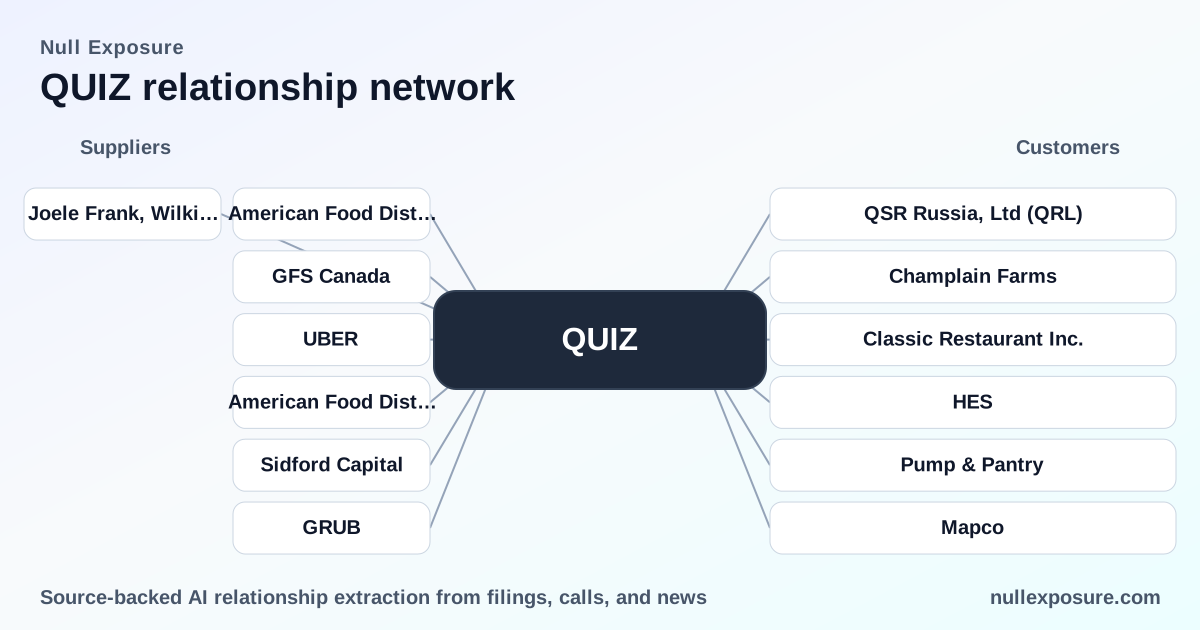
QUIZ customer map: what Quiznos’ partner roster tells investors
Quiznos operates as a franchisor and channel-expander that monetizes through franchise fees, ongoing royalties and distribution agreements that place branded outlets inside third‑party retail and convenience networks. Revenue accrues from traditional franchising plus strategic placement deals with convenience and fuel retailers that drive low‑capex expansion and recurring royalty streams. For a concise portfolio view and more relationship intelligence, visit https://nullexposure.com/.
Thesis: a franchisor that sells scale through partners, not balance‑sheet stores
Quiznos’ business model is built on outsourcing location economics to franchisees and retail partners while retaining a fee and royalty stream. The company leverages master franchises (international), regional franchisees, and retail convenience partners to accelerate footprint with limited corporate capital — a structure that amplifies growth when partner execution is strong and concentrates counterparty risk where a handful of channel partners control distribution density.
The partner list and what each relationship delivers
Below are each of the customer relationships extracted from public reporting, with a short plain‑English summary and source reference.
QSR Russia, Ltd (QRL)
Quiznos selected QSR Russia, Ltd as the master franchisee to launch its flagship Russian restaurants, positioning QRL as the vehicle for Quiznos’ initial international rollout in that market. According to RestaurantNews (FY2012), this was announced as the company’s chosen partner to expand ahead of major sporting events. Source: RestaurantNews (FY2012) — https://www.restaurantnews.com/quiznos-expands-into-russia-ahead-of-olympics-world-cup/
Champlain Farms
Quiznos entered a placement partnership with Vermont-based Champlain Farms to open Quiznos restaurants inside 40 Champlain convenience locations, using the retailer’s real estate to scale quickly in the Northeast. RestaurantNews reported this initiative as part of a broader convenience channel push (FY2011). Source: RestaurantNews (FY2011) — https://www.restaurantnews.com/quiznos-expands-convenience-growth-strategy-to-northeast-with-champlain-farms-partnership/
HESS (listed also as HES)
Quiznos expanded its convenience footprint through partnerships with major convenience retailers including HESS, enabling entry into dozens of forecourt and convenience outlets as part of a 2011 program that added more than 200 in‑store locations that year. RestaurantNews documented HESS as a named partner in Quiznos’ convenience development initiative (FY2011). Source: RestaurantNews (FY2011) — https://www.restaurantnews.com/quiznos-expands-convenience-growth-strategy-to-northeast-with-champlain-farms-partnership/
HES
An additional listing for HES references the same FY2011 convenience initiative; the public report names HES among the convenience industry leaders that partnered with Quiznos during the 2011 expansion push to add hundreds of locations. Source: RestaurantNews (FY2011) — https://www.restaurantnews.com/quiznos-expands-convenience-growth-strategy-to-northeast-with-champlain-farms-partnership/
Classic Restaurant Inc.
Classic Restaurant Inc., a franchise operator, owned a local Quiznos restaurant that closed and liquidated equipment, highlighting the franchisee risk and single‑site operational volatility that can affect local revenue and brand density. A local news article in FY2010 covered the closure and auction of equipment tied to Classic Restaurant Inc. Source: GoUpstate (FY2010) — https://www.goupstate.com/story/news/2010/07/27/quiznos-restaurant-closes-equipment-being-auctioned/29832464007/
Mapco
Quiznos’ convenience development included a channel partnership with Mapco, adding branded outlets inside Mapco convenience stores as part of the broader FY2011 convenience expansion that counted 200+ locations that year. RestaurantNews listed Mapco among the convenience partners powering Quiznos’ channel strategy. Source: RestaurantNews (FY2011) — https://www.restaurantnews.com/quiznos-expands-convenience-growth-strategy-to-northeast-with-champlain-farms-partnership/
Pump & Pantry
Quiznos’ modern comeback effort included a 2022 partnership with Nebraska-based Pump & Pantry, marking a recent phase of growth through regional convenience partners that reintroduced the brand into retail networks. RetailWire chronicled this partnership as part of Quiznos’ resurgence strategy (FY2024 commentary). Source: RetailWire (FY2024) — https://retailwire.com/quiznos-comeback/
What the partner mix signals about Quiznos’ operating model
No explicit contractual constraints were captured in the dataset supplied; that absence is itself a company‑level signal for investors to note. Taken together with the partner list, the relationships indicate the following operating characteristics:
- Contracting posture — franchise and placement heavy. Quiznos structures expansion through third‑party real estate and master‑franchise agreements rather than corporate‑owned stores, transferring site execution risk to partners while preserving fee‑based income.
- Counterparty concentration — dispersed but channel‑concentrated. Partners include many regional convenience chains and franchise operators; risk is not heavily concentrated in a single franchisee but is concentrated by channel (convenience/fuel retail).
- Criticality — distribution partners are strategically material. Convenience and fuel retailers (HESS/HES, Mapco, Champlain Farms, Pump & Pantry) serve as primary distribution channels, meaning partner execution directly affects sales per location and royalty flow.
- Maturity — legacy relationships and recent re‑entry. The dataset spans legacy franchise activity (FY2010–FY2012) and a more recent comeback partnership (noted in FY2024), indicating a company cycling between historical contraction and targeted re‑expansion.
Investment implications: upside, risks, and what to watch
Quiznos’ partner-driven model offers capital efficiency and rapid footprint growth when partners execute, but it also concentrates operational dependency on third parties and retail channel health. Key investor takeaways:
-
Upside: Low corporate capex and multiple co‑branding outlets create scalable royalty economics when retail partners expand aggressively.
-
Risk: Franchisee closures and local operator distress (e.g., Classic Restaurant Inc.) compress royalties and signal execution risk at the unit level.
-
Watchlist: Track announcements of new master‑franchise deals, renewals with large convenience chains, and any disclosure of royalty rates or minimum guarantees; these items materially affect revenue quality.
-
Operational indicators to monitor: partner churn, store openings inside convenience networks, and the balance between master franchise royalties and single‑site franchise income.
For a deeper portfolio analysis and ongoing monitoring of QUIZ customer relationships, visit https://nullexposure.com/.
Bottom line
Quiznos monetizes growth through franchising and convenience‑store placements that trade corporate asset intensity for partner dependency. Investors should treat partner execution and channel concentration as the primary operational risk and principal lever of upside.