uniQure’s commercial pivot: cashing in Hemgenix through a single, strategic customer
uniQure NV is a clinical-stage gene therapy company that monetizes primarily through strategic licensing and supply agreements rather than broad commercial rollouts of its own. The company sold exclusive global rights to Hemgenix to CSL Behring in 2021, retains contractual manufacturing and supply obligations, and collects a mix of license/royalty receipts plus contract manufacturing revenue—a business model that centers concentrated commercial exposure to CSL Behring and predictable near-term cash flow from minimum purchase commitments. For investors evaluating uniQure’s customer relationships, the CSL Behring arrangement is the dominant commercial reality and the key driver of revenue visibility.
If you want a rapid, relationship-level view for due diligence, see the homepage for our product overview: https://nullexposure.com/
Why the CSL Behring tie matters more than a typical supplier contract
uniQure’s relationship with CSL Behring is not a standard vendor list item: it is the monetization axis for a commercially approved product. uniQure converted years of R&D into a license sale for Hemgenix and then layered a development and commercial supply agreement on top of that sale, creating multiple revenue streams and ongoing operational commitments. That combination means uniQure collects license revenue and contract manufacturing receipts, while also being contractually responsible for supply until capabilities are transferred to CSL or a designated contract manufacturer.
This commercial configuration creates a defined near-term revenue base and reduces market execution risk for uniQure — but it also concentrates commercial risk in a single counterparty and requires continued delivery and quality performance under multi-year commitments.
Contract features investors should price into the model
- License sale plus royalty stream. The company’s filings record license revenue (royalty payments) from CSL Behring and explicitly note the sale of exclusive global Hemgenix rights in 2021, converting long-term R&D value into upfront and recurring cash. According to the FY2024 Form 10‑K, uniQure records license revenue from CSL Behring of “$ 10,133.”
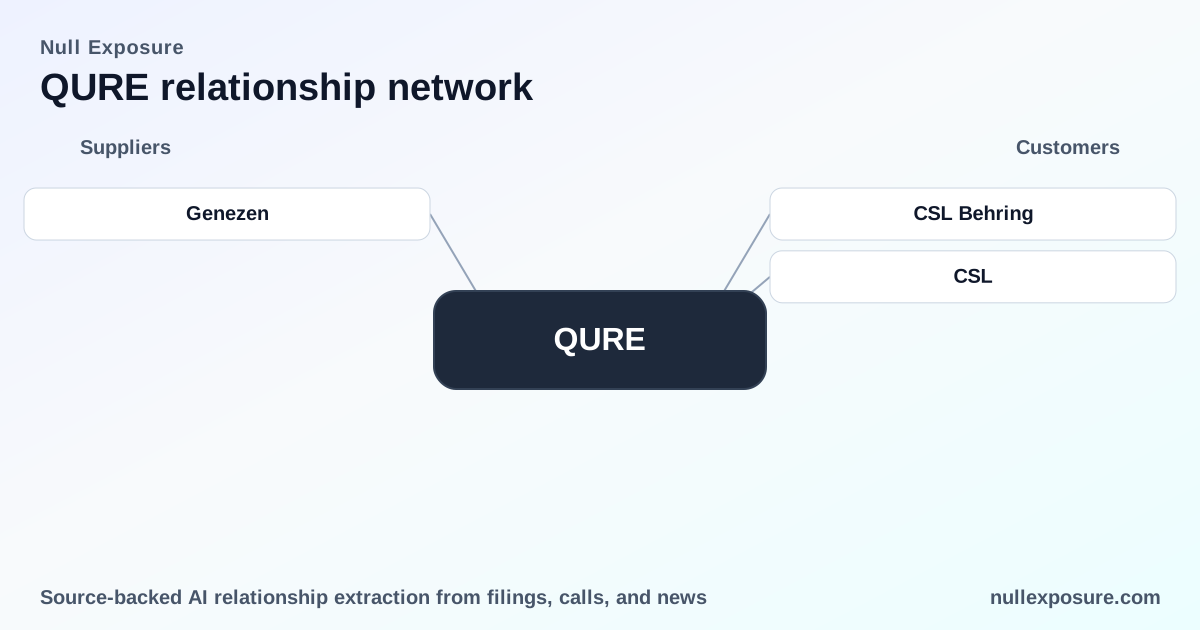
- Supply obligations remain in force. uniQure remains contractually obligated to supply Hemgenix under the Development and Commercial Supply Agreement until transfer of capabilities is completed; the FY2024 filing notes these obligations “remain in effect notwithstanding the subcontracting to Genezen.”
- Minimum purchase commitments provide revenue floors. The filing discloses minimum purchase commitments that create a measurable revenue floor: $43.3 million over the first three years of the CSA in the aggregate and $13.6 million of minimum purchases committed by CSL Behring over the next 12 months as disclosed. The filing also shows contract-related totals reported as “$27,119” in the revenue schedule.
- Active, multi-role commercial relationship. Regulatory and corporate disclosures indicate the relationship spans roles: uniQure acts as seller/supplier and receives license royalties, while CSL Behring is the licensee and commercial marketer for Hemgenix.
These terms impose both upside (predictable cash from minimums and royalties) and downside (single-customer dependency, transfer risk, and manufacturing performance exposure).
Customer relationships in the record — what each source says
-
uniQure’s FY2024 10‑K records contract manufacturing revenue from CSL Behring and confirms ongoing supply obligations to CSL Behring for Hemgenix even when manufacturing is subcontracted to Genezen. This is the primary official disclosure of the commercial structure and commitments. (Source: uniQure FY2024 Form 10‑K, filed covering FY2024)
-
A March 2026 TradingView post summarizing a Zacks note flagged that Hemgenix is marketed in partnership with CSL Behring in the U.S. and EU, reinforcing media recognition that Hemgenix is a commercial product operated in conjunction with CSL. (Source: TradingView, Zacks summary, March 2026)
-
The same March 2026 TradingView/Zacks item also appears referenced under the CSL Behring name and reiterates that Hemgenix’s U.S. and EU commercialization is conducted in partnership with CSL Behring, a media echo of the company’s licensing and commercialization arrangement. (Source: TradingView, Zacks summary, March 2026)
What the constraints tell investors (and how they translate to risk/reward)
Several constraint-level signals extracted from company disclosures are material to valuation and operational due diligence:
-
Contract type — licensing. uniQure sold exclusive global rights to Hemgenix to CSL Behring in 2021, converting asset value into license proceeds and ongoing royalties; this is a structural monetization move rather than an open-market commercialization push. (Evidence: 2024 Form 10‑K)
-
Relationship roles — seller, licensee counterparty, and buyer dynamics. The company remains both a seller/supplier under the CSA and a recipient of license revenue while CSL Behring functions as the licensee and commercial seller; this dual posture gives uniQure recurring cash but also places operational obligations on uniQure to deliver product. (Evidence: 2024 Form 10‑K)
-
Active stage and minimum commitments. The supply agreement is active and includes explicit minimum purchase commitments, including $43.3 million over the first three years and $13.6 million in the next 12 months, which create a measurable revenue floor and reduce near-term top-line volatility. (Evidence: 2024 Form 10‑K)
-
Spend band (mid‑range materiality). Extracted commitments and reported contract totals place the customer spend band in the $10m–$100m range, large enough to materially affect uniQure’s revenue profile but small relative to blockbuster therapies sold at scale; this signals material concentration risk with some revenue predictability. (Evidence: 2024 Form 10‑K)
Collectively, these constraints frame uniQure as a company that has traded broad commercial exposure for a concentrated, contractually backed revenue stream tied to a single global partner.
If you want a mapped summary of these relationships and constraints for modeling or competitive benchmarking, visit our platform: https://nullexposure.com/
Investment implications — how to weight uniQure in a portfolio
-
Positive case: The licensing + supply structure delivers predictable near-term cash and de-risks commercialization execution because CSL Behring takes the commercial lead; minimum purchase commitments and royalty receipts reduce revenue variance for uniQure while management focuses on R&D and tech transfer. This increases short-term revenue visibility and supports a re-rating if delivery and transfer milestones proceed on time.
-
Risk case: The arrangement concentrates commercial exposure in one partner; any dispute, quality issue, or failure in transfer to CSL or designated manufacturers would disproportionately affect uniQure’s revenue. Operational performance (manufacturing quality, timely tech transfer) and the commercial performance of Hemgenix under CSL’s stewardship are the primary external risk vectors.
-
Valuation note: Given uniQure’s modest reported revenue base and negative operating margins, the CSL Behring relationship is the principal lever for near-term valuation — investors should price both the certainty of contractual minimums and the downside of concentration into any model.
Bottom line
uniQure has deliberately converted a lead asset into a license-plus-supply commercial arrangement with CSL Behring that supplies both royalties and contract revenue while leaving the commercialization burden largely with its partner. That structure provides predictable, contract-backed revenue in the near term but concentrates commercial risk. For investors, the single-customer dynamic is the dominant factor for revenue modeling, risk assessment, and sensitivity to manufacturing and transfer execution.
For a concise, relationship-level dashboard and to explore downstream partner risk signals, review our coverage at https://nullexposure.com/