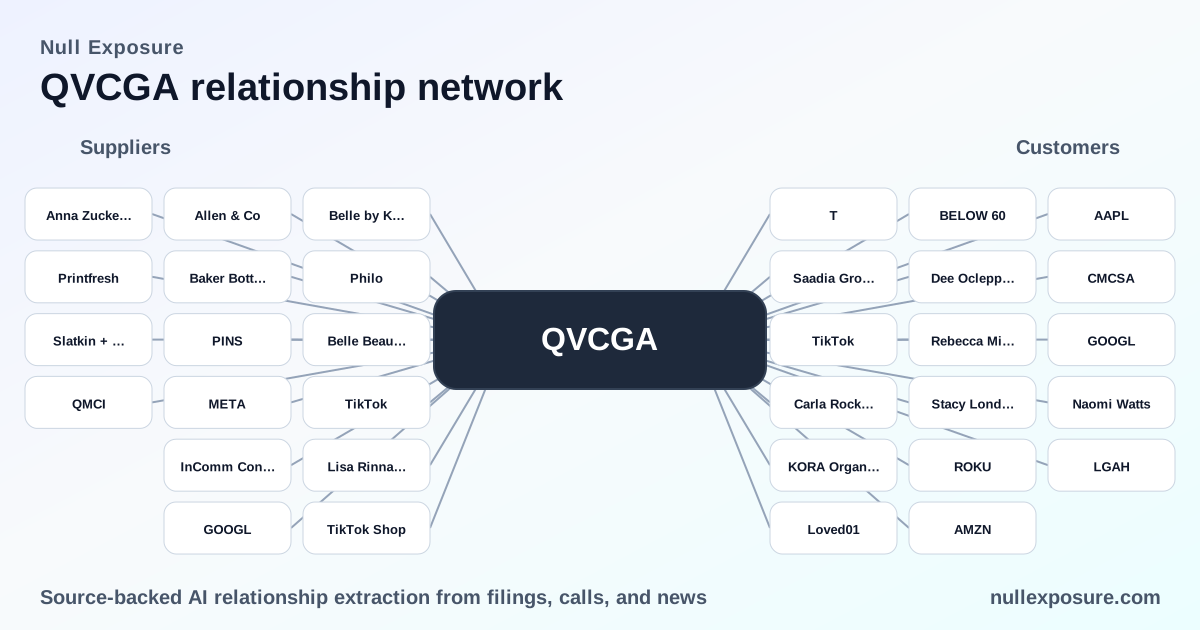
QVCGA: Distribution-heavy retail media with branded supply-side relationships
QVCGA operates a video-first retail platform that monetizes through direct merchandise sales, branded exclusives and platform distribution deals; it sells third‑party brands and exclusive designer collections via televised and streaming channels, and extends reach through integrations with streaming and pay-TV platforms. Investors should view QVCGA as a distribution and merchandising business where audience reach and curated brand partnerships drive revenue, not a traditional margin-rich product manufacturer.
For a concise commercial intelligence brief on customer relationships and partner concentration, visit the NullExposure homepage: https://nullexposure.com/
Why distribution partnerships are the strategic moat
QVC’s core competency is reach: televised shopping plus streaming placements convert brand awareness into immediate sales. The company amplifies that reach by placing channels on major streaming platforms and by signing exclusives with celebrity and lifestyle brands that drive short-term spikes in order volume. These contracts are operationally straightforward — content distribution deals and merchandising agreements — which implies an emphasis on scale, audience access and curation rather than complex, bespoke vendor integrations.
Streaming and carriage deals drive daily household coverage
QVC has executed broad carriage across device ecosystems and pay-TV vendors to maximize daily household reach. That distribution posture signals high availability and low single-customer concentration, and positions QVC to monetize both live programming and product exclusives.
- The company expanded into streaming channels distributed on major platforms, which increases discoverability for merchant partners and stabilizes viewership across cord-cutters and traditional pay-TV subscribers.
You can explore more contextual intelligence at NullExposure: https://nullexposure.com/
Comprehensive relationship runbook (each relationship in the record)
-
AT&T TV NOW — CordCuttersNews reported that AT&T added the HSN and QVC channels to the AT&T TV NOW lineup, expanding QVC’s carriage on that OTT service (coverage referencing FY2019). Source: CordCuttersNews (FY2019 report archived 2026).
-
T (duplicate entry) — The same CordCuttersNews item is cataloged under the ticker T; it documents AT&T’s addition of QVC/HSN to AT&T TV NOW, reinforcing QVC’s pay-provider carriage. Source: CordCuttersNews (FY2019).
-
Saadia Group — LancasterOnline reported that Saadia Group purchased a vacant 5.1‑acre lot from QVC for $1.0 million, reflecting a real-estate transaction tied to QVC’s campus divestiture activity (reported in FY2021). Source: LancasterOnline (FY2021).
-
TikTok — The Philadelphia Inquirer quoted QVC leadership describing an agreement with TikTok as “the first 24-7 live shopping experience in the U.S.,” underscoring QVC’s strategic push into social-stream commerce (reported FY2025). Source: The Inquirer (May 2025).
-
Carla Rockmore — PR Newswire announced a signature collection by designer Carla Rockmore launching exclusively with QVC, illustrating the company’s ongoing exclusive designer partnerships to generate episodic sales (PR release Oct 28, 2024; aggregated via Finviz). Source: PR Newswire / Finviz (Oct 2024).
-
KORA Organics — PR Newswire noted that KORA Organics debuted on QVC, signaling the platform’s role as a channel for beauty brand distribution (PR release Oct 15, 2024; aggregated via Finviz). Source: PR Newswire / Finviz (Oct 2024).
-
Loved01 — PR Newswire reported that John Legend’s inclusive personal care brand Loved01 debuted on QVC, showing QVC’s continued attraction of celebrity and lifestyle product launches (PR release Oct 31, 2024; aggregated via Finviz). Source: PR Newswire / Finviz (Oct 2024).
-
BELOW 60 (Hilary Duff) — PR Newswire released news that Hilary Duff’s BELOW 60 fragrance collection came to QVC with an exclusive offer, a classic example of limited-time exclusives that drive conversion (PR release Apr 24, 2025; aggregated via Finviz). Source: PR Newswire / Finviz (Apr 2025).
-
Dee Ocleppo Hilfiger — PR Newswire announced an exclusive collection with QVC from entrepreneur and designer Dee Ocleppo Hilfiger, further demonstrating QVC’s continued focus on style-focused exclusives (PR release Nov 26, 2024; aggregated via Finviz). Source: PR Newswire / Finviz (Nov 2024).
-
Rebecca Minkoff — A PR Newswire release detailed Rebecca Minkoff’s expanded partnership with QVC, including a debut footwear line and exclusive studio collection, reflecting multi-category brand collaborations (PR release Mar 5, 2026; aggregated via Finviz). Source: PR Newswire / Finviz (Mar 2026).
-
Stacy London — PR Newswire announced Stacy London launching an exclusive collection with QVC as a Q50 ambassador, illustrating QVC’s strategy of celebrity ambassadors to sustain recurring product drops (PR release Aug 22, 2024; aggregated via Finviz). Source: PR Newswire / Finviz (Aug 2024).
-
Roku (PR Newswire) — A company release on PR Newswire (FY2022) noted that QVC’s streaming experience is available on Roku among other platforms, confirming Roku as a distribution partner for QVC streaming channels. Source: PR Newswire (FY2022).
-
Roku (Inquirer) — The Inquirer reported that QVC and HSN launched on streaming platforms such as Roku in recent years, reinforcing Roku’s role in QVC’s cross-platform distribution strategy (reported FY2025). Source: The Inquirer (FY2025).
-
ROKU (duplicate entry) — The PR Newswire streaming-executive announcement is cataloged multiple times under ROKU/ROKU entries; each record documents availability on Roku as part of QVC’s streaming rollout (FY2022 press coverage). Source: PR Newswire (FY2022).
-
Amazon (Amazon Fire TV) — PR Newswire lists Amazon Fire TV as a distribution endpoint for QVC’s streaming experience, broadening access to Fire TV households (FY2022 release). Source: PR Newswire (FY2022).
-
Apple (Apple TV) — PR Newswire lists Apple TV among platforms carrying the QVC streaming experience, indicating presence across key connected-TV ecosystems (FY2022 release). Source: PR Newswire (FY2022).
-
Comcast — PR Newswire confirms QVC’s streaming availability on Comcast X1, Xfinity Flex and X-Class TV, preserving carriage on large MSO platforms (FY2022 release). Source: PR Newswire (FY2022).
-
Google (Android TV / Google Play Store / Google TV) — PR Newswire identifies Android TV, Google Play and Google TV as distribution channels for QVC’s streaming presence, supporting broad Android-device reach (FY2022 release). Source: PR Newswire (FY2022).
-
Naomi Watts — PR Newswire announced Naomi Watts launching a pro‑aging beauty brand on QVC as a Q50 ambassador, another example of celebrity-led brand introductions that drive episodic demand (PR release Sep 19, 2024; aggregated via Finviz). Source: PR Newswire / Finviz (Sep 2024).
-
LG — PR Newswire lists LG as a platform carrying QVC’s streaming experience, further validating cross-manufacturer distribution on smart TV platforms (FY2022 release). Source: PR Newswire (FY2022).
Operational constraints and business-model signals
-
Geographic footprint: QVC operates across North America, Europe and Asia, with the strongest signal in North America; the company runs international channels but North American business shows the highest operational density (company disclosures aggregated across filings; confidence signals in the record).
-
Customer concentration: Public excerpts state QVC does not depend on any single customer for a significant portion of revenue, which signals low counterparty concentration on the buyer side and supports resilient wholesale/retail flows.
-
Role and contracting posture: QVC predominantly functions as a seller/retailer and curator of brands, contracting standard carriage and merchandising agreements rather than deep, bespoke integrations; a separate company-level signal also positions QVC as a buyer where it sources or curates inventory for resale.
-
Maturity and criticality: Distribution agreements with platform incumbents (Roku, Amazon Fire TV, Apple TV, Comcast, Google, LG) are critical for reach but operationally standard, suggesting low implementation risk and high leverage to audience monetization.
What investors should watch next
-
Monitor the cadence and scale of exclusive brand launches: exclusive drops and celebrity partnerships are the immediate lever for revenue spikes. PR activity for designers and beauty lines is a leading indicator of near-term product-driven sales.
-
Track streaming carriage renewals and expansion into social-stream platforms (TikTok): distribution breadth determines traffic flow and conversion efficiency.
-
Real-estate sales such as the Saadia Group transaction are non-core liquidity events that reduce fixed-cost footprint and can influence near-term capital allocation.
Bold takeaway: QVCGA is a distribution-first retail media business whose valuation hinges on audience scale and the ability to convert exclusive brand partnerships into repeat sales, not unique product economics.
For tailored customer-risk reports and ongoing monitoring of QVCGA partner activity, visit https://nullexposure.com/