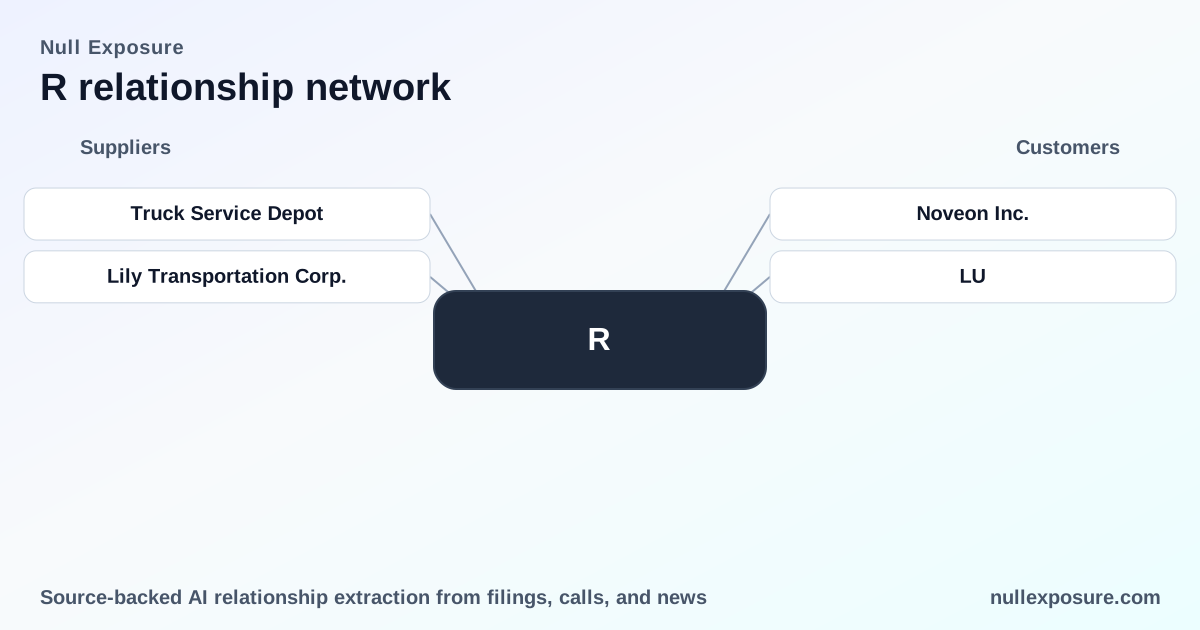
Ryder System (R): Customer Relationships that Drive Predictable Fleet Economics
Ryder monetizes a capital-intensive logistics platform by leasing and renting vehicles, providing maintenance and fleet management, and running supply-chain and dedicated-transport services for enterprise customers. Revenue mixes between long-term leased assets and recurring service contracts create high visibility and operating leverage — Ryder reported roughly $12.7 billion in trailing revenue and a diversified split across SCS, FMS and DTS that underpins margins and steady cash flow.
For a concise look at relationship-level signals and what they imply for investors and operators, read on. If you want a deeper look at how these customer ties map to commercial exposure, visit https://nullexposure.com/ for full profiles.
How Ryder’s commercial model actually works — the practical constraints that matter
Ryder is not a spot carrier. Its operating model is defined by long-dated equipment leases and service contracts combined with a smaller short-term rental business and usage-linked products. The company’s disclosures show it leases revenue-earning equipment typically for three to seven years (ten years for trailers) and delivers many SCS and FMS services under long-term arrangements — a posture that creates durable revenue streams and capital intensity.
- Contracting posture: Predominantly long-term, with selective short-term rental and usage-based pricing (ChoiceLease) layers that add elasticity to demand exposure.
- Concentration and customer mix: Ryder serves both small businesses and large enterprises, but its SCS accounts skew to large, complex customers — a commercial profile that favors scale and customized solutions.
- Criticality: Ryder functions as a service provider and, for many customers, a strategic logistics partner — elevating switching costs and revenue stickiness where Ryder operates as lead logistics provider or dedicated fleet manager.
- Geographic footprint and maturity: Revenue and operations remain North America-centric, with targeted international expansions such as CALA execution for select customers; the core businesses are mature and cash-generative (SCS ~43% of consolidated revenue, FMS ~38%, DTS ~18% in 2025).
These constraints make Ryder a capital-light-to-capital-heavy hybrid: service margins drive profitability while lease and maintenance obligations require disciplined asset management.
Deal-by-deal: customer relationships you should know now
Embark Trucks — yard operations and transfer-point network (result 1)
Ryder agreed to provide yard operations, maintenance and fleet management to support Embark’s plan for up to 100 freight transfer points as part of a coast-to-coast autonomous trucking network. Source: Ryder corporate newsroom press release (March 9, 2026), announcing the partnership.
Embark coverage in news outlets (result 2)
Independent reporting echoed Ryder’s role providing maintenance and yard operations to support Embark fleet partners in the autonomous network rollout. Source: Samoa Observer technology coverage (reported March 2026).
Noveon Inc. — multi-year transportation management contract (result 3)
Ryder secured a multi-year transportation management engagement with Ohio-based specialty-chemicals maker Noveon Inc., expanding its customer base in chemical logistics and TMS execution. Source: TruckingInfo industry report (March 10, 2026).
Kirkland’s Home — in-home delivery and light assembly (result 4)
Ryder partnered with Kirkland’s Home to provide in-home delivery and light-assembly services as the retailer scales furniture sales, signaling Ryder’s push into last-mile premium services for retail customers. Source: HomePageNews coverage of the partnership (reported March 2026).
Aurora — embedded maintenance for autonomous Class 8 tractors (result 5)
As part of a pilot with Aurora, Ryder embedded technicians at Aurora’s South Dallas terminal to perform inspections, preventive maintenance and repairs on autonomous Class 8 tractors—illustrating Ryder’s role as a technical maintenance partner for autonomous fleet operators. Source: TruckingInfo report on the Ryder–Aurora agreement (reported March 2026).
Lucent Technologies — LLP expansion into Caribbean and Latin America (result 6)
Lucent expanded its North America contract with Ryder to add Lead Logistics Provider services across the Caribbean and Latin America (CALA), broadening Ryder’s remit from regional to cross-border logistics for a network equipment provider. Source: TruckingInfo coverage of Lucent’s contract expansion with Ryder (March 10, 2026).
Embark (financial release mention) — real-estate and support services (result 7)
Embark’s investor communications referenced optimized real estate sites and support services secured through partnerships that include Ryder, underlining Ryder’s role in enabling operational footprints for autonomous players. Source: Embark third-quarter financial release (GlobeNewswire, referenced in 2022 filing and cited in related 2026 coverage).
Lucent (duplicate feed) — confirmation of CALA scope (result 8)
A second outlet reiterated that Ryder will act as Lead Logistics Provider for Lucent’s CALA operations, confirming scope and regional extension of the existing North America contract. Source: TruckingInfo duplicate feed on the Lucent expansion (March 10, 2026).
What these relationships say about Ryder’s strategic positioning
Collectively, these engagements reveal three clear strategic themes:
- Platform utility across new mobility and legacy verticals. Partnerships with Embark and Aurora show Ryder translating core maintenance and yard operations capabilities into the autonomous ecosystem, while contracts with Lucent, Noveon and Kirkland’s demonstrate durable demand across telecom, chemical and retail verticals.
- Service-led growth backed by asset leasing and management. Many wins are services-first (LLP, TMS, last-mile delivery) but often tie back to Ryder’s equipment, technician footprint and maintenance capabilities — reinforcing revenue stickiness and cross-sell opportunities.
- North America anchor with selective international extension. The Lucent CALA expansion is consistent with Ryder’s careful international push while keeping the North American base dominant.
Investment implications and alpha drivers
- Visibility and earnings quality: Long-term contracts and leased assets create predictable revenue and support valuation multiples that reflect recurring cash flows (R’s trailing EV/EBITDA ~5.5).
- Growth vectors: Autonomous-fleet maintenance and last-mile premium services are high-margin adjacencies where Ryder leverages existing scale.
- Key risks: Geographic concentration in North America, capital intensity from equipment leasing, and counterparty concentration in large enterprise clients expose Ryder to cyclical industrial demand and contract renewal risk.
- Operational execution matters: Embedded maintenance pilots and LLP expansions are strategic but require precision in technician deployment and regional operations to convert into durable margin uplift.
For a consolidated view of customer exposures and custom alerts on contract wins and expirations, see the full relationship map at https://nullexposure.com/.
Conclusion: Ryder’s customer relationships are strategic, often long-term, and increasingly oriented toward services that lock in recurring revenue. The company’s ability to monetize asset ownership alongside high-value services positions it as a predictable industrial logistics play with optionality in autonomous and last-mile markets. Investors should watch contract renewal timelines, regional expansions, and the conversion of pilots into multi-year engagements as the next triggers for upside.