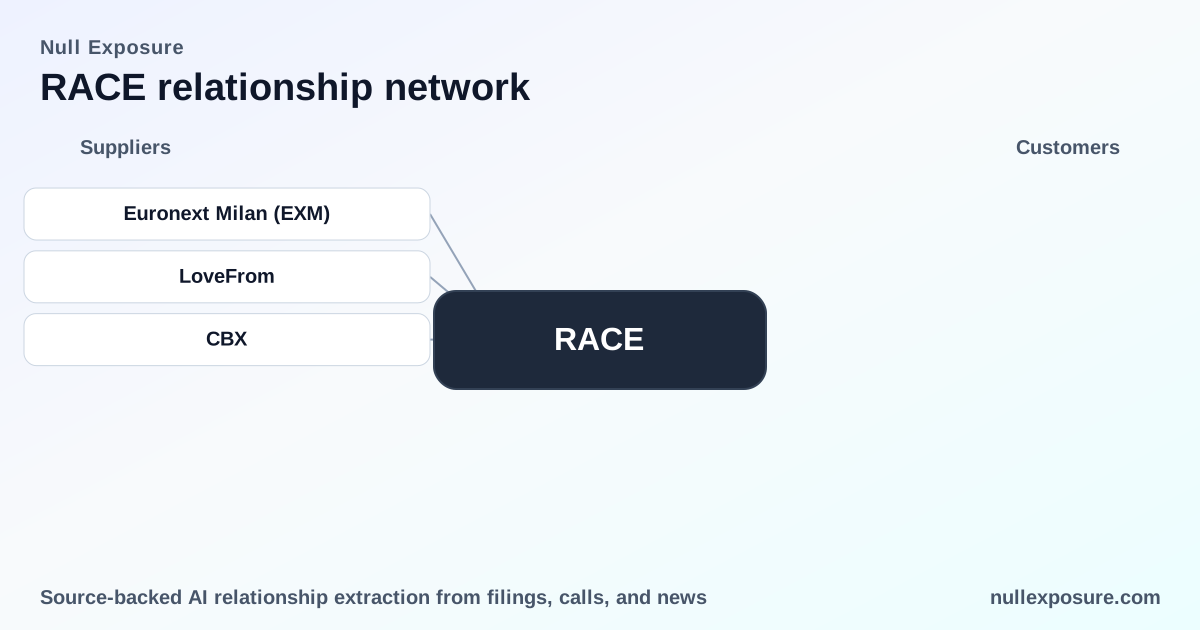
Ferrari (RACE): Customer relationships that underpin a luxury franchise
Ferrari monetizes a tightly controlled luxury franchise through car sales, high-margin licensing, and motorsport partnerships that reinforce brand exclusivity. The company sells limited-volume, high-priced sports cars while extracting recurring profitability from brand licensing and technical supply agreements—a mix that drives strong margins and steady free cash flow. Investors should value Ferrari as an asset-light luxury manufacturer with concentrated but strategically critical customer and partner relationships that both protect pricing power and create diversified revenue streams.
If you want a concise map of Ferrari’s external ties for underwriting or operational diligence, start with how licensing and motorsport suppliers translate into cashflow resilience and brand control. For a deeper audit and tracker of partner exposure, visit https://nullexposure.com/.
Why these relationships matter to investors Ferrari’s economics are driven by two interlocking engines: product scarcity and brand monetization. Conventional auto cycles are muted in Ferrari’s P&L because licensing and brand partnerships contribute high-margin revenue that is largely decoupled from vehicle volume. At the same time, Ferrari’s technical supplier relationships—especially in Formula 1—are strategic and mission-critical, affecting both brand halo and R&D leverage. The company’s FY2025 financials (roughly $7.15bn revenue and ~28.6% operating margin) reflect this duality: premium goods sales plus outsized margin sources.
Explore more company relationship intelligence at https://nullexposure.com/.
Relationship snapshots: who Ferrari is working with (and why it matters) Below are the customer/partner relationships surfaced in public reporting. Each entry is a plain-English takeaway with the reporting source.
Puma — licensing extends brand reach and adds margin
Ferrari runs licensing deals with leisure and lifestyle brands such as Puma to sell co-branded products that capture margin without incremental vehicle production; these agreements extend the Ferrari ecosystem and provide high-margin income decoupled from auto cycles. According to an Ad‑Hoc News overview published May 3, 2026, Puma is cited among brands used in Ferrari’s licensing strategy.
Hansgrohe — luxury home fittings as a brand extension
Ferrari licenses its name to non-automotive premium categories like Hansgrohe, further diversifying revenue into consumer goods and experiences while preserving brand aura. Ad‑Hoc News (May 3, 2026) specifically lists Hansgrohe alongside other licensing partners as part of Ferrari’s high-margin ecosystem.
Garrett Motion (GTX) — technical supply for Formula 1 power units
Garrett Motion retains a technical supply role, contracted to develop and supply the next‑generation turbo system for Ferrari’s Formula 1 power unit under the 2026 FIA regulation cycle; this is a mission-critical engineering partnership that ties directly into Ferrari’s motorsport competitiveness and technology transfer. GlobeNewswire reported on January 30, 2026 that Garrett extended its agreement to remain a supplier for Ferrari’s F1 program.
MSGM — manufacturer-backed collaboration for racing IP and content
Ferrari provided detailed manufacturer support for the Official 24 Hours of Le Mans game, including collaboration on the Le Mans Centenary-winning 499 to ensure an authentic representation of its cars; this is an example of Ferrari commercializing motorsport IP through entertainment channels. Motor1 wrote on March 10, 2026 that this game was developed with significant manufacturer support, including Ferrari’s collaboration.
Penske Automotive Group (PAG) — retail footprint reinforcement
Penske strengthened its relationship with Ferrari at the brand’s home base through dealership activity, including the acquisition of a Ferrari dealership, which tightens retail distribution and local brand control in important markets. TradingView referenced this strengthening of ties in a March 10, 2026 report, and an InsiderMonkey transcript of Penske’s Q4 2025 earnings call cited the Ferrari dealership acquisition as part of its U.S. and Italian growth strategy (March 10, 2026).
Operating model and business-model characteristics investors should note
- Contracting posture: Ferrari pursues selective, long-duration partnerships for high-signal value—licensing contracts with global consumer brands and long-term technical supply pacts for Formula 1—favoring controlled exposure over broad distribution. This posture preserves pricing power and quality control.
- Concentration: The company is concentrated by design—low-volume vehicle production and selective retail partners such as Penske mean customer concentration is higher than mass-market OEMs, but that concentration is deliberate and value-enhancing rather than a pure risk of single-customer dependency.
- Criticality: Several relationships are operationally critical: technical suppliers for F1 are mission-critical because they support Ferrari’s motorsport platform and R&D halo; selected dealership relationships are critical for retail presence in key markets. Licensing partners are commercially important but less operationally critical.
- Maturity: Licensing and brand partnerships represent mature, repeatable revenue streams that scale faster than vehicle production constraints allow; technical supply relationships show an engineering lifecycle aligned to regulation cycles (notably the 2026 F1 rulebook), so these contracts follow multi-year renewal and development rhythms.
Company-level signals from constraints No explicit contractual constraints or negative covenants were disclosed in the relationship dataset provided; the absence of flagged constraints is itself a signal that public reporting on Ferrari’s partner relationships is currently standard commercial disclosure rather than litigious or distressed contracting.
What this means for investors and operators
- Upside: The brand-licensing model provides margin diversification and downside protection for vehicle volume volatility; Ferrari’s premium pricing and brand control support structural margins well above mass-market peers.
- Key risks: Concentration is intentional but creates single-point importance on partner selection—loss of strategic suppliers or erosion of brand exclusivity would have outsized impact. Motorsport partnerships are sensitive to regulation cycles and technology performance.
- Operational focus: Investors should monitor contract renewals in motorsport supply chains (for example, the Garrett Motion agreement tied to the 2026 FIA cycle) and the growth rate of licensing income as indicators of revenue mix durability.
Final takeaway Ferrari’s external relationships are a deliberate extension of its luxury franchise: licensing provides recurring, high-margin income while selective technical and retail partners secure performance and distribution. For underwriters and operating executives, the critical questions are the longevity of technical agreements tied to regulatory cycles and the pace at which licensing scales relative to vehicle revenue.
For an ongoing, investor-focused feed and relationship tracker, visit https://nullexposure.com/ for structured coverage and alerts.