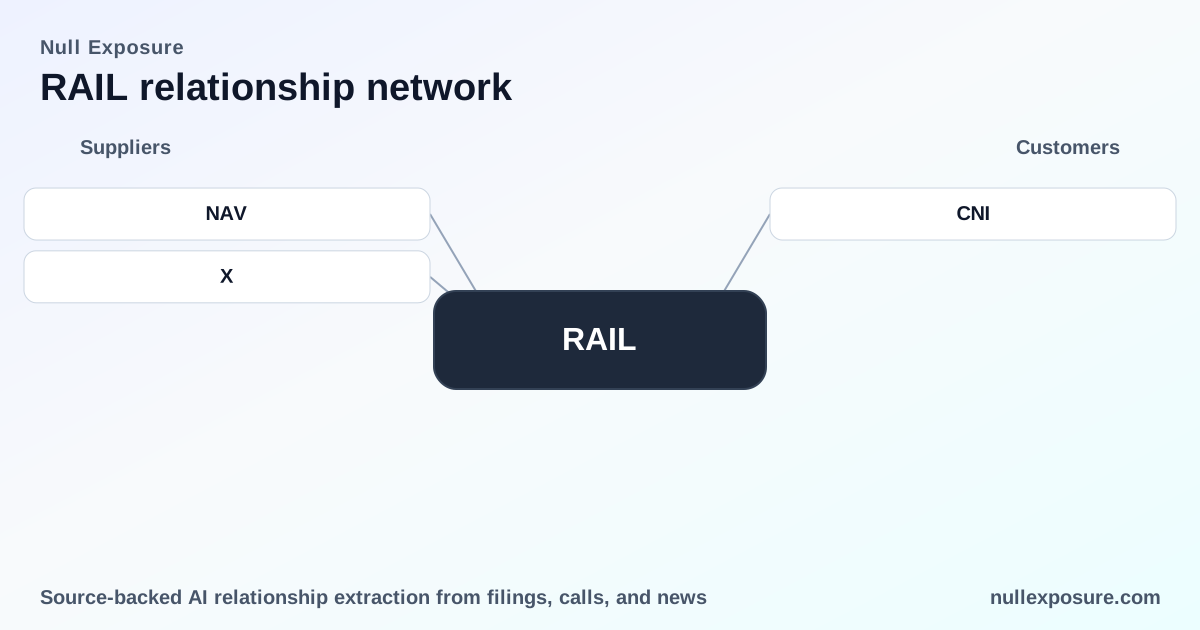
FreightCar America (RAIL): Customer Relationships and Strategic Implications for Investors
FreightCar America designs and manufactures freight railcars and components and monetizes through direct sales to railroads, shippers and financial lessors, plus aftermarket parts and services tied to those fleets. Revenue is driven by large, project-style orders from major rail operators and periodic replacement cycles, while margins are anchored in manufacturing scale and contract terms. For investors evaluating customer risk and revenue durability, the mix of long-term enterprise buyers and concentrated top-customer exposure is the principal structural story. For a quick look at relationship-level signals and sourcing, visit https://nullexposure.com/.
Quick operating and financial snapshot for context
FreightCar America operates a North American-focused manufacturing business that sells finished railcars and components. The company reported approximately $501 million in trailing twelve‑month revenue, with gross profit of roughly $73 million and EBITDA near $39.7 million. Market capitalization is modest at about $154 million, implying a low absolute market value relative to its manufacturing revenue base; valuation multiples show EV/EBITDA around 19x and P/E roughly 7.6x on trailing earnings. These figures frame why customer contracts and order cadence are central to forward earnings visibility: large, discrete orders materially move revenue and cash flow.
What public sources show about customer relationships
Below I cover every customer relationship returned in the public results and state the takeaways with source context.
CN (Canadian National Railway)
CN placed an order for iron-ore cars that FreightCar America is building at its Castanos, Mexico plant, highlighting a direct commercial buyer relationship for heavy-commodity rolling stock. Source: Progressive Railroading, March 10, 2026 — “CN purchases iron-ore cars; enhances US Steel partnership.” (https://www.progressiverailroading.com/RailPrime/details/CN-purchases-iron-ore-cars-enhances-US-Steel-partnership--71673)
CNI (inferred symbol for CN)
A duplicate public mention identifies the same CN transaction; the firm-level takeaway is identical: FreightCar America fulfills large, asset‑intensive orders for major North American railroads. Source: Progressive Railroading, March 10, 2026 — same article and notice as above.
How these relationship signals map to FreightCar's operating model
The company-level text and the public news items combine into a clear operating profile:
-
Contracting posture — long-term, project-based: FreightCar’s revenue profile is dominated by multi-car orders and long-standing commercial ties to large purchasers. The company states it maintains “strong long‑term relationships with many large purchasers of railcars,” a posture that supports multi-year production planning and capital allocation decisions. This is a company-level signal drawn from management disclosures in the 2024 filing.
-
Counterparty type — large enterprises dominate: FreightCar sells primarily to large railroads, shippers and financial institutions; contract counterparties are enterprise buyers rather than retail or spot customers. This elevates credit and performance risk to the enterprise level while reducing transaction churn.
-
Geographic concentration — North America: The business is concentrated in North America with manufacturing and build activity into Mexican facilities for U.S./Canadian buyers, as exemplified by the CN order built at Castanos, Mexico. This regional concentration shapes exposure to North American commodity cycles and trade/regulatory dynamics.
-
Materiality and concentration — meaningful top-customer share: Management disclosed that the top three customers contributed 13%, 9% and 9% of revenue in 2024 and the top five comprised about 48% of total revenue. Customer concentration is therefore a material strategic risk that amplifies revenue volatility when a single major order is delayed or lost.
-
Relationship role — buyer orientation: FreightCar’s primary role with counterparties is supplier of manufactured rail assets; its customer base is split among financial institutions (42% of sales), shippers (33%) and railroads (22%) in 2024, showing diversified buyer types but still concentrated dollars at the top.
-
Relationship stage — active, programmatic engagements: Public reporting and news citations indicate active order flow and continuing engagements with major railways; the CN order is a near-term example of active execution.
-
Segment and spend character — manufacturing core, mixed spend bands: The Manufacturing segment drives the majority of revenue through railcar sales, while certain small transactions (for example, specialty parts sold to a minority‑owned entity for amounts under $1,000) indicate small-dollar ancillary sales exist alongside large contract work.
Investment implications: growth, margins and risk profile
-
Growth levers: Winning repeat orders from large railroads and capturing replacement cycles for ore and bulk carriers are the primary ways top-line growth accelerates. The CN iron-ore order confirms FreightCar wins asset-intensive contracts for commodity fleets, which are higher-margin than aftermarket parts in many cases.
-
Margin and capital intensity considerations: Manufacturing railcars is capital and working-capital intensive; margins depend on utilization and order cadence. A lumpy order book produces earnings volatility, and the EV/EBITDA multiple in public markets reflects those execution and cyclicality risks.
-
Concentration risk is real and measurable: With nearly half of revenue tied to the top five customers, loss or deferral of a major order would materially impact results; investors must monitor order backlog, scheduling and counterparty credit. Management itself highlights material customer concentration in its 2024 filing.
-
Operational exposure to North American commodity cycles: The customer base is heavily linked to bulk commodities and containerized freight demand. A downturn in ore, coal or similar volumes depresses replacement and new-car demand.
-
Governance and related-party noise are immaterial on the revenue side: Small-value sales to a minority-owned entity tied to a board member were disclosed (under $1,000 in the years cited), which is a governance disclosure but not a substantive commercial dependency.
If you want a concise, relationship-level monitor or deeper counterparty risk briefing, see more at https://nullexposure.com/.
Bottom line for investors
FreightCar America is a niche manufacturer whose earnings trajectory is tightly coupled to a small set of large enterprise buyers and the timing of discrete railcar orders. The CN order reported in March 2026 underscores the company’s ability to secure sizable, regional contracts and to execute builds in Mexico for North American customers — a structural advantage for cost-competitive manufacturing. However, customer concentration and the lumpy nature of orders are the dominant risk factors. Investors should prioritize monitoring backlog disclosures, customer credit, and order timing to track near-term revenue and margin visibility.