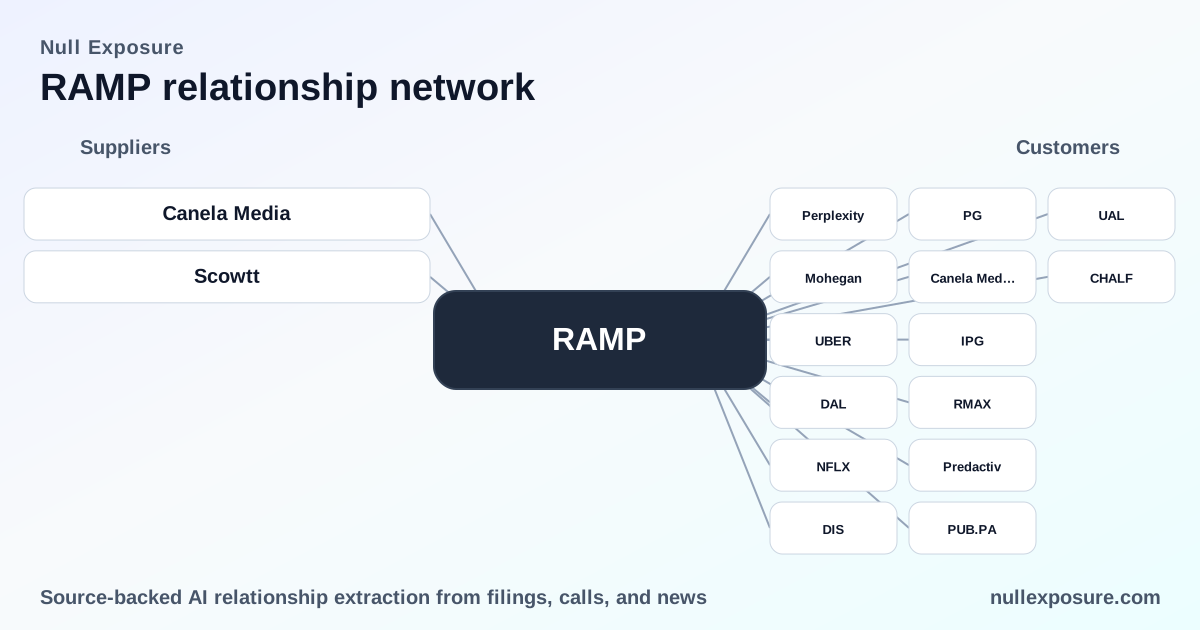
LiveRamp (RAMP): Customer Relationships That Drive Growth and Risk
LiveRamp runs an enterprise data connectivity platform that converts customer identifiers into privacy-safe, interoperable IDs and sells access to that infrastructure largely on annual subscriptions while capturing incremental usage-based revenue through marketplace transactions and publisher integrations. The company monetizes by selling identity resolution, audience activation and measurement tools to large advertisers, agencies and publishers—a model that leans on deep integrations with a small set of high-profile partners and broad distribution across hundreds of enterprise customers. For background research and partnership tracking, see https://nullexposure.com/ for ongoing coverage.
Quick read: what investors should take away
- Recurring revenue with usage upside. LiveRamp’s core economics are subscription-led with meaningful transactional and marketplace fees layered in.
- Enterprise-heavy customer base. Clients skew toward Fortune 1000 brands and global media platforms, increasing deal sizes but also concentration risk.
- Platform-critical relationships. Partnerships with ad platforms, publishers and identity-first vendors materially expand LiveRamp reach and measurable outcomes.
- Commercial maturity and global footprint. Relationships reported in FY2025–FY2026 show active deployments across advertising, TV, gaming and travel sectors.
For direct access to more relationship intelligence, visit https://nullexposure.com/.
How LiveRamp contracts and where the revenue comes from
LiveRamp’s public disclosures classify revenue into subscription and marketplace/transactional streams. Management states the business is primarily sold on annual subscription terms while marketplace activity and publisher integrations generate usage-based fees—a structure that creates a stable revenue base with scalable upside as partners and activations grow. The company operates as a service provider to enterprise marketers and publishers, serves a global customer set, and reports professional services as immaterial (<5% of revenue), indicating a mature product-led deployment model rather than bespoke services.
Customer relationships — what management and the press have reported
Mohegan
LiveRamp helped launch a casino media network with Mohegan over the past year, demonstrating the company’s push into venue- and property-level advertising environments that convert offline audiences into targetable segments. This was disclosed on LiveRamp’s Q4 FY2025 earnings call in March 2026.
Perplexity
LiveRamp added AI start-ups like Perplexity as connectivity partners, signaling continued expansion into AI-driven data consumers and tooling that use LiveRamp identity infrastructure. Management mentioned Perplexity on the Q4 FY2025 earnings call (March 2026).
Predactiv
Predactiv integrated LiveRamp’s identity resolution to route offline PII into privacy-safe identifiers for activation and modeling, positioning LiveRamp as the trusted on-ramp for secure PII onboarding. Multiple press items in March–May 2026 reported the Predactiv integration and described how LiveRamp handles identity resolution and hashing for downstream use (Sahm Capital; SimplyWall/St.; Bitget; March–May 2026).
Uber / Uber Advertising / Uber Intelligence
Uber Advertising launched “Uber Intelligence,” a data and insights platform powered by LiveRamp, and Uber was listed among enterprise attendees at LiveRamp events; these items underscore a multi-faceted commercial arrangement spanning measurement, audience reach and insights. The collaboration was disclosed in a GlobeNewswire press release covering FY2026 results (Feb 5, 2026) and reiterated in the Q4 FY2025 earnings call (March 2026).
Netflix (NFLX)
LiveRamp cited Netflix as an established connectivity partner among new additions, which highlights Reach into premium streaming inventory for identity-driven activation. Netflix was discussed on the Q4 FY2025 earnings call (March 2026).
Unity
LiveRamp expanded its collaboration with Unity to bring RampID into Unity’s mobile ad exchange, enabling identity-based buying across Unity’s vast mobile-gaming footprint and improving addressability for in-game inventory. Reporting on this expanded partnership appeared in April 2026 coverage (Sahm Capital; April 2026).
Procter & Gamble (PG)
Procter & Gamble was named as a representative global brand participant at LiveRamp events, indicating continued engagement from major CPG advertisers that drive sizable subscription and measurement contracts. Management listed P&G among attendees on the Q4 FY2025 earnings call (March 2026).
Delta (DAL)
Delta was also listed among participating global brands at LiveRamp’s industry event, reinforcing airline and travel vertical relationships that support audience networks and in-flight/airport media use cases. This was covered in the Q4 FY2025 earnings call (March 2026).
Disney (DIS)
Disney was cited as a brand participant at LiveRamp events, signaling agency and direct brand usage of LiveRamp solutions for cross-channel measurement and audience connectivity. Management noted Disney’s participation on the Q4 FY2025 earnings call (March 2026).
IPG
IPG was specifically called out as one of LiveRamp’s large customers undergoing renewal activity, underlining the company’s exposure to major holding companies and the revenue sensitivity tied to large contract renewals. The Q4 FY2025 earnings call referenced IPG in March 2026.
REMAX (RMAX)
LiveRamp’s platform helped launch a real estate media network with RE/MAX, showing vertical specialization (real estate) where property-level data and identity resolution create monetizable media products. This was stated on the Q4 FY2025 earnings call (March 2026).
United (UAL)
LiveRamp helped launch an airline media network with United, extending the company’s media-network play into airline inventory and traveler targeting use cases. LiveRamp disclosed this on the Q4 FY2025 earnings call (March 2026).
DIRECTV Advertising / DIRECTV
DIRECTV Advertising expanded its relationship with LiveRamp by integrating LiveRamp’s Conversions API (CAPI) Hub to improve real-time outcome measurement across TV and digital inventory—an example of LiveRamp monetizing through measurement and integration services. Multiple press items in April 2026 covered the DIRECTV integration (PR Newswire; SimplyWall; Finviz; April 2026).
Definitive Healthcare (DH)
Definitive Healthcare launched a partnership with LiveRamp for digital marketing, illustrating LiveRamp’s penetration into healthcare-adjacent data and audience solutions. Coverage appeared in TipRanks news referencing FY2025/2026 activity (TipRanks; 2026).
Canela Media
Canela Media joined LiveRamp’s network to enable better access to U.S. Hispanic OTT audiences, demonstrating how LiveRamp expands culturally targeted supply-side integrations. This partnership was reported in February–March 2026 (Sahm Capital; Feb 2026).
Publicis (PUB.PA)
LiveRamp’s expanded partnership with Publicis enables agencies to build client solutions on LiveRamp’s modular infrastructure while mitigating channel conflicts—signaling agency-level productization rather than exclusive vendor relationships. The point was discussed in analysis of LiveRamp’s Q4 2025 results (IndexBox; March 2026).
Chalice (CHALF)
Chalice, an AI start-up, was named among new connectivity partners, indicating LiveRamp’s openness to integrating identity consumers across mature platforms and emerging AI vendors. Mentioned on the Q4 FY2025 earnings call (March 2026).
Operating constraints and what they imply for investors
- Contracting posture: LiveRamp is subscription-first, sold on annual terms, with usage-based marketplace and transactional revenue providing upside. This structure creates predictable baseline revenue with variable margins tied to activation volumes.
- Customer concentration: The base skews to large enterprises and agencies (Fortune 1000), which increases average contract value but concentrates renewal risk (management cites 840 direct customers worldwide).
- Global scale and maturity: LiveRamp serves a global set of clients across US, EMEA and APAC; relationships reported in FY2025–FY2026 are active and represent platform-level deployments rather than one-off professional services.
- Service role and materiality: LiveRamp functions as a service provider (identity and activation platform) with professional services immaterial to revenue, pointing to productized delivery and potential for high gross margin as usage scales.
Conclusion: portfolio implications
LiveRamp’s client roster and recent partner integrations show broad enterprise adoption and strategic tie-ins across ad tech, publishers, gaming and TV—a favorable profile for subscription growth and transaction expansion. Investors should value LiveRamp at the intersection of recurring enterprise contracts and opportunistic usage revenue while monitoring renewal cycles with major holding companies and the execution of integrations that convert identity coverage into measurable ad outcomes.
If you want continuous monitoring of LiveRamp’s partner moves and relationship-level signals, visit our research hub at https://nullexposure.com/.