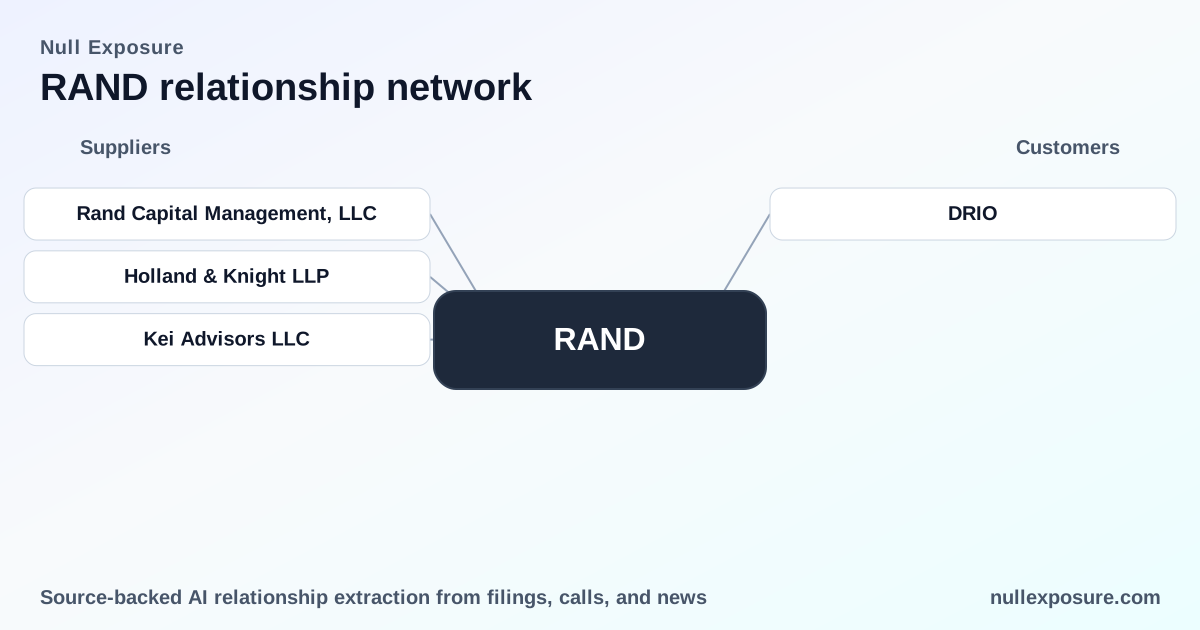
Rand Capital (RAND) — customer relationships that shape returns
Rand Capital is a publicly traded, actively managed growth-capital investor that monetizes through a mix of interest on structured debt, PIK features, and equity upside from lower middle‑market companies across healthcare, technology and services. The firm sources returns from loan interest and fees, realized gains and losses on exits, and continuing marked‑to‑market equity stakes; its operating posture is decidedly credit‑plus equity oriented and driven by selective follow‑on financings and restructurings. For a concise view of portfolio relationships and deal flow, see NullExposure’s company coverage at https://nullexposure.com/.
How these customer relationships translate into cash and risk
Rand’s disclosed activity over FY2025 and into early 2026 shows a clear operating pattern: small‑ticket debt instruments often paired with modest equity stakes, active position management including restructurings, and intermittent realizations (both gains and losses). That playbook produces steady yield when loans perform, concentrated downside when portfolio companies reorganize, and asymmetric upside when equity recoveries occur.
Key business‑model signals:
- BDC regulatory posture: Rand elected BDC status and must invest at least 70% of assets in qualifying companies while providing managerial assistance — an explicit company‑level constraint that explains the firm’s hands‑on, deal‑level involvement.
- Concentration and ownership: The firm’s market cap and insider ownership profile indicate a compact shareholder base and a concentrated portfolio; this magnifies the impact of single large repayments or write‑downs on NAV and quarterly earnings.
- Contracting posture: Deal structures observed (term loans with high cash interest plus PIK, and small equity co‑investments) indicate a yield‑first approach with optional equity upside rather than large controlling equity takeovers.
If you want a structured watchlist of these counterparties and how they affected FY2025 performance, NullExposure maintains a relationship tracker at https://nullexposure.com/ for subscribers.
Relationship scorecard — every disclosed counterparty, one sentence each
-
DRIO / DarioHealth Corp. — Rand participated in a debt financing facility to DarioHealth as part of a strategic refinancing of up to $50 million, positioning Rand as a co‑lender alongside Callodine Group. According to PR Newswire (March 10, 2026), the financing closed as a refinancing facility executed in 1Q 2026.
-
DarioHealth Corp. (duplicate listing) — The same PR Newswire release on March 10, 2026 reiterates Rand’s role in the $50 million debt facility for DarioHealth, confirming the company’s exposure to a publicly traded digital health debtor (NASDAQ: DRIO).
-
Food Service Supply — Rand funded a $400,000 follow‑on debt investment into Food Service Supply, reflecting continued minority credit exposure to commercial kitchen and renovation services. MarketBeat’s FY2025 earnings summary (Nov 7, 2025) reports the $400,000 follow‑on funding.
-
Food Service Supply (duplicate listing) — GuruFocus coverage of Rand’s Q3 FY2025 earnings call (published May 3, 2026) also references the $400,000 follow‑on, reinforcing that this position received active replenishment during the period.
-
Lumus — Rand exited its Lumus exposure and reported receiving $713,000 in loan and principal proceeds while recognizing a modest $77,000 realized loss on the position. MarketBeat’s Nov 7, 2025 earnings write‑up documents the exit and loss.
-
Lumius (alternate spelling entry) — In the same reporting cycle Rand acknowledged the exit from "Lumius," recording $713,000 returned and a $77,000 realized loss; MarketBeat’s Nov 7, 2025 note uses this alternate spelling in its disclosures.
-
Tilson Technology Management — Rand recognized a $2.9 million realized loss following Tilson’s Chapter 11 process and subsequent asset sale, a material write‑down for a firm with a compact balance sheet. MarketBeat’s November 7, 2025 earnings report details the loss as tied to the Chapter 11 outcome.
-
Tilson Technology Management (duplicate listing) — GuruFocus’ Q3 FY2025 earnings coverage (May 3, 2026) reiterates the significant realized loss related to Tilson’s restructuring and asset disposition.
-
Verda (formerly SQF Holdco) — Rand retains its investment in SQF Holdco, now branded as Verda, carrying the position at $2.0 million on the balance sheet and noting it is not part of the Tilson bankruptcy estate. MarketBeat’s Nov 7, 2025 disclosure highlights Verda’s separate operating status and $2.0 million book value.
-
Black Jet Direct Marketing — Rand committed $2.5 million to Black Jet Direct Marketing, composed of a $2.25 million term loan at 14% cash interest plus 1% PIK and a $250,000 equity investment, demonstrating Rand’s use of high‑yield structured credit with co‑invest equity. GuruFocus’ May 3, 2026 Q3 FY2025 coverage describes the full structure of the commitment.
-
BlackJet Direct Marketing (duplicate listing) — MarketBeat’s Nov 7, 2025 earnings recap echoes the $2.25 million term loan plus $250,000 equity detail, confirming the structuring and pricing of the commitment.
-
Seybert’s (the Rack Group) — Seybert’s (also described as the Rack Group) repaid $7.6 million of principal to Rand, with Rand retaining a small equity stake valued at $500,000; this large repayment materially reduced portfolio carrying value volatility. MarketBeat’s Nov 7, 2025 report documents the $7.6 million principal repayment and remaining equity carry.
-
Siebert’s (alternate spelling entry) — In Q3 FY2025 commentary (GuruFocus, May 3, 2026) management said repayments such as the $7.6 million from Siebert’s contributed to declines in portfolio fair value through the mechanics of realized returns and valuation changes.
-
the Rack Group (alternate naming entry) — Management remarks cited by GuruFocus (May 3, 2026) group Siebert’s / the Rack Group and underscore that large single‑counterparty cash flows materially shift portfolio composition and fair value.
-
ChiTech — Following the Rack Group repayment and valuation adjustments elsewhere, ChiTech rose to become one of Rand’s largest positions by carrying value, indicating concentration drift toward remaining performing assets. MarketBeat’s Nov 7, 2025 earnings summary identifies ChiTech among the largest positions post‑repayment.
-
INEA (Ephenia) — INEA (Ephenia) also moved into the ranks of Rand’s largest holdings after the Rack Group principal repayment and other valuation changes, highlighting portfolio re‑weighting dynamics. MarketBeat’s Nov 7, 2025 coverage flags INEA/Ephenia as a top position.
What investors should take away
- Deal‑by‑deal exposure matters: Several single‑name events (Tilson Chapter 11, Rack Group repayment, Lumus exit) produced outsized NAV and earnings impacts in FY2025; that volatility is the natural outcome of a compact, BDC‑style portfolio where every realization shifts concentration materially.
- Risk/reward tilt: Rand’s structuring (high‑coupon loans with PIK plus small equity stakes) prioritizes current yield, but restructurings and bankruptcies create occasional significant write‑downs—investors should trade between yield stability and episodic downside.
- Active sourcing and follow‑on behavior: The firm’s follow‑on investments (Food Service Supply, Black Jet) and participation in larger refinancings (DarioHealth) demonstrate a willingness to allocate incremental capital into existing relationships when management judges recovery or growth is achievable.
- Regulatory and operational constraint: Rand’s BDC status legally binds it to qualifying asset concentration and managerial assistance obligations, which explains the hands‑on portfolio management and smaller, concentrated financings.
For an ongoing tracker of these counterparties and position‑level changes, see NullExposure’s coverage at https://nullexposure.com/.
Rand’s FY2025 disclosures and early‑2026 deal announcements present a straightforward picture: small book size, active credit deployment, occasional material losses, and selective refinancing opportunities — a profile that rewards investors who understand concentrated BDC dynamics and tolerate episodic mark‑to‑market volatility.