RANI Customer Relationships: How strategic pharma tie-ups convert RaniPill into commercial optionality
Rani Therapeutics operates as a platform therapeutics company that licenses and provides services around its RaniPill™ oral delivery technology, capturing value through upfront license fees, milestone payments and fee-for-service evaluation work. Its commercialization model combines large, high-value partnerships for development and commercialization with smaller, project-level service contracts that generate near-term revenue and non-dilutive cash, creating a two‑track revenue profile attractive to investors tracking platform monetization and de‑risking cadence.
If you want the long view on how these relationships de-risk the platform and convert pipeline value into near-term cash flow, start at Rani’s press releases and follow-on market coverage. For a quick company primer and relationship map, visit https://nullexposure.com/.
The headline relationship: Chugai turns RaniPill into a potential blockbuster pathway
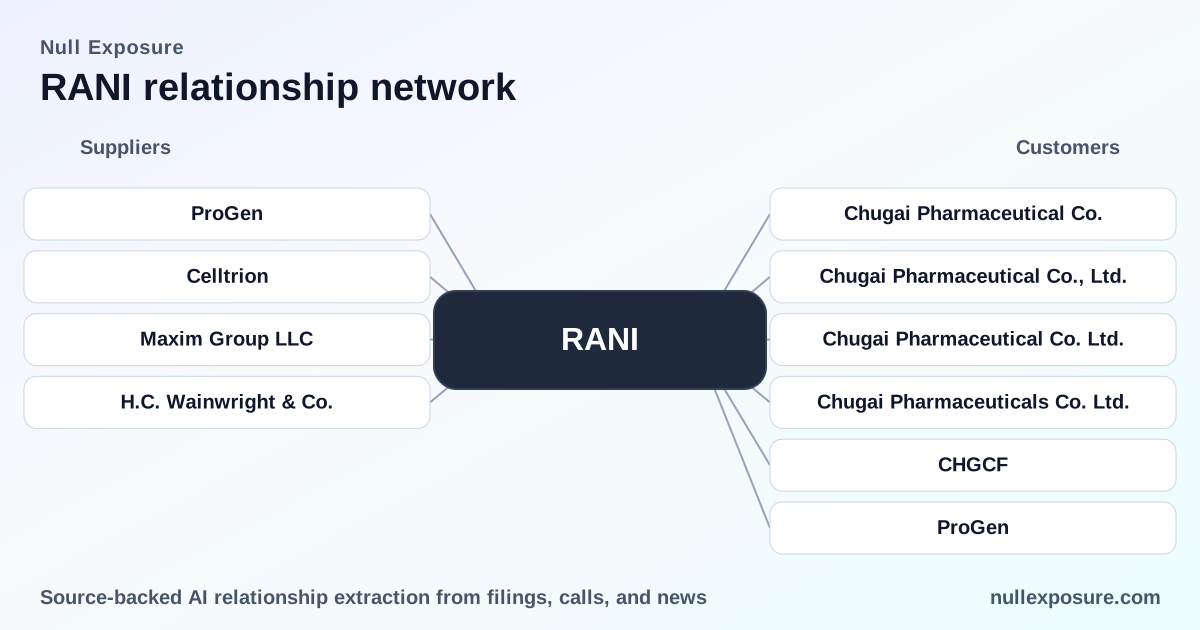
Rani’s relationship with Chugai Pharmaceutical is the defining commercial partnership for investors in the near term. According to Rani’s October 17, 2025 press release and subsequent company updates (reported by GlobeNewswire, MarketScreener and multiple market outlets), Rani signed a Collaboration and License Agreement with Chugai to combine the RaniPill platform with Chugai’s rare-disease antibody, with total deal economics cited at up to approximately $1.085–1.09 billion across multiple programs. The agreement includes an initial $10 million upfront payment, technology transfer and development milestone tranches (reported collectively at first-drug milestone amounts and additional program options) and the ability to expand the collaboration across additional targets. (Sources: GlobeNewswire Oct 17, 2025; MarketScreener/press coverage Oct–Nov 2025.)
- Key implications: This is a strategic, high-value commercialization partnership that validates Rani’s platform for injectable-to-oral conversion, brings meaningful near-term cash (the upfront) and creates large upside through milestones and potential program expansions. Multiple market reports tied the Chugai deal to Rani’s oversubscribed $60.3M private placement, with Rani citing the Chugai payments as a funding runway advantage into 2028. (Sources: GlobeNewswire Oct 23, 2025; Finance press coverage Oct–Nov 2025.)
A clinical-stage collaboration: ProGen and the obesity program
Rani has an active clinical collaboration with ProGen focused on an obesity indication. Company financial reporting and the March 26, 2026 corporate update (GlobeNewswire) state that Rani initiated a Phase 1 study of RT‑114 delivered by the RaniPill in collaboration with ProGen, signaling the platform’s progression into first‑in‑human testing for metabolic indications. (Source: GlobeNewswire Mar 26, 2026.)
- Key implication: ProGen is a development partner that demonstrates Rani’s platform applicability beyond rare disease antibodies into metabolic/obesity targets, broadening addressable market opportunities for licensing or co‑development.
Relationship summaries (concise investor view)
- Chugai Pharmaceutical Co. — Collaboration and License Agreement to develop oral versions of Chugai’s rare‑disease antibody using the RaniPill, with up to ~$1.085–1.09 billion in potential value and a $10M upfront payment; reported across Rani press releases and market coverage in Oct–Nov 2025. (Sources: GlobeNewswire Oct 17 & Nov 6, 2025; MarketScreener, Benzinga, Investing.com.)
- ProGen — Phase 1 collaboration for RT‑114 (obesity) using the RaniPill platform; clinical program initiated per Rani’s FY2025/FY2026 corporate update. (Source: GlobeNewswire Mar 26, 2026.)
These entries cover every counterparty relationship disclosed in the collected reporting set: Chugai (multiple press items and market writeups) and ProGen (corporate update).
What the disclosed contracting signals tell investors about Rani’s operating model
Rani’s public disclosures and filing excerpts establish a consistent operating posture: the company acts as a seller of both technology licenses and services, and it recognizes revenue from discrete evaluation projects as well as from partnership economics. Company filings describe an August 2024 evaluation contract where Rani provided evaluation services for customer compounds using RaniPill HC, which generated an $0.6 million upfront payment and an aggregate $1.2 million contract value — and the firm recognized contract revenue tied to those evaluation services in the fiscal year ended December 31, 2024. The same disclosures note typical contractual language such as indemnities for customers. (Company filing excerpts summarized from Rani’s financial disclosures.)
From those points derive four actionable operating characteristics:
- Contracting posture — seller of services and licensor of platform IP. Rani executes both fee‑for‑service evaluation agreements and larger licensing/collaboration deals with milestone economics.
- Revenue concentration and cadence — episodic but top‑weighted. Small evaluation contracts generate near‑term cash in the $0.6–$1.2M band (company‑level signal), while a small number of large partnerships (Chugai) carry outsized value and move the revenue needle.
- Criticality — platform‑level leverage. Partners buy access to the RaniPill to convert injectable biologics to oral formats; those development and commercialization options are strategically valuable to partners with advanced antibodies.
- Maturity — project‑based, early commercial validation. The mix of evaluation services recognized as single performance obligations plus first clinical trials shows Rani is in a commercially early but technically validated phase: moving from service revenue to partnership milestones and clinical proof points.
Risks that follow from the relationship mix
- Concentration risk: A small number of partnerships produce most of the tangible financial upside; Chugai is demonstrably material to short‑ and medium‑term cash expectations (upfront and milestone mechanics cited in multiple releases).
- Milestone delivery risk: Reported headline values are milestone‑weighted rather than guaranteed revenue; realization depends on successful tech transfer, clinical progress and regulatory/commercial execution (as described in company releases and market reporting).
- Project revenue volatility: Evaluation contracts sit in the $1M band with upfront payments and single performance obligations, which produces discrete revenue events rather than recurring streams (company disclosure, Aug 2024 example).
Valuation and investor takeaway
Rani’s investor case is now dual: near‑term de‑risking via evaluation services and upfront/cash from partners, and long‑term asymmetric upside from large, milestone‑based licensing arrangements such as Chugai. The Chugai contract converts platform validation into tangible commercial optionality; the ProGen collaboration signals breadth of application. For investors valuing RANI, the critical variables are the timing and probability of milestone realization and the company’s ability to replicate Chugai‑style deals at scale.
If you want a concise map of Rani’s counterparties, cash runway implications and where to watch next (milestone triggers and Phase 1 readouts), Null Exposure curates the relationship-level signals and filing interpretations on the RANI customer page — see https://nullexposure.com/customers/rani.
Where to watch next and recommended monitoring
- Track Chugai milestone architecture and any reported technology‑transfer payments or R&D start dates in subsequent Rani corporate updates and partner disclosures (press releases cited above).
- Monitor clinical progress for RT‑114 with ProGen for Phase 1 readouts that would expand platform validation into metabolic indications.
- Watch subsequent SEC filings for realized milestone revenue and changes in contract terms that affect cash flow timing.
Conclusion: Rani’s partnerships convert the RaniPill from a technological proof into commercial optionality, combining modest, predictable service income with high‑upside, milestone‑weighted licensing deals. That duality is the company’s core value proposition for investors focused on platform plays in biotech.
Explore the full relationship tracking and source compilation on the RANI customer page at Null Exposure: https://nullexposure.com/.