Rapport Therapeutics: What the Tenacia China Deal Teaches Investors About Commercial Strategy
Rapport Therapeutics (NASDAQ: RAPP) is a clinical-stage biotech that monetizes primarily through licensing and partnership transactions around its lead assets, while retaining global development control where strategic. The company advances clinical-stage candidates (notably RAP‑219) through trials and converts program value into near-term non-dilutive cash via regional out-licenses that include upfront payments, milestones and tiered royalties — a model that shifts execution risk to commercial partners while preserving upside. For a focused read on partner exposure and customer relationships, visit https://nullexposure.com/ for structured deal intelligence.
One partnership dominates the customer map — the details investors need
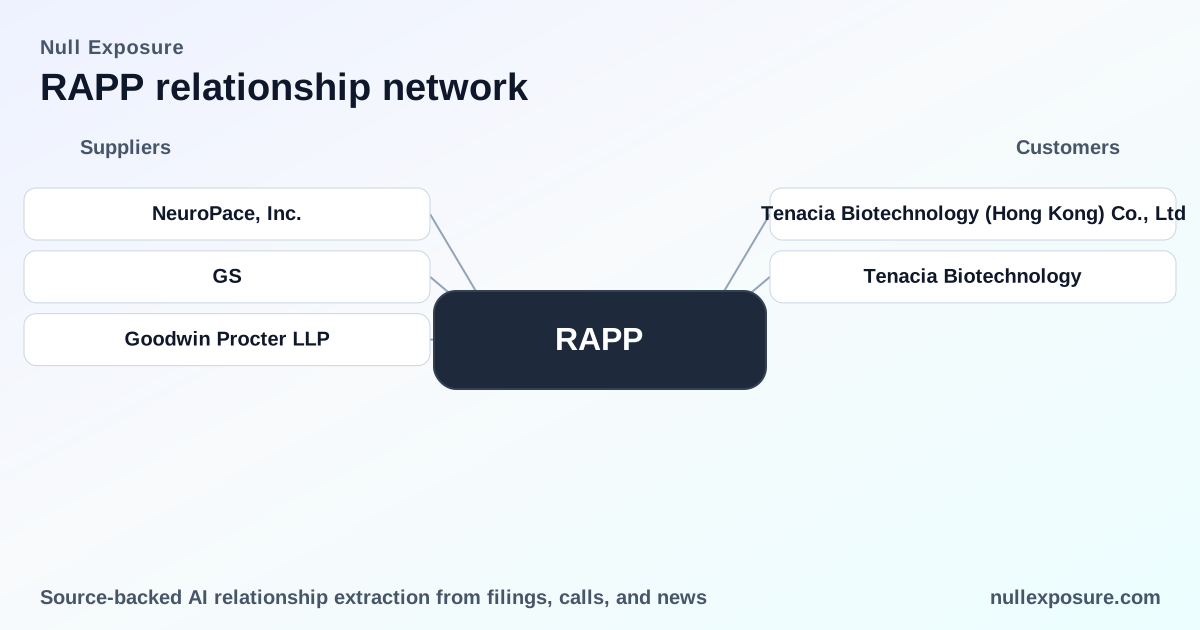
Rapport’s customer-relationship profile in public reporting is concentrated: Tenacia Biotechnology (Hong Kong) Co., Ltd. holds the sole listed commercial development relationship across the reviewed results. The arrangement grants Tenacia exclusive Greater China rights to develop and commercialize RAP‑219, with a US$20 million upfront payment, roughly US$308 million of potential development and commercialization milestones, and tiered royalties — a conventional biotech licensing structure that turns clinical progress into contingent revenue streams. According to Rapport’s March 2026 corporate disclosures and associated press releases, Tenacia will handle development and commercialization in mainland China, Hong Kong, Macau and Taiwan while Rapport retains rights elsewhere (GlobeNewswire, March 9–10, 2026; SimplyWall.st coverage, March 2026).
Tenacia Biotechnology (Hong Kong) Co., Ltd.
Tenacia received exclusive rights to develop and commercialize RAP‑219 in Greater China, and Rapport recorded a US$20 million upfront plus potential milestone and royalty economics as part of the transaction. This was announced in Rapport’s investor communications and multiple press outlets in March 2026 (GlobeNewswire press release, March 9–10, 2026; SimplyWall.st, March 2026).
Why the Tenacia deal matters for near‑term cash and long‑term economics
The Tenacia license delivers immediate non-dilutive cash and a clear contingent upside path: the upfront provides runway management flexibility, while milestones and royalties replace the certainty of direct product sales with probability-weighted future income. This structure is consistent with a capital-efficient commercialization strategy for companies that are asset-focused and early in commercial operations; it preserves Rapport’s global upside while leveraging a regional partner’s commercial capabilities and market access in Greater China (GlobeNewswire March 2026 investor update).
At the same time, the economics are lumpy and milestone-dependent, so reported revenue contributions will be episodic and tied to trial readouts, regulatory approvals and Tenacia’s execution. SimplyWall.st flagged investor reaction to the China deal in March 2026, reflecting how the market prices licensing-driven funding as both de-risking and a deferral of direct revenue capture (SimplyWall.st, March 2026).
Reading the relationship: operational impact and counterparty concentration
- Operational posture: Rapport uses licensing to de-risk regional commercialization without ceding global control of programs, indicating a selective, rights-retentive contracting posture that prioritizes strategic optionality.
- Concentration: Publicly disclosed customer exposure is concentrated; Tenacia is the only partner in the reviewed set, which implies single-partner concentration for Greater China commercialization and concentrated dependency on a single commercial counterparty for that geography.
- Criticality: For RAP‑219’s path to being a global product, regional partnerships are critical for market access and local regulatory navigation; therefore partner execution in Greater China is a material operational vector for realizing the asset’s full value.
- Maturity: The relationship reflects a company still in the clinical-to-commercial transition: licensing of a clinical-stage asset signals a mix of near-term financing and deferred commercial upside rather than immediate product revenue.
These are company-level signals derived from the pattern of disclosed deals and the licensing terms; they reflect how Rapport organizes commercialization risk and capital allocation across geographies, not constraints tied to a single document.
What investors should weigh now
- Balance sheet relief vs. upside dilution: The US$20 million upfront strengthens cash runway without dilution; the trade-off is future revenue is conditional on milestones and partner performance. GlobeNewswire investor materials in March 2026 make this funding pathway explicit.
- Execution risk moves to partner: Tenacia’s regional development and commercialization execution becomes the primary determinant of China revenue; investors should track Tenacia’s execution milestones and regulatory progress alongside Rapport’s clinical program updates (GlobeNewswire, March 2026).
- Value retention strategy: Rapport’s retention of rights outside Greater China preserves global upside, keeping the company’s valuation tied to both clinical success and future licensing/commercialization transactions.
- Market reaction is immediate: News coverage in March 2026 documented a pronounced market response to the licensing announcement, illustrating how investors price licensing events that reshape near-term cash while deferring direct commercial returns (SimplyWall.st, March 2026).
For deal-level monitoring, investors will want timely updates on milestone achievement schedules, regulatory filings in Greater China, and any extension of the partner roster beyond Tenacia.
Final takeaways for investors
- Tenacia is the single, material customer/partner disclosed in the reviewed period; the deal provides non-dilutive capital and contingent upside through milestones and royalties.
- Rapport’s business model is licensing-first at this stage: selective out-licensing for regional markets, retention of global rights, and reliance on partner execution to convert clinical progress into revenue.
- Concentration and counterparty execution are the primary near-term risks investors must monitor.
If you evaluate partnerships and counterparty risk across biotech portfolios, our platform consolidates disclosures and press coverage into deal-focused insights — see https://nullexposure.com/ for more.