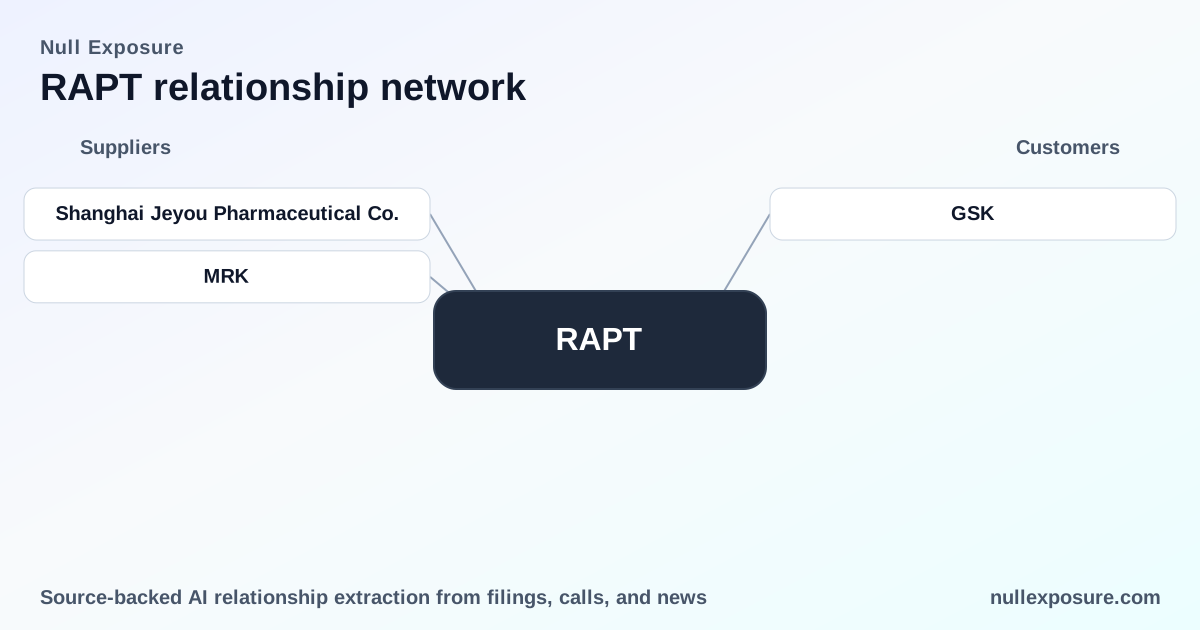
RAPT Therapeutics: Acquisition by GSK Consolidates Value and Ends RAPT’s Standalone Customer Narrative
RAPT Therapeutics operated as a development-stage biopharma focused on an anti‑IgE monoclonal antibody for food allergy and related immunological indications, monetizing through value creation in clinical development and exit via licensing or M&A. The company’s commercial thesis crystallized into a definitive cash sale: GSK agreed to acquire RAPT for $58.00 per share, valuing the deal at roughly $2.2 billion, converting RAPT’s pipeline upside into immediate equity value for holders and a strategic asset for GSK’s immunology franchise. For investors tracking counterparties and deal risk, this transaction converts RAPT’s customer and commercialization uncertainty into a single-owner integration story; more detail and relationship signals are available at https://nullexposure.com/.
Transaction snapshot and market reaction
GSK’s acquisition is a clear liquidity event: $58 per share in cash representing a roughly 65% premium to the pre-announcement price and an enterprise valuation in the neighborhood of $2.2 billion. Financial and trade press reported the terms consistently and noted an expected close in early 2026, underscoring that the transaction is structured as a strategic buyout rather than a partnership or license. According to MedCity News, GSK will pay $58 in cash per share, representing a 65.2% premium to the stock’s recent close; other outlets reported the deal’s estimated equity value and timing. This is an outright acquisition that collapses RAPT’s counterparty exposure into a single, parent-level relationship with GSK.
Key takeaway: The acquisition eliminates multi-party commercial risk for RAPT shareholders by delivering cash consideration, but it also ends RAPT’s independent commercial upside—value now depends on GSK’s integration and development execution.
Operating-model and business-model characteristics investors should parse
With constraints data absent, the acquisition itself functions as the dominant company-level signal: RAPT’s operating posture transitions from a standalone, development-stage biotech to a target integrated into a global pharma platform. From that vantage:
- Contracting posture: The definitive agreement model transfers governance and contracting control to GSK as buyer; future commercialization contracts will be executed under GSK’s corporate umbrella.
- Concentration: Prior to closing, RAPT exhibited single-asset concentration risk—value driven by one clinical program—now subsumed into GSK’s diversified portfolio.
- Criticality: RAPT’s lead asset is strategically critical to GSK’s immunology pipeline, explaining the premium and immediacy of acquisition activity.
- Maturity: The company’s lifecycle stage—pre-commercial, with clinical-stage value—made it an acquisition target rather than a mature, multi-product customer of large pharma.
Implication for operators and counterparties: Partners and suppliers should expect contract novations and integration into GSK procurement and development processes; investors should shift focus from boutique execution risk to GSK’s ability to integrate and develop the asset.
All recorded customer-relationship mentions (each source in the record)
Below are short, plain-English summaries of every relationship mention in the collected results. Each entry references the original reporting and date context.
-
Chemical & Engineering News (Jan 27, 2026) reported that GSK is slated to buy Rapt Therapeutics in a deal worth $2.2 billion, framing the transaction as a strategic acquisition in immunology and inflammation. Source: https://cen.acs.org/business/Jan-27-Business-Watch-Vioneo/104/web/2026/01
-
FinViz (Mar 10, 2026) covered commentary noting that RAPT’s sale to GSK is priced at $58.00 per share, summarizing the cash consideration announced to the market. Source: https://finviz.com/news/290912/halper-sadeh-llc-encourages-pen-rapt-lsta-shareholders-to-contact-the-firm-to-discuss-their-rights
-
FinViz (Mar 10, 2026) repeated the deal language using the buyer name GSK plc, again identifying $58 per share as the transaction price that underpins the acquisition. Source: https://finviz.com/news/290912/halper-sadeh-llc-encourages-pen-rapt-lsta-shareholders-to-contact-the-firm-to-discuss-their-rights
-
FinViz (Mar 10, 2026) ran further coverage questioning fairness and shareholder process, while reiterating that RAPT is being sold to GSK for $58.00 per share, the same cash offer central to deal reporting. Source: https://finviz.com/news/308375/are-rapt-algt-lsta-avo-obtaining-fair-deals-for-their-shareholders
-
FinViz (Mar 10, 2026) again listed the buyer as GSK plc and the per-share cash price, reflecting syndicated market reporting on the acquisition terms. Source: https://finviz.com/news/308375/are-rapt-algt-lsta-avo-obtaining-fair-deals-for-their-shareholders
-
Intellectia (Mar 10, 2026) reported that GSK entered a definitive agreement to acquire RAPT for an estimated equity value of $2.2 billion with the transaction expected to close in Q1 2026, positioning the deal as a near-term strategic close. Source: https://intellectia.ai/news/stock/gsk-acquires-rapt-therapeutics-for-22-billion
-
MedCity News (Jan 2026 reporting) summarized financial terms, noting GSK will pay $58 in cash per share for RAPT, a 65.2% premium to the stock’s recent close, highlighting the premium paid to secure the asset. Source: https://medcitynews.com/2026/01/gsk-aquisition-rapt-therapeutics-food-allergy-ige-immunology-inflammation/
-
SimplyWall.st (Mar 10, 2026) reported that GSK has signed a definitive agreement to acquire RAPT Therapeutics, emphasizing the change in corporate control and the end of RAPT’s independent public life. Source: https://simplywall.st/stocks/us/pharmaceuticals-biotech/nasdaq-rapt/rapt-therapeutics/news/gsk-buyout-turns-volatile-rapt-into-food-allergy-cash-out-st/amp
-
European Pharmaceutical Review (Mar 10, 2026) reported that GSK is acquiring RAPT, obtaining global rights to a potential best‑in‑class anti‑IgE monoclonal antibody, underlining the scientific rationale for the purchase. Source: https://www.europeanpharmaceuticalreview.com/news/270554/gsk-acquires-food-allergy-firm-rapt-therapeutics/
-
FinViz (Mar 10, 2026) reiterated the transaction’s $58 per share cash terms in a third run of syndicated coverage, underscoring market attention on the deal price and shareholder implications. Source: https://finviz.com/news/290912/halper-sadeh-llc-encourages-pen-rapt-lsta-shareholders-to-contact-the-firm-to-discuss-their-rights
Investment implications, integration risks, and what to watch next
- Liquidity delivered; strategic value transferred. RAPT shareholders receive cash; GSK acquires the asset and assumes development and commercialization risk.
- Integration execution is now the primary value driver. The upside for the asset depends on GSK’s development sequencing, regulatory strategy, and commercialization planning rather than on RAPT’s independent execution.
- Regulatory and clinical readouts still matter under new ownership. Clinical safety and efficacy remain gating factors for ultimate commercial value even after acquisition.
- Supplier and partner contracts will normalize under GSK. Vendors and co-development partners should expect novation to GSK terms and purchasing processes.
For a focused read on counterparties, contract posture, and post-deal integration signals, review our relationship monitoring at https://nullexposure.com/.
Bottom line for investors and operators
The GSK acquisition converts RAPT’s speculative pipeline value into realized cash for shareholders and a strategic development asset for GSK. This is a classic biotech exit: concentrated asset value purchased at a significant premium, transferring development and commercialization risk to a large, integrated pharma organization. Monitor GSK’s integration milestones, regulatory filings, and any announced development timelines to assess whether the purchase price translates into sustained commercial success.