RBB Bancorp: concentrated community bank with real-estate-heavy lending and deposit concentration
RBB Bancorp (Royal Business Bank) operates as a regional commercial bank focused on Asian-American retail and commercial clients, monetizing through net interest income on a loan portfolio dominated by real-estate collateral, fee income from deposit and wealth-management services, and a steady program of SBA-originations and trade finance. With a market capitalization around $408 million, a trailing P/E of 10.25, a dividend yield near 2.6%, and a Price/Book below 1.0, the bank presents a value-oriented profile underpinned by concentrated customer relationships and regulatory sensitivity to commercial real estate (CRE) risk.
Explore a data-driven view of RBB’s customer relationships and operational constraints at https://nullexposure.com/.
How RBB gets paid and where economic exposure sits
RBB’s economics flow from three clear channels: (1) interest income on commercial and consumer loans (SBA, CRE, construction, mortgage), (2) deposit-related fees and interchange, and (3) wealth-management and brokerage revenue. The bank’s product set includes SBA 7A/504 loans, investor and commercial real-estate loans, business lines of credit, trade finance, and retail deposit services including treasury management. Company-level disclosures show the bank’s revenue mix is both interest-driven and fee-supported; its trade finance and wealth units generate noninterest income while loan yields carry the bulk of margin.
Key operating levers: loan portfolio composition (real estate concentration), deposit stickiness and concentration, SBA origination throughput, and local branch footprint across select U.S. metro areas. These drive both upside in stable rate environments and downside in localized economic stress.
Contracting posture and revenue maturity: long and short tenors coexist
RBB operates with a mixed contracting posture that combines long-lived credit exposure with short-duration lending and deposit relationships. The bank originates SBA loans that can have maturities up to 25 years, creating durable asset duration in that segment. At the same time, the institution runs a material book of short-term real-estate construction loans (generally prime-rate based with maturities under 18 months) and deposit contracts that are terminable at will, including money-service-business relationships where fees can be ended by either party. These dynamics produce both stable long-term cash flows (SBA amortization) and pronounced liquidity exposure from short-term lending and core deposit volatility.
Concentration is a defining risk — and a capital consideration
RBB’s customer base is highly concentrated geographically and by product:
- Company filings (Dec 31, 2024) report that California and New York account for roughly 88% of the loan portfolio, and operations explicitly target Asian-centric communities in specific metro areas.
- At year-end 2024, 165 deposit clients each holding aggregated balances above $2.0 million represented $1.1 billion or ~34% of total deposits, a level that creates tangible liquidity sensitivity to outflows.
- CRE loans comprised about 94% of loans by collateral presence, and CRE exposure represented 207% of bank risk-based capital at Dec 31, 2024 — a regulatory pressure point compared with 183% the prior year.
The net effect for investors: high concentration multiplies both return and risk. Branch-level franchise strength in selective ethnic markets underpins deposit gathering, but the same concentration exposes capital ratios and liquidity to localized shocks and regulatory scrutiny.
One public customer relationship in the record — Younan Properties
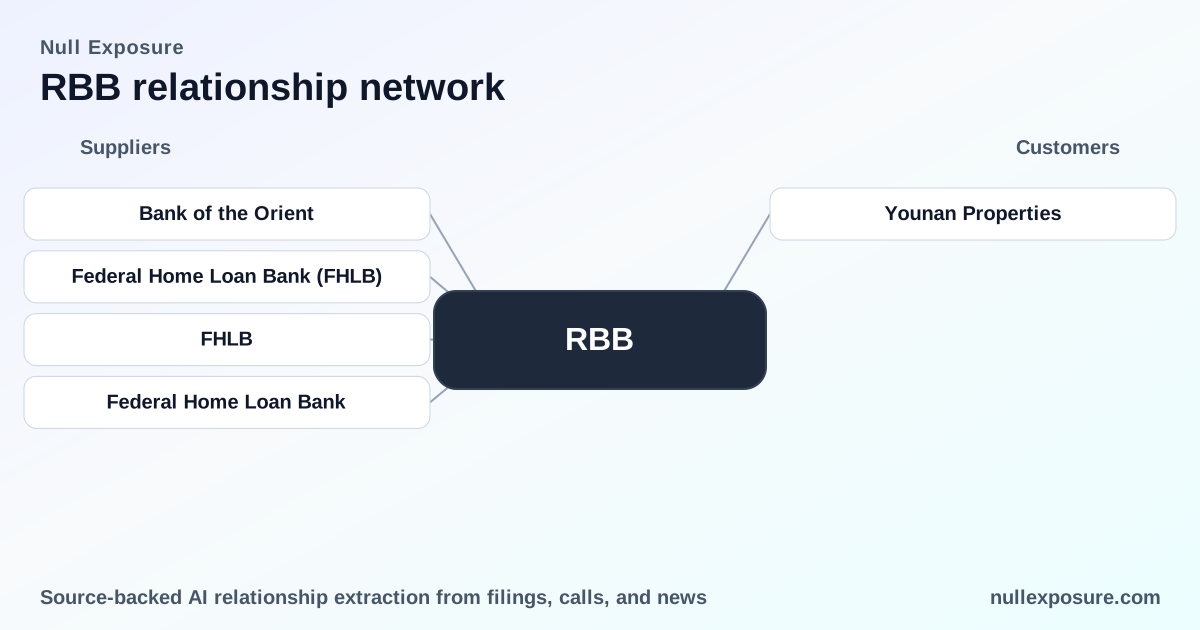
Royal Business Bank is publicly entangled in a high-profile litigation claim by Younan Properties. A GlobeNewswire press release dated March 5, 2025, reported that Younan launched a fraud lawsuit against Royal Business Bank and several executives, alleging wrongdoing tied to loan originations; the filing notes that then-CEO Alan Thian was placed on leave during an internal investigation and subsequently resigned, with the complaint stating he was involved in originating loans. This legal dispute is the only customer-related relationship surfaced in the public-results set for RBB. (Source: GlobeNewswire press release, March 5, 2025.)
What the constraints tell investors about operational characteristics
Company-level constraint signals from regulatory and SEC disclosures translate into practical operational realities:
- Contract types: A combination of long-term amortizing SBA loans (up to 25 years) and short-term construction loans and at-will deposit contracts creates mismatched maturities and episodic liquidity demand.
- Counterparty mix: The client base skews toward individuals, small businesses and mid-market commercial borrowers, concentrating credit risk in small- and medium-sized enterprises and owner-occupied investor real estate.
- Geography: Operations and credit concentration are domestic and heavily focused on California and New York metropolitan areas, reinforcing the bank’s sensitivity to local economic cycles.
- Materiality and criticality: A small set of large depositors account for over a third of deposits; CRE loan concentration is multiple times regulatory capital — both material and operationally critical to capital planning and branch expansion approvals.
- Relationship role: RBB functions both as a seller of financial products (loans, wealth products) and as a service provider (trade finance, treasury services), creating mixed margin profiles and diversified fee lines.
These constraints are company-level signals that inform governance, capital stress testing, and underwriting discipline expectations for management and investors.
Investment implications: risk-reward framed by concentration and valuation
RBB trades at a modest multiple—trailing P/E ~10.25, forward P/E ~9.25, and Price/Book under 0.8—reflecting the market’s discount for concentration, CRE exposure, and regulatory uncertainty. For value-oriented investors, the bank’s relatively high dividend yield and discount to book are attractive if one is comfortable with localized CRE and deposit concentration risk and with management’s ability to resolve governance/legal issues quickly. Conversely, the reliance on a small number of large depositors and high CRE ratios translates into a clear downside under stress scenarios, and regulators (FDIC/DFPI) have grounds to restrict branch growth or require capital remediation if concentrations worsen.
If you want a concise, relationship-level dossier and monitoring feed tailored to banks like RBB, see how that coverage looks at https://nullexposure.com/.
Bottom line
RBB Bancorp is a community-focused regional bank that delivers steady loan-driven earnings and fee income but carries amplified concentration risk — geographic, deposit, and CRE loan concentration — that defines its risk-reward profile. The Younan Properties litigation is a discrete but notable customer-facing legal event that investors should track alongside capital and deposit trends disclosed in periodic filings. Investors centered on yield and value will find RBB’s metrics compelling only if they accept elevated idiosyncratic exposure and active regulatory scrutiny as part of the trade.