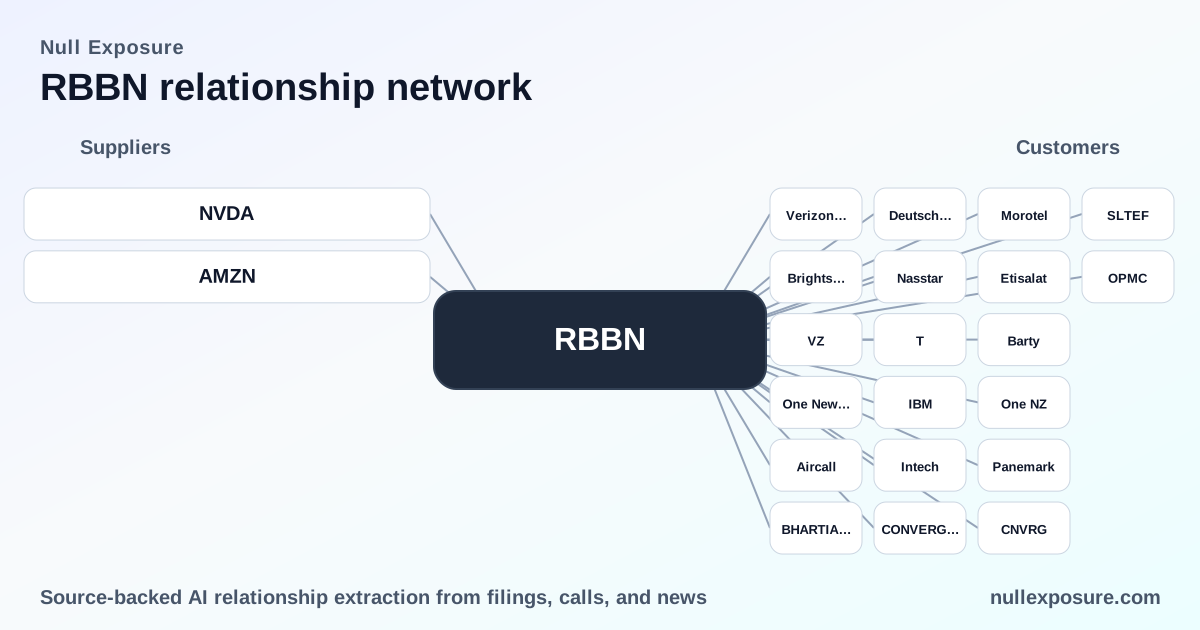
Ribbon Communications (RBBN): Customer Relationships and Commercial Footprint — Investment Brief
Ribbon Communications sells software, hardware and services that modernize voice and optical networks for service providers and large enterprises, monetizing through product sales, perpetual and term software licenses, subscriptions (SaaS) and professional services/support contracts. Its go-to-market blends direct service-provider deals and channel sales; a small set of large telco customers drives material revenue, while global enterprise and critical-infrastructure wins supply diversification.
For a deeper look at customer concentration and signals for diligence, visit https://nullexposure.com/.
Big-picture takeaways for investors
- Concentration is real: Ribbon publicly discloses single-customer revenue concentration in its 2024 Form 10‑K.
- Hybrid monetization: Revenue mixes hardware, perpetual and term licenses, subscription SaaS, and services/support, creating recurring deferred revenue plus large project spikes.
- Global footprint: Customers span NA, EMEA and APAC; Ribbon competes for both operator modernization programs and enterprise voice/cloud voice rollouts.
- Commercial risk and optionality: Large telco programs are material and timing-sensitive, while cloud-native offers open opportunities with hyperscalers and UCaaS providers.
How Ribbon commercializes — practical constraints that shape outcomes
Ribbon’s public disclosures provide operating signals that investors must treat as business-model constraints rather than abstract metrics:
- Contracting posture: Ribbon sells perpetual and term licenses, subscription SaaS, hardware and professional services, so revenue recognition is a mix of point-in-time hardware/license bookings and over‑time SaaS/support/service revenue. (Company disclosures, FY2024.)
- Revenue concentration and materiality: Top five customers represented ~34% of revenue in 2024, with individual customers exceeding 10% in multiple years — a structural concentration that makes timing of large contracts critical to near-term results. (Ribbon 2024 10‑K.)
- Customer mix and counterparty types: Ribbon serves service providers and large enterprises, while also addressing government, utilities and transportation verticals; this breadth reduces single-segment cyclicality but still concentrates on a few large telco accounts. (Company filing.)
- Global sales footprint: Ribbon reports meaningful revenue in North America, EMEA and APAC, supporting both local optical network builds and cloud-voice modernization projects. (FY2024 revenue disclosure.)
- Product/segment mix: The company sells hardware (optical and routing), software (licenses and cloud services) and services (professional services, customer support) — each with distinct margins and revenue timing. (Company disclosures.)
If you want a compact commercial map of Ribbon’s customers and news coverage, see https://nullexposure.com/.
Detailed customer and partner relationships (each sourced)
Below I list every named relationship surfaced in the reporting and press coverage, with a concise plain-English summary and the source referenced.
- Verizon Communications Inc. — Verizon accounted for approximately 14% of Ribbon’s revenue in FY2024 and is the marquee anchor for Ribbon’s voice modernization program. (Ribbon 2024 Form 10‑K; FY2024.)
- VZ (Verizon symbol in news transcripts) — Company transcripts reiterate that Verizon is ramping the first phase of a multi-year modernization program, driving material activity in 2025 and beyond. (Earnings call transcript coverage, Q4‑2025 / Q1‑2026.)
- Verizon (earnings-call coverage) — Management states voice modernization with Verizon is a strategic priority and expects acceleration in the second half of the year, reinforcing the account’s revenue importance. (Q1‑2026 earnings call transcript.)
- Brightspeed — A PR Newswire release (Mar 2026) notes Brightspeed is deploying multiple Ribbon products (C20 Call Controller, SBC, PSX, RAMP) to modernize central office equipment. (PR Newswire, Mar 10, 2026.)
- Nasstar — Multiple press items show Nasstar selected Ribbon to power a UK voice network transformation for the cloud era, positioning Ribbon as a supplier to managed‑service providers. (PR Newswire and MarketScreener, FY2025–FY2026.)
- Intech — Ribbon announced that Intech deployed Ribbon’s NPT 2100 IP Router to support India connectivity projects, reflecting product traction in APAC enterprise and service-provider markets. (Company press coverage, FY2026.)
- Planters Broadband — Planters Broadband selected Ribbon’s Apollo optical platform and Apollo‑ready optical route for a network upgrade, illustrating wins with regional broadband operators. (Press reports, May 2026.)
- Aircall — Aircall publicly credited Ribbon (and AWS) for enabling global communications connectivity via Ribbon’s SBC SWE on AWS, highlighting cloud‑native voice and SaaS interoperability. (PR Newswire and FinViz press coverage, FY2025–FY2026.)
- Salt / Salt Business (SLTEF references) — Ribbon announced edge solutions powering Salt Business’s corporate voice offering in Switzerland, confirming wins in European enterprise voice deployments. (EQS News / ad‑hoc news, FY2026.)
- Bharti Airtel / BHARTIARTL — Historical and press reports show Bharti Airtel selected Ribbon’s Apollo platform for long‑haul DWDM network expansion in India, a substantial operator reference in APAC. (ANI News, FY2023 coverage cited.)
- Bardi / Barty / Barty Airtel (transcript variants) — Management commentary references Bharti (rendered in various transcripts as “Bardi” or “Barty”) as a 10%+ customer and a driver of strong India growth, confirming operator-level sales impact. (Earnings call transcripts, Q4‑2025 / Q1‑2026.)
- Deutsche Bahn — Ribbon reported significant projects with Deutsche Bahn, indicating traction in critical infrastructure and transportation segments in Europe. (Earnings call transcript, Q4‑2025.)
- Panemark — Ribbon cited wins with Panemark (a Danish railway) as part of its critical‑infrastructure rail portfolio, supporting the company’s railway/transport strategy. (Earnings call transcript, Q4‑2025.)
- CONVERGE / CONVERGE CICT / CNVRG — Reports describe Converge’s deployment of Ribbon’s Apollo optical system to optimize backbone transmission in the Philippines, showing regional ISP wins. (Fibre‑Systems coverage, FY2024.)
- Morotel — Ribbon management lists Morotel among optical transport expansion projects in Southeast Asia, consistent with regional carrier activity. (Earnings call transcript, Q4‑2025.)
- One New Zealand (One NZ) — One NZ is leveraging cloud‑native instances of Ribbon SBC, PSX, RAMP and Analytics to modernize voice services, underlining cloud deployments for national carriers. (Press coverage, FY2025.)
- Etisalat — Historical press about Ribbon’s Kandy business notes Etisalat as a named customer of Ribbon’s Kandy platform, reflecting enterprise/communications platform references pre‑divestiture. (PR Newswire, FY2020.)
- AT&T / T — Kandy (a previous Ribbon division) historically listed AT&T among its customers, cited in sale announcement materials for the Kandy business. (PR Newswire, FY2020.)
- IBM — Same PR Newswire materials list IBM among Kandy’s enterprise customers, a reference point for enterprise adoption of Ribbon’s cloud UC capabilities. (PR Newswire, FY2020.)
- City of Los Angeles — Kandy materials also named City of Los Angeles as a recognized customer, illustrating public‑sector references in legacy communications business disclosures. (PR Newswire, FY2020.)
- Optimum (OPMC) — Earnings commentary identifies Optimum as a lead customer for Ribbon’s AI Ops and automation platform “acumen,” with proofs‑of‑concept and expected go‑live timing affecting near‑term revenue cadence. (Earnings call transcript, Q1‑2026.)
- Horizon (HRRB) — Management says Horizon remained a 10%+ customer in the first quarter, signifying another material telco relationship. (Earnings call transcript, Q1‑2026.)
What this customer map implies for investors
- Revenue is lumpy and top‑heavy. Large modernization programs (particularly Verizon, Bharti, Horizon and similar telcos) determine quarter‑to‑quarter performance. Watch contract milestones and recognition timing.
- Recurring revenue is building but not dominant. Ribbon combines support/subscription and professional services; deferred revenue balances indicate active subscription/support contracts alongside project work.
- Geographic diversification is real but selective. Wins in EMEA and APAC (Deutsche Bahn, Bharti Airtel, Converge, One NZ) lower single‑market risk but link performance to global operator capex cycles.
- Execution risk offset by strategic partnerships. Cloud and hyperscaler references (AWS + Aircall) and managed‑service partnerships (Nasstar) expand routes to market and reduce single‑deal dependency.
Final read and next steps
Key investor action: monitor Verizon implementation milestones, deferred‑revenue trends in quarterly filings, and announcements from large APAC/EMEA operator wins for revenue timing signals. For more structured customer intelligence and weekly update tracking, visit https://nullexposure.com/.