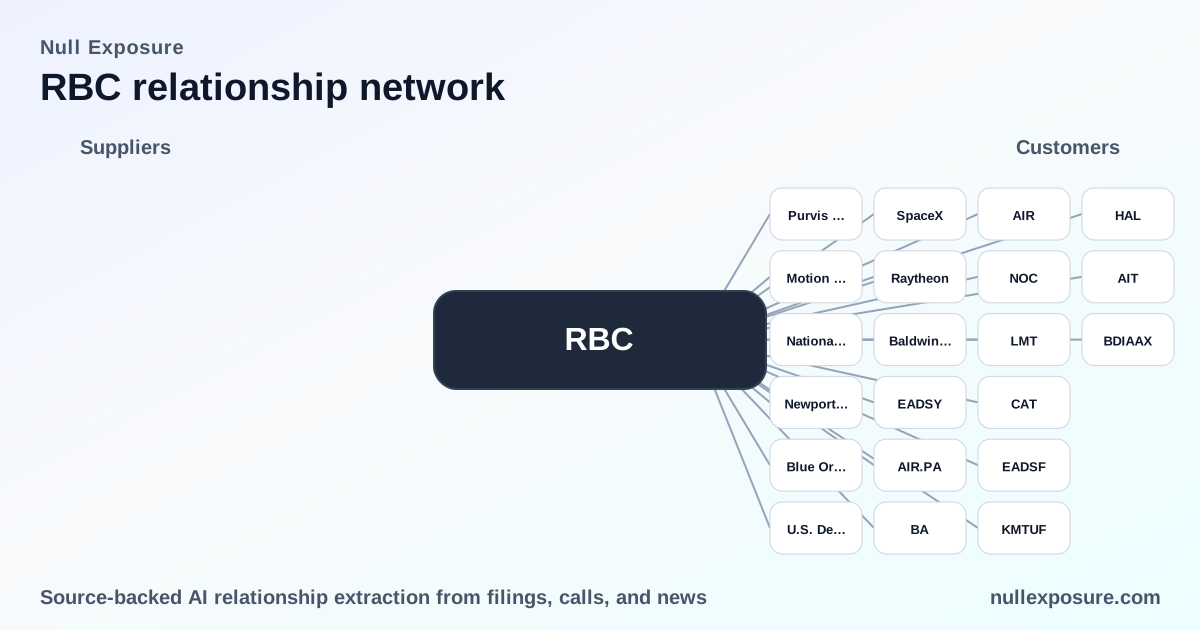
RBC Bearings — customer map, contracting posture, and investment implications
RBC Bearings designs and sells precision bearing products and complementary services to aerospace, defense and heavy industrial customers; the company monetizes primarily through the sale of engineered goods (single performance obligations) and a smaller services stream that includes repair, refurbishment and design work. Revenue is concentrated in North America with significant exposure to large OEMs and aftermarket distributors; long-cycle aerospace programs and a modest government footprint create a mix of short-term order activity and multiyear commitments that determine near-term visibility and backlog.
For a concise dashboard of how these customer relationships stack up for investors, see NullExposure’s platform: https://nullexposure.com/
What the customer list reveals about RBC’s commercial model
RBC’s disclosed customers read like a who’s-who of aircraft and heavy-equipment OEMs plus distribution partners. That mix implies high technical differentiation (bearing content on complex platforms), program-driven demand profiles and some price / volume leverage to OEM production rates. Key operating signals from company filings:
- The company reports the majority of contracts have durations under one year, which drives transactional revenue recognition cadence and sensitivity to production-rate changes. (FY2025 Form 10‑K)
- RBC also uses long‑term agreements (LTAs) with certain customers that span multiple years, providing pockets of supply certainty and partially mitigating order volatility. (FY2025 Form 10‑K)
- Government sales are material enough to note: ~3% of net sales were direct to the U.S. government in FY2025, with an estimated additional 9% indirect, giving total government exposure near the low‑double digits. (FY2025 Form 10‑K)
- Geography: U.S. origin of revenue dominates, supported by a direct sales force positioned across North America, Europe, Asia, Australia and Latin America. (FY2025 Form 10‑K)
- Backlog/multi‑year exposure: the company reports approximately $542.2 million of transaction price allocated to remaining performance obligations for contracts longer than one year (March 29, 2025), which signals meaningful multi‑year revenue under contract. (FY2025 Form 10‑K)
Collectively, these points show a business that is operationally lean toward short-cycle order flow but with strategically important LTAs and program-based revenue that produce both volatility and durable runway from aerospace programs.
Customer roster: who buys RBC’s bearings and why
Below I summarize every named relationship disclosed in the available materials and recent call commentary. Each line includes the primary source.
Newport News Shipbuilding
RBC lists Newport News Shipbuilding among its largest aerospace and defense customers, reflecting content on naval and defense platforms. Source: FY2025 Form 10‑K (filed March 29, 2025).
Baldwin Supply
Baldwin Supply is cited as an aftermarket distributor channel for RBC’s industrial products, indicating RBC’s reliance on distribution partners for downstream aftermarket reach. Source: FY2025 Form 10‑K (filed March 29, 2025).
Purvis Industries
Purvis Industries appears in the company’s list of aftermarket distributors, underscoring RBC’s multi‑channel industrial sales strategy. Source: FY2025 Form 10‑K (filed March 29, 2025).
Raytheon
Raytheon is named among major aerospace and defense OEM customers, signaling program-level content in missile and defense systems. Source: FY2025 Form 10‑K (filed March 29, 2025).
SpaceX
SpaceX is identified as a customer in the aerospace and defense cohort, representing RBC’s participation in commercial space and launch platforms. Source: FY2025 Form 10‑K (filed March 29, 2025).
U.S. Department of Defense
RBC reports direct and indirect sales to the U.S. government (direct ~3% of net sales, indirect ~9%), confirming the DOD as an important, though not dominant, customer segment. Source: FY2025 Form 10‑K (filed March 29, 2025).
Blue Origin
Blue Origin is listed among aerospace and defense customers, indicating RBC’s exposure to private launch and space programs. Source: FY2025 Form 10‑K (filed March 29, 2025).
Motion Industries
Motion Industries is named as a major aftermarket distributor for RBC’s industrial product lines, supporting broad aftermarket penetration. Source: FY2025 Form 10‑K (filed March 29, 2025).
National Precision Bearing
National Precision Bearing is cited as an aftermarket distribution partner in aerospace and defense channels, supporting spare‑parts and MRO demand. Source: FY2025 Form 10‑K (filed March 29, 2025).
Airbus
Management disclosed a ~20% increase in Airbus content during a Q3 FY2026 earnings call, highlighting accelerating commercial‑aircraft revenue from Airbus platforms. This was reiterated across call transcripts and analyst notes in March 2026. Source: Q3 FY2026 earnings call transcript and related March 2026 press coverage (InsiderMonkey / FinViz / The Globe and Mail).
Boeing
Boeing is a core OEM customer and management commentary ties RBC’s factory utilization and plant dependence to Boeing production rates (including 737 and 787 program cadence), making Boeing a direct driver of near‑term revenue variability. Source: Q3 FY2026 earnings call transcript and March 2026 coverage (The Globe and Mail / Motley Fool excerpts).
Northrop Grumman
Named among large aerospace and defense customers in the FY2025 10‑K, indicating program content on defense platforms. Source: FY2025 Form 10‑K (filed March 29, 2025).
Lockheed Martin
Lockheed Martin is included in the company’s list of large aerospace and defense customers, reflecting defense program exposure. Source: FY2025 Form 10‑K (filed March 29, 2025).
Caterpillar
Caterpillar is cited as a principal industrial customer, showing RBC’s presence on heavy equipment OEM platforms. Source: FY2025 Form 10‑K (filed March 29, 2025).
Komatsu
Komatsu is listed among major industrial customers, reinforcing exposure to global heavy equipment OEM demand. Source: FY2025 Form 10‑K (filed March 29, 2025).
Halliburton
Halliburton appears as a named industrial customer, signaling exposure to energy‑sector aftermarket and equipment content. Source: FY2025 Form 10‑K (filed March 29, 2025).
Applied Industrial
Applied Industrial is referenced as an aftermarket distributor for industrial channels, supporting RBC’s non‑OEM distribution network. Source: FY2025 Form 10‑K (filed March 29, 2025).
BDI
BDI is identified among aftermarket distributors in the FY2025 filing, highlighting RBC’s multi‑partner distribution approach. Source: FY2025 Form 10‑K (filed March 29, 2025).
(Each of the above distributor and OEM relationships is drawn from RBC’s FY2025 Form 10‑K or from Q3 FY2026 call transcripts and press coverage where noted.)
For deeper, interactive visibility into contract durations, program exposure and the distribution network, visit NullExposure’s research hub: https://nullexposure.com/
Investment implications — what investors should watch next
- Revenue sensitivity to OEM production rates is a primary risk and opportunity. Management’s Airbus and Boeing comments indicate near‑term upside if production ramps continue, and downside if schedules slip. (Q3 FY2026 call).
- Contracting posture is mixed: transactional short‑term contracts dominate cash flow timing, but LTAs and ~$542M of remaining RPO provide partial medium‑term visibility. (FY2025 Form 10‑K).
- Concentration and criticality: a broad set of marquee OEMs and distributors reduces single‑counterparty concentration, but program dependency (e.g., Boeing 787/737 content) creates plant‑level criticality.
- Geographic mix favors North America; international exposure exists but is smaller. This reduces currency diversification benefits while concentrating macro and supply‑chain risk in U.S. end markets. (FY2025 Form 10‑K).
- Services are a smaller but strategic margin lever. Repair/refurbishment and engineering services improve aftermarket capture and customer stickiness without being the primary revenue driver.
Bottom line
RBC is a precision components supplier whose revenue is driven by OEM program cycles, aftermarket distribution reach and a small but meaningful government footprint. Investors should monitor OEM production rates (Boeing and Airbus commentary), LTA renewals and the pace of replacement/aftermarket demand as primary drivers of near‑term earnings variability and long‑term value capture.
Explore more enterprise‑grade relationship maps and contract signals at NullExposure: https://nullexposure.com/