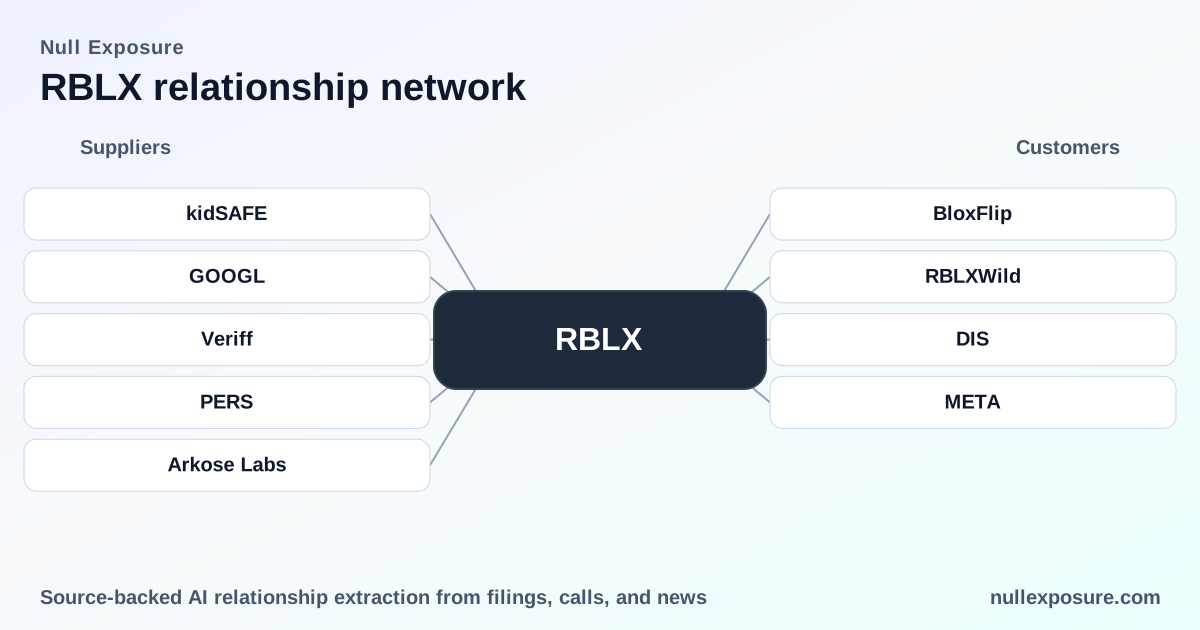
Roblox Corp (RBLX) — customer relationships that shape monetization and risk
Roblox operates a creator-driven online entertainment platform that hosts user-generated experiences and monetizes primarily through the sale of virtual currency (Robux), developer revenue-sharing, premium subscriptions, and brand advertising/partnerships. The company converts engagement into cash via one-off Robux purchases and a recurring Roblox Premium subscription, while brand integrations and in-experience advertising capture incremental revenue from large IP and advertiser partners. With trailing revenue of about $5.30 billion and a market capitalization near $34 billion, Roblox is a scaled platform business whose unit economics hinge on sustained user engagement and third-party partner relationships.
For a concise vendor- and partner-risk view, see NullExposure for enterprise-grade signals: https://nullexposure.com/
Why partner relationships matter for valuation and risk
Roblox’s business model is platform-native: creators, advertisers, and IP owners amplify user time-on-platform, which translates almost directly into Robux spend and ad impressions. That structure creates a few consequential characteristics for investors evaluating customer relationships:
- Contracting posture — recurring and hybrid: Roblox sells Robux as one-off purchases and through the monthly Roblox Premium subscription, giving the company a mix of recurring revenue and transactional inflows that both stabilize revenue and retain sensitivity to engagement trends.
- Geographic concentration vs. global scale: The user base is global, but revenue concentration skews regionally: users outside U.S. and Canada account for the bulk of daily activity, while the U.S. and Canada generate a meaningful share of revenue, producing differing monetization rates by geography.
- Role and criticality: Roblox sits between advertisers/IPs and end users—its platform acts as both marketplace and distribution channel. That dual role makes relationships with brand partners and ad-sellers strategically critical for growth and reputation.
- Maturity and exposure: The Platform is a mature software-led entertainment product with strong network effects, yet revenue margins and margins are sensitive to moderation, regulatory, and partner-driven headwinds.
These company-level signals should guide how investors weight concentration, counterparty risk, and operational leverage when modeling future cash flows.
A close read of every named relationship in the public signals
Below are plain-English takeaways for each relationship flagged in public content, with source context for verification.
Euronet Worldwide (EEFT)
Roblox was cited as a content distribution partner in Japan when Euronet mentioned signing a distribution agreement that includes Roblox content, indicating regional distribution or payment-channel cooperation as part of Euronet’s merchant network. This was noted in an Euronet earnings call transcript reported by Investing.com in May 2026.
Magnite (MGNI)
Magnite obtained exclusive rights to handle rewarded-video inventory for Roblox in January 2026, connecting the platform’s large daily active user base to external advertising demand and creating a direct commercial path between Roblox video placements and ad buyers. Coverage of the Magnite arrangement was reported on PPC.Land in May 2026.
BloxFlip (third‑party gambling site)
A class-action complaint and subsequent reporting allege that illegal third‑party sites such as BloxFlip enabled gambling with Robux and that parents blamed Roblox for insufficient shutdown efforts; plaintiffs assert Roblox benefits economically because platform transaction records feed into third‑party flows. This issue was reported by win.gg in March 2026 covering the lawsuit filing from August 15, 2023.
RBLXWild (third‑party gambling site)
RBLXWild was named alongside other illicit marketplaces in the same lawsuit narrative describing illegal Robux wagering and parental claims that Roblox did not adequately police these external sites; the reporting highlights a reputational and legal risk tied to third‑party ecosystems. This reporting is from win.gg in March 2026.
Super League (SLE)
Super League, as a member of Roblox’s Partner Program, leverages Roblox’s immersive ad placements to drive users into branded worlds—an example of IP and brand partnerships that increase engagement and direct monetization inside experiences. The Super League collaboration with DreamWorks/Trolls on Roblox was announced via GlobeNewswire in October 2023 and referenced in later partner summaries.
Disney (DIS)
A critical investigation cited instances where Roblox players were exposed to in‑experience advertising placements for Disney’s Inside Out 2, illustrating how major entertainment IP shows up on the platform and how ad placements can shape user experience. That observation appears in a Hindenburg Research report dated 2026.
Meta / Instagram (META)
Independent reporting from PC Gamer and the Hindenburg Research material documented examples of Instagram and Facebook-sourced ads appearing adjacent to problematic in‑experience content, with specific mentions of Instagram ads shown in games containing objectionable material; these accounts underscore ad-safety and brand risk for major advertisers like Meta. The coverage ran in March 2026 across PC Gamer and Hindenburg Research.
What these relationships signal for investors
- Advertising partnerships and inventory deals (Magnite, Meta/Instagram, Disney) are revenue amplifiers but also concentrate reputational risk: brand safety incidents can lead to short-run ad spending pullbacks that would depress yields on engagement.
- IP and partner programs (Super League, Disney) validate Roblox’s platform as a distribution channel for entertainment franchises, supporting ARPU expansion if experiences are effective monetizers.
- Third‑party illicit sites (BloxFlip, RBLXWild) create legal and regulatory downside that can translate into higher content-moderation costs and potential revenue disruption if parental litigation or regulator actions accelerate.
- Payment and distribution relationships (Euronet) reflect geographic expansion and payments integration that support monetization in markets like Japan, important given the platform’s global DAU footprint but regional revenue concentration.
Investment implications and near-term watchlist
- Monitor ad-safety governance and partner retention: brand ad partners are strategic customers whose pullback would affect advertising revenue growth and margins.
- Track legal exposure from third‑party gambling claims and associated moderation investments; these are direct downside risks to operating leverage.
- Watch subscription vs. one‑time purchase mix for shifts that change revenue predictability; rising subscription adoption increases recurring revenue stability.
- Follow regional monetization trends—global DAUs are valuable only if conversion and ARPU across geographies sustain current economics.
For a deeper, partner-level risk profile and historical relationship signals, visit NullExposure to explore our curated evidence set: https://nullexposure.com/
Bottom line
Roblox’s partner ecosystem is a core growth engine and a concentrated risk vector. Brand and ad partnerships provide scale and higher-yield monetization, while third‑party illicit marketplaces and ad-safety failures are the principal operational and legal threats to the revenue model. Investors should underwrite future valuation on sustained engagement growth, advertising partner retention, and the company’s ability to convert global DAUs into resilient ARPU across regions.