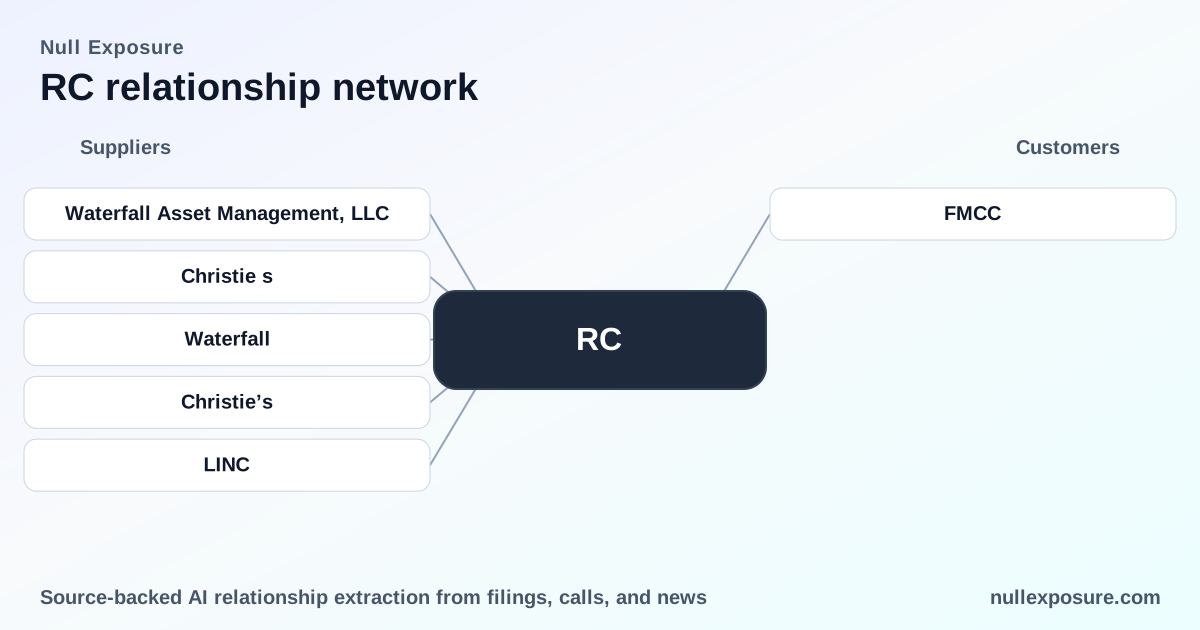
Ready Capital (RC): Agency channels and servicing are the commercial engine
Ready Capital operates as a multi-strategy real estate finance REIT that originates, acquires, finances and services lower-middle-market (LMM) commercial real estate and small business loans. The company monetizes through net interest income on held loans, servicing fees, and gains on loan sales and securitizations (including agency channels) — a hybrid model that relies on an active servicing platform and recurring access to agency buyers for balance sheet management. For investors, the thesis is straightforward: Ready Capital’s return profile depends on loan yield spread capture plus execution of sale/securitization strategies to recycle capital and manage duration and credit exposures.
For a quick read on our coverage and relationship mapping, visit https://nullexposure.com/.
Why the Freddie/Fannie connections matter for RC’s economics
Ready Capital is both an originator and an active seller/servicer in agency programs; these relationships are central to its monetization choices. Agency acceptance (Freddie Mac/Fannie Mae/Ginnie Mae) enables Ready Capital to convert originated loans into liquidity through sales or securitizations and to earn servicing revenue when loans remain on its books or are serviced for third parties. That dual pathway — hold-to-collect and sell-to-agency — is the structural lever investors should watch when assessing earnings variability and capital efficiency.
Relationship catalog: what’s on the record
Below I list each relationship flagged in the results and the public reference for that item.
FMCC (inferred symbol FMCC)
Ready Capital continued to deploy a mixed monetization strategy that includes holding loans, securitizing them and selling qualifying small-balance commercial loans to agency buyers such as Freddie Mac to optimize loan monetization and balance sheet management. This activity was reported in coverage of Ready Capital’s 10‑K and related commentary. Source: TradingView coverage of Ready Capital’s 10‑K commentary (March 10, 2026).
Freddie Mac (inferred symbol FMCC)
The company explicitly sells qualifying loans to Freddie Mac and uses Freddie Mac channels — including Small Balance Loan (SBL) sales — as part of its balance sheet optimization and liquidity strategy; that same coverage highlighted securitization and sale as recurring strategic options. Source: TradingView coverage of Ready Capital’s 10‑K commentary (March 10, 2026).
Operating- and business-model constraints that shape partner dynamics
The following strategic signals are company-level characteristics derived from public disclosures and should inform how operators and investors view each counterparty relationship.
- Contracting posture: long-term. Ready Capital originates fixed- and floating-rate mortgages with contractual terms from two to 30 years, which implies long-term asset durations on the balance sheet before monetization events occur (confidence: high, 90%).
- Counterparty profile: small-business focus. The firm is an SBA-approved player, acquiring and originating owner-occupied SBA Section 7(a) loans and holding preferred-lender status, so a meaningful portion of counterparties are small businesses rather than institutional owners (confidence: moderate-high, 80%).
- Geographic footprint: North America primary with selective EMEA exposure. Portfolio disclosures show diversification across all 50 U.S. states and some European exposure, with clear U.S. state concentration (for example, Texas ~19% of UPB) — a mixed national footprint with pockets of concentration (NA confidence 90%; EMEA signal 80%).
- Relationship roles: seller and service provider. Ready Capital is an approved Freddie Mac seller/servicer and performs third-party servicing activities, which makes it both a supply source for agency securitizations and a recurring services vendor to investors (seller confidence 85%; servicer confidence 80%).
- Lifecycle stage: active servicing with an active pipeline. The company performs active servicing for third parties and reports a pipeline of acquisition/origination opportunities; the active servicing signal is strong (80%), while the prospect-stage pipeline is evident but lower-confidence (60%).
- Segment focus: services-driven lending platform. Operations are reported across LMM commercial real estate and Small Business Lending, signaling an integrated origination‑to‑servicing business model rather than a pure warehouse lender (confidence 80%).
- Deal-size profile: broad range, skewed to multi-million-dollar originations. Origination sizes generally run from roughly $500k up to $40M; typical ticket sizes place counterparties across the $100k–$100M spend bands, concentrated between $1M and $100M, which translates into exposure across small businesses and larger property investors (confidence 90%).
What this means for investor risk and upside
- Liquidity and execution are the critical levers. Ready Capital’s economics depend on timely access to agency buyers (e.g., Freddie Mac) and securitization markets to recycle capital and smooth margin compression. The public reporting of SBL sales to Freddie Mac is a positive liquidity indicator.
- Concentration risk is real but manageable by design. Geographic concentration (notably in Texas and a handful of other states) means local economic cycles will disproportionately affect credit performance; however, the portfolio is spread across many states and includes agency sales avenues to offload risk.
- Servicing competency is an asset and a liability. As an approved seller/servicer, Ready Capital earns recurring fees and retains optionality, but servicing requires scale, compliance and systems investment; failures here would be operationally consequential.
- Capital efficiency hinges on securitization execution. The company’s decision to hold versus sell influences reported yield and volatility; successful agency sales compress duration and credit exposure but reduce future interest income — investors should monitor sale volumes and servicing retention metrics.
Quick tactical watchlist for analysts and operators
- Track agency conduit volumes and the split between hold vs. sell — this drives near-term ROE and liquidity profiles.
- Monitor state-level exposure trends (Texas, California, Florida) and delinquency movements within SBA and LMM portfolios.
- Watch servicing revenue growth and third‑party servicing inflows as a stabilizer of cash flows.
- Assess the pipeline signal (prospect) given its lower confidence; a material ramp in acquisitions would require capital adjustments.
Closing assessment
Ready Capital’s business model is a balance of loan spread capture and active balance-sheet management via agency channels and securitization. The Freddie Mac relationship is a structural enabler of liquidity and an explicit execution channel for SBL sales and securitizations. For investors and operators, the investment case rests on the company’s ability to sustain originations, execute sale/securitization strategies, and maintain servicing quality while managing geographic and borrower concentration. For further relationship mapping and ongoing monitoring, visit https://nullexposure.com/ for expanded coverage and updates.