Red Cat Holdings (RCAT): Customer Relationships That Define Defense-Drone Economics
Red Cat is a vertically integrated drone supplier that monetizes by selling hardware, software and services into government and allied defense channels. The company combines product sales (sUAS platforms such as the Black Widow and Teal families), recurring services (integration, training, field support) and software-enabled mission capabilities to capture procurement dollars from U.S. federal agencies, NATO buyers and regional integrators. For investors, the revenue profile is driven by a mix of multi-award framework work and episodic spot orders tied to defense procurement cycles; that mix creates both validated pipeline and near-term lumpiness. Learn more at https://nullexposure.com/.
How Red Cat wins contracts and gets paid
Red Cat’s commercial posture is shaped by three operating realities that flow from its customer relationships:
- Government-first counterparty mix. Red Cat targets U.S. federal and allied defense customers, which drives long procurement cycles, requirements for approved vendors, and high contractual scrutiny. This is a company-level characteristic supported by multiple disclosures indicating focus on DoD and federal agencies.
- Dual contracting modes: frameworks and spot orders. The business combines participation in firm multi-award frameworks that deliver predictable, multi-year revenue windows, alongside spot/purchase-order wins that produce episodic boosts to bookings and revenue. Frameworks reduce sales friction for repeat buys; spot orders create short-term volatility.
- Product + services + software revenue streams. Red Cat sells hardware platforms, delivers services and integration, and licenses software or mission payloads, which together enable higher ticket sizes on defense procurements and increase switching costs for customers.
These company-level signals explain why revenue can be lumpy yet strategically durable: framework awards underpin longer-term demand while spot orders capture program-specific procurement. Red Cat’s reported concentration — three customers accounted for material shares of revenue as of April 30, 2024 — amplifies both upside from contract renewals and downside from customer attrition.
Customer relationships that drive revenue and validation
Below are the customer and partner relationships surfaced in public filings and industry reporting. Each relationship is summarized concisely with source context.
-
DLTH — Teledyne Marine and partners: An earnings call from Teledyne (2025 Q4) noted expansion of key partnerships with defense, drone and subsea leaders, including Red Cat, signaling cooperative arrangements and channel partnerships across defense-focused OEMs and integrators. (DLTH earnings call, cited March 2026.)
-
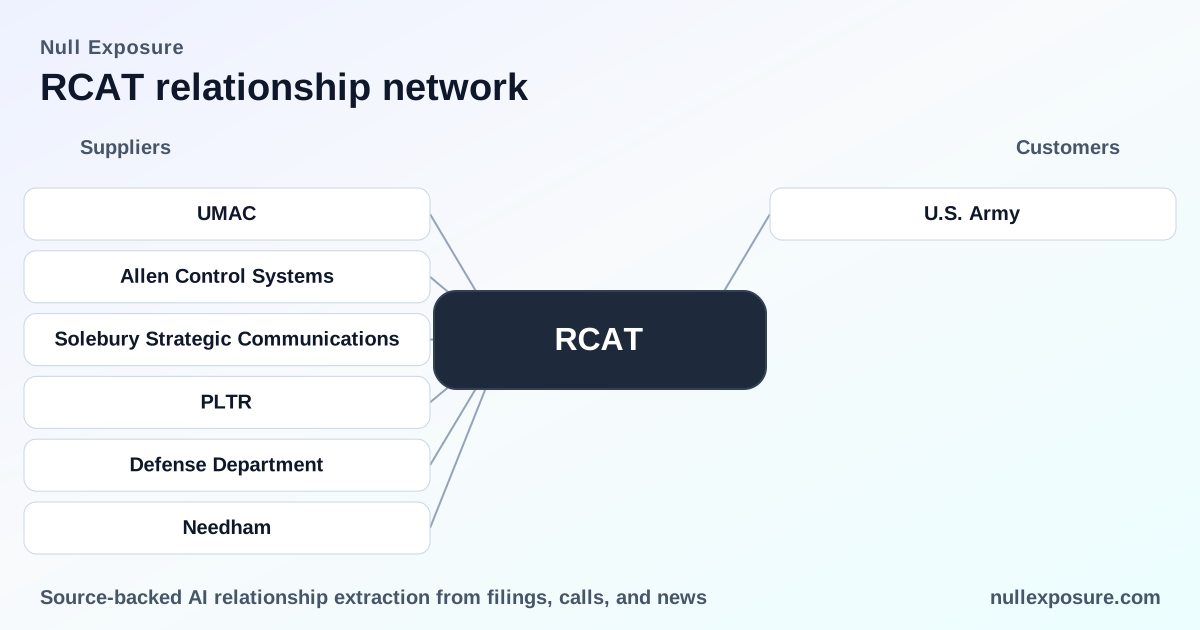
U.S. Army — Black Widow platform procurement: Multiple news reports state that Red Cat supplies the U.S. Army with its Black Widow short‑range reconnaissance quadcopter and that the Army’s SRR Tranche 2 program has been a major demand driver for the company. These placements represent direct DoD revenue and endorsement of the platform. (StockTwits news aggregation, March 10, 2026; Sahm Capital coverage, March 18, 2026.)
-
NATO Support and Procurement Agency — NATO contract win: Industry press reported that Red Cat secured a competitive contract via the NATO Support and Procurement Agency to deliver Black Widow sUAS for tactical intelligence missions, demonstrating NATO-level procurement acceptance and export‑oriented demand. (Unmanned Systems Technology, April 2026.)
-
LTRX (Lantronix) — supplier/technology integrator relationship: A January 2026 press release from Lantronix described a partnership to advance AI-driven edge intelligence for defense and autonomous systems, referencing support for critical defense contracts such as Red Cat’s Teal drones, which suggests third‑party supplier integrations for edge compute and mission software. (Lantronix / GlobeNewswire press release, January 27, 2026.)
Why each relationship matters to revenue and valuation
- DLTH partnership expands channel and integration reach; integration with established defense suppliers accelerates procurement inclusion and reduces program risk. (DLTH earnings call, 2025Q4.)
- U.S. Army wins validate product performance under rigorous military requirements and unlock program-level scale (SRR Tranche 2 is explicitly cited as a major demand driver). (StockTwits; Sahm Capital, FY2026 commentary.)
- NATO procurement opens multilateral buyers and exportable contract frameworks, shifting some demand offshore and increasing revenue diversification. (Unmanned Systems Technology, FY2026.)
- Lantronix (LTRX) supplier relationships bolster on‑platform computing and AI capabilities, making Red Cat platforms more defensible in procurement evaluations. (GlobeNewswire, Jan 27, 2026.)
Operational constraints and what they signal about risk/reward
Public evidence paints a consistent operating profile:
- Framework awards exist alongside spot orders. Red Cat benefits from multi-award framework access that provides a baseline of addressable spend, while one-off purchase orders (e.g., DLA, CBP-related buys historically connected to related subsidiaries) create near-term revenue upside and volatility.
- Concentration risk is real. Company disclosures indicate three customers represented material shares of revenue as of April 30, 2024, which increases sensitivity to program renewals and award timing.
- Defense and government counterparties dominate. The customer mix is concentrated in the federal/military space and North America, which lowers commercial diversification but increases the company’s exposure to defense budget cycles and procurement policy.
- Hybrid product mix smooths lifecycle value capture. Selling hardware together with services and software increases per-customer lifetime value but requires continued investment in field support and software capabilities to maintain competitive differentiation.
These constraints combine to produce a risk-reward profile typical of defense-focused tech suppliers: validated market access and sticky contracts on one hand, and concentration and timing risk on the other.
What investors should watch next
- Contract award cadence against the SRR Tranche 2 program and NATO follow‑on orders; renewals or scale-ups unlock material revenue growth.
- The mix between framework-derived repeat orders and spot purchase orders, which will determine short-term revenue volatility versus structural revenue growth.
- Execution on integrations (e.g., edge compute partnerships) that convert platform wins into higher margins and recurring service revenue.
Red Cat’s fundamentals show modest current revenue (Revenue TTM: $40.7M) and operating losses, while equity market valuation and analyst sentiment reflect bullish expectations (consensus target price and several Buy recommendations). The investment case hinges on continued program wins with the U.S. Army and NATO and on converting those wins into predictable, framework-driven revenue.
For a concise set of primary-source relationship briefings and ongoing monitoring, visit https://nullexposure.com/.
Conclusion — Red Cat is a defense‑channel growth story: the company has secured validation from major buyers and integrators, but investors must price in concentration and procurement timing risk while monitoring whether framework awards convert into sustainable revenue streams.