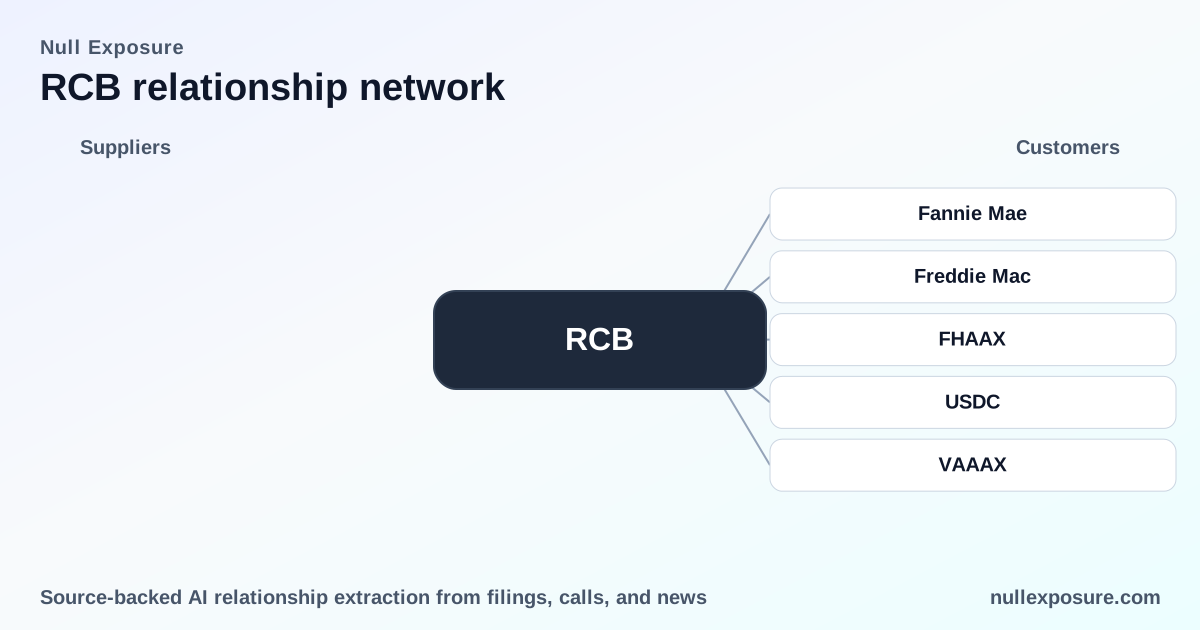
Ready Capital (RCB): Agency and Government Guarantees Anchor a Shift to LMM and SBA Lending
Ready Capital operates as a multi-strategy real estate finance company that originates, acquires, finances and services lower-to-middle-market (LMM) commercial real estate loans and government‑backed small business loans. The firm monetizes through net interest margin on held‑for‑investment loans, gain‑on‑sale economics from agency-eligible originations, and servicing and fee income on loans it retains or manages. For investors, the combination of agency channels and government guarantees provides liquidity options and risk transfer capabilities that underpin the company’s strategic pivot to LMM and SBA lending. For more detail on Ready Capital’s relationship footprint, visit https://nullexposure.com/.
How the business actually contracts and where value is captured
Ready Capital’s operating model blends long-duration mortgage assets with short-term construction paper and government guaranteed small business flows. Key operating characteristics:
- Contracting posture: The company holds a mix of long‑term fixed or floating mortgages (two to 30 years) and short‑term construction/pre‑construction loans, producing a laddered maturity profile that balances stable yield with cyclical origination activity.
- Counterparty profile: The borrower base is concentrated in LMM and small business segments—owner‑operators and smaller commercial owners—so underwriting is granular and relationship driven rather than corporate balance‑sheet lending.
- Concentration and geography: Portfolio concentration is primarily U.S.‑centric with notable state exposures (Texas ~19%, California ~11% and other states), but Ready Capital reports diversification across 50 states and Europe, indicating an operating footprint that is national with some international exposure.
- Criticality and roles: Ready Capital functions as both seller (gain on sale of agency loans) and service provider (originates and services SBA, USDA, FHA, VA, and agency loans)—a dual role that provides multiple monetization levers but also operational complexity.
- Maturity and materiality: The strategic shift to LMM and SBA lending approved by the Board in late 2023 is a material transformation of the firm’s core product mix and capital allocation.
These characteristics position Ready Capital to capture yield through held assets while retaining the option to transfer credit using agency and government channels.
Relationship inventory from the 2024 Form 10‑K — every cited counterparty
Fannie Mae
Ready Capital’s Mortgage Finance subsidiary (GMFS) originates loans that are eligible to be purchased, guaranteed, or insured by Fannie Mae, creating a conduit to agency liquidity and potential gain‑on‑sale opportunities. According to Ready Capital’s 2024 Form 10‑K (rcb-2024-12-31), FY2024.
Freddie Mac
GMFS also originates loans eligible for purchase or guarantee by Freddie Mac, and Ready Capital notes Freddie Mac program participation as part of its multifamily and bridge origination channels. According to Ready Capital’s 2024 Form 10‑K (rcb-2024-12-31), FY2024.
FHAAX (FHA)
GMFS originates loans that are eligible to be purchased, guaranteed, or insured by the Federal Housing Administration (FHA), enabling credit enhancement and broadened borrower access for certain product types. According to Ready Capital’s 2024 Form 10‑K (rcb-2024-12-31), FY2024.
USDC (USDA)
Ready Capital’s origination channels include loans eligible for purchase, guarantee or insurance by the U.S. Department of Agriculture (USDA), a channel relevant for rural and special‑purpose collateral. According to Ready Capital’s 2024 Form 10‑K (rcb-2024-12-31), FY2024.
USDA
The company explicitly states that GMFS originates loans that are eligible to be purchased, guaranteed or insured by USDA, supporting participation in government‑backed rural housing and development programs. According to Ready Capital’s 2024 Form 10‑K (rcb-2024-12-31), FY2024.
FHA
Ready Capital reiterates that GMFS’s originations meet FHA eligibility for purchase, guarantee or insurance, underscoring the firm’s access to HUD‑insured channels. According to Ready Capital’s 2024 Form 10‑K (rcb-2024-12-31), FY2024.
VA
GMFS originates loans eligible for purchase, guarantee or insurance by the Department of Veterans Affairs (VA), adding a government‑backed avenue for a specific borrower cohort. According to Ready Capital’s 2024 Form 10‑K (rcb-2024-12-31), FY2024.
VAAAX (VA)
The filing also lists VA eligibility under an inferred symbol entry (VAAAX) noting that Ready Capital’s originations satisfy VA program requirements for guarantee or purchase. According to Ready Capital’s 2024 Form 10‑K (rcb-2024-12-31), FY2024.
Why these relationships matter to investors
The company’s explicit agency and government eligibility status is strategically important. Agency eligibility (Fannie/Freddie) creates a sellable inventory pathway that reduces duration and credit concentration for portions of the portfolio via gain‑on‑sale economics. Simultaneously, FHA, VA and USDA channels provide guarantee overlays that lower expected loss and expand borrower reach in segments otherwise limited by conventional underwriting. Ready Capital’s SBA license and preferred lender status similarly position it to capture fee and servicing income from small business loans.
Risk vectors and portfolio implications
- Interest‑rate and repricing risk: Long‑dated mortgages (2–30 years) produce exposure to rate movements; short‑term construction loans reprice quickly and increase originations cyclicality.
- Concentration risk: Geographic concentration (Texas, California, Florida, Arizona, Oregon) amplifies regional economic sensitivity even as the firm claims national diversification across 50 states and Europe.
- Operational complexity: Acting as seller/servicer and being approved by agencies like Freddie Mac introduces operational and compliance requirements that are material to continued access to those channels.
- Transaction economics: The reported origination band for certain Freddie Mac SBL programs ($1M–$7.5M) makes individual loan economics significant and can materially influence originator profitability on a per‑deal basis.
Bottom line: what to watch and where value is created
Ready Capital’s combination of agency sell pathways and government‑guaranteed channels is a core competitive asset: it provides liquidity optionality, credit risk transfer, and fee income diversification. Investors should focus on origination mix (agency vs held), servicing scale, geographic concentration trends, and execution on the strategic pivot to LMM and SBA lending—the Board‑approved shift is a material reorientation of capital and risk. For a deeper look at relationship dynamics and to monitor ongoing disclosures, visit https://nullexposure.com/.