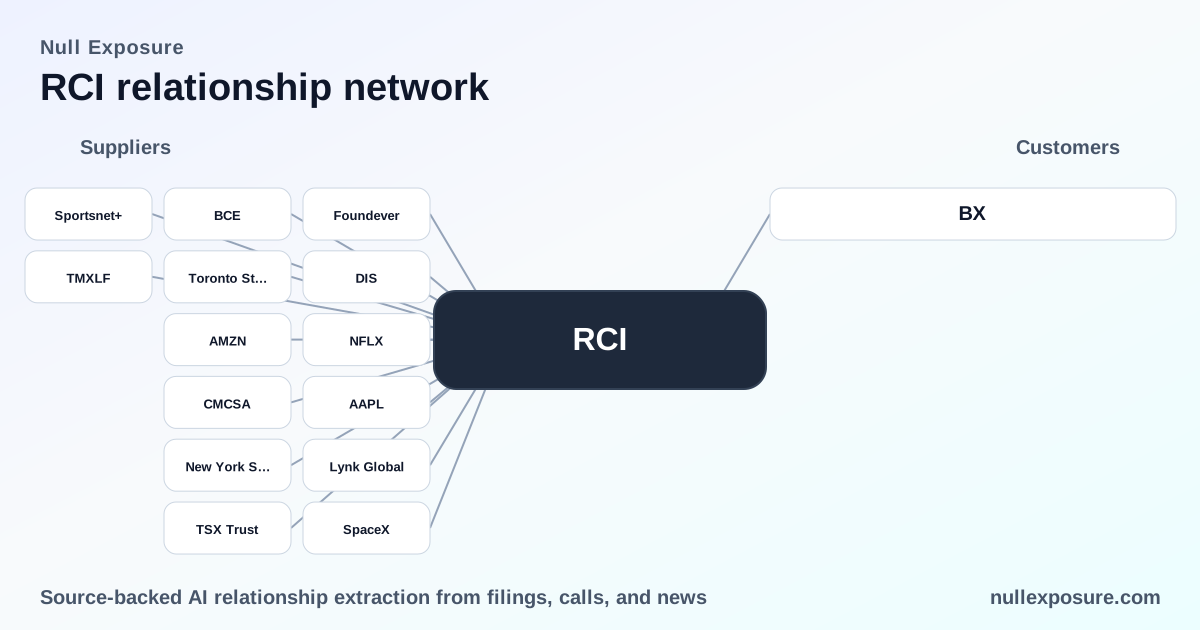
Rogers Communications (RCI): Network monetization reshapes customer relationships
Rogers Communications operates as Canada’s integrated telecom and media incumbent, monetizing through wireless subscriptions, cable video and broadband, advertising, and network services. Recently the company supplemented traditional operating cash flows by structuring asset-level capital partnerships—notably a $6.7 billion transaction tied to its backhaul network—turning infrastructure ownership into near‑term liquidity while preserving commercial access. This asset-monetization posture is the lens investors should use to evaluate evolving customer and counterparty dynamics. For more context on commercial counterparties and contract risk, see Null Exposure’s coverage at https://nullexposure.com/.
A single material customer relationship: the Blackstone backhaul transaction
Rogers disclosed a large structured equity arrangement with Blackstone that transfers economic ownership of a portion of its backhaul network while allowing Rogers to continue operating the assets commercially. This is not a simple vendor sale; it is a capitalization strategy that converts network assets into a long-term financing relationship with an institutional investor.
According to The Globe and Mail (March 10, 2026), Rogers “closed its $6.7‑billion structured equity deal with Blackstone Inc. for a portion of its backhaul network during the quarter.” The transaction was reported as a quarter-closing event tied to FY2025 results (The Globe and Mail, 2026).
What the Blackstone arrangement implies for cash flow and capital structure
- Immediate liquidity: The $6.7 billion structured equity proceeds materially bolster Rogers’ capital base and provide flexibility to fund operations, spectrum, or shareholder returns without issuing traditional debt.
- Operational continuity with third‑party capital: The structure implies Rogers retains commercial access to the backhaul capacity while transferring economic interest, converting a fixed asset into recurring service obligations and/or fees to the new owner.
Rogers’ reported trailing revenue of $22.2 billion and EBITDA of $9.456 billion indicate the company can support large asset financings while maintaining operational scale. The Blackstone deal is a financing instrument more than a customer win, but it creates a counterparty relationship where Blackstone effectively becomes a long‑term owner and commercial partner for critical network infrastructure.
Detailed relationship listings (every result in the record)
Blackstone Inc. — Globe and Mail mention (result 1)
Rogers closed a $6.7 billion structured equity deal with Blackstone for part of its backhaul network in the quarter; the deal monetizes infrastructure while preserving Rogers’ network use. Source: The Globe and Mail, March 10, 2026 — https://www.theglobeandmail.com/business/article-rogers-raises-service-revenue-guidance-records-steep-profit-decline-in/
BX (ticker reference to Blackstone) — Globe and Mail mention (result 2)
A duplicate market mention identifies BX as the counterparty to the same transaction: Blackstone (BX) acquired structured equity in Rogers’ backhaul assets under the $6.7 billion arrangement, creating an owner‑operator financing relationship. Source: The Globe and Mail, March 10, 2026 — https://www.theglobeandmail.com/business/article-rogers-raises-service-revenue-guidance-records-steep-profit-decline-in/
Both entries reference the same transaction and are consistent in substance; they reflect media coverage of a single, material capital partnership rather than two independent commercial customers.
Operating model signals and business‑model constraints
Even though no formal contract constraints are published in our customer scope record, the observable actions imply concrete company-level characteristics:
- Contracting posture — monetization over retention of absolute ownership. Rogers is willing to transfer economic ownership of non‑core or capital‑intensive assets while keeping commercial access through contracts. This reduces balance‑sheet capital intensity and transfers long‑tail asset risk to institutional investors.
- Concentration — strategic partnerships with large institutional counterparties. The decision to transact with Blackstone signals preference for deep-pocketed, long-duration partners rather than many small buyers.
- Criticality — backhaul is a core network element. Even when economic title changes hands, the backhaul remains operationally critical; contractual terms will therefore be structured to preserve service continuity and priority.
- Maturity — telco cash flows support asset recycling. Rogers’ scale and EBITDA margin profile enable structured equity raises as a repeatable financing tool rather than a one-off fix.
These are company-level signals inferred from the transaction; no constraint item in the customer-record explicitly names contractual obligations or restrictive covenants.
Investment implications: risk and opportunity in one move
- Opportunity — balance-sheet optionality. The structured equity injection provides immediate capital without diluting operating cash flow from the core customer base and supports allocation flexibility for spectrum, network upgrades, or shareholder distributions. Rogers’ market capitalization of approximately $19.4 billion and robust profitability metrics justify sophisticated capital transactions.
- Risk — operational dependence on third-party owners. Even with contractual protections, migrating ownership of critical assets to a financial sponsor concentrates a non-operational risk: disputes, refinancing cycles, or strategic divergence could introduce service or cost pressures over time.
- Credit and valuation nuance. Investors should view this transaction as partially substituting corporate leverage with asset-level financing; valuation multiples and credit metrics will reflect both the liquidity benefit and the off‑balance-sheet economic relinquishment.
If you want full visibility into how major counterparties change Rogers’ commercial profile and what that implies for contract risk, visit Null Exposure for deeper relationship intelligence: https://nullexposure.com/.
Bottom line
The Blackstone structured equity deal is the predominant customer/counterparty event in the current record and it redefines Rogers’ approach to infrastructure capital. For investors, the tradeoff is clear: immediate liquidity and reduced balance‑sheet strain versus increased dependence on third‑party capital owners for core network components. Monitor subsequent disclosures for the contract mechanics — revenue recognition, service-level guarantees, and residual ownership clauses — because those will determine whether the transaction is a durable strength or a latent operational constraint.