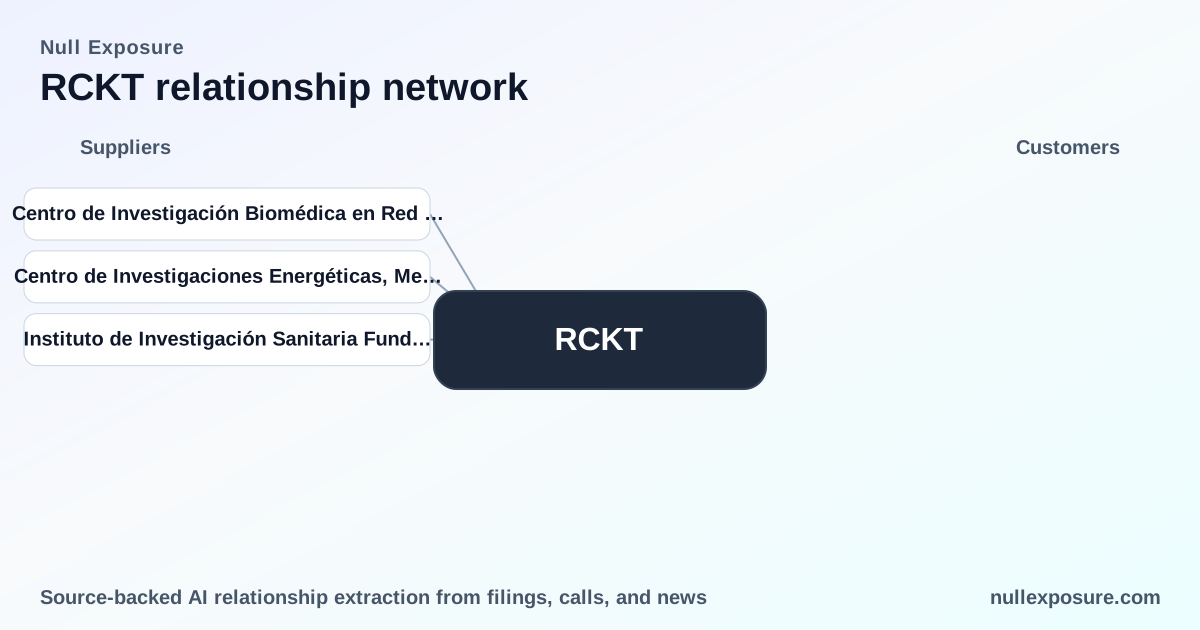
Rocket Pharmaceuticals (RCKT) — Financing partnership and customer map for investors
Rocket Pharmaceuticals is a development-stage gene therapy company focused on rare pediatric diseases that derives value primarily from clinical-stage programs and capital markets activity rather than product revenue. The company funds R&D and operations through equity and financing arrangements while advancing multiple gene therapy candidates; its balance sheet and investor composition are therefore material to commercial and execution risk. For investors evaluating customer and capital relationships, the recent financing collaboration with Cantor Fitzgerald is the principal counterparty signal to model into dilution and runway scenarios.
Explore more corporate relationship intelligence at https://nullexposure.com/.
Quick thesis: clinical programs demand financing; counterparties are strategic capital providers
Rocket operates as a clinical-stage biotech with zero reported revenue and negative earnings, which forces a business model that monetizes progress through clinical value inflection points and access to capital. The company’s commercial upside depends on successful trials and subsequent partnering or product commercialization, while downside is driven by cash consumption and the terms of financing arrangements. Financing partners that provide committed or on‑demand capital materially affect dilution, liquidity, and optionality.
What the Cantor Fitzgerald collaboration concretely does
- Cantor Fitzgerald will have the flexibility to buy Rocket common stock at times determined by market conditions, creating a financing channel that converts equity into near-term cash as needed. This structure is a classic equity distribution/at‑the‑market financing arrangement that delivers liquidity without immediate large cash obligations from third parties, while introducing dilution risk that investors must price into models. According to a Bitget news release dated May 3, 2026, this collaboration gives Rocket the option to issue and sell common stock to Cantor Fitzgerald when market conditions are appropriate (Bitget, FY2026).
Every relationship disclosed in the results (complete list)
The provided results contain two syndicated news entries that report the same Cantor Fitzgerald arrangement; both are listed below to ensure no omission.
- Cantor Fitzgerald & Co. (Bitget AMP page, first notice, 2026-05-03): Rocket granted Cantor Fitzgerald the flexibility to purchase Rocket common stock at market-appropriate times, establishing a secondary equity channel for financing. The press coverage was first seen on May 3, 2026 (Bitget AMP news, FY2026).
- Cantor Fitzgerald & Co. (Bitget news page, duplicate notice, 2026-05-03): The same announcement was published on Bitget’s primary news feed, confirming that Cantor Fitzgerald will be an equity purchaser under terms that allow sales based on market conditions. This item was also dated May 3, 2026 (Bitget news, FY2026).
Takeaway: Both entries document a single counterparty relationship: an equity distribution/placement arrangement with Cantor Fitzgerald that gives Rocket a sell-side financing option tied to market windows.
How this relationship fits Rocket’s business model and operating constraints
Rocket’s company-level profile drives the significance of this financing relationship:
-
Contracting posture — transactional and capital-focused. Rocket’s primary commercial relationships are financial rather than revenue-generating customers; agreements like the Cantor Fitzgerald arrangement are transactional financing contracts intended to support ongoing clinical spend. This posture prioritizes optionality and immediacy of capital over long-term revenue contracts.
-
Concentration — market and investor concentration are material. Institutional ownership is high (reported at 88.09%), which concentrates governance and liquidity pressures among a few large holders and institutional desks. That ownership profile increases the impact of financing events on share price and voting outcomes.
-
Criticality — financing counterparties are critical to runway. Reported financials show zero revenue and negative EPS, so capital providers directly affect operational continuity. A reliable equity facility materially reduces near-term liquidity risk versus opportunistic spot sales in open markets.
-
Maturity — development-stage; capital-dependent. With no product revenue and ongoing losses, Rocket operates at a pre-commercial maturity where the value is tied to trial milestones and successful fundraising; financing partnerships are therefore strategic operational inputs rather than ancillary commercial relationships.
No constraints were listed in the provided relationship constraints set, so the absence of constraints is itself a signal about disclosed contractual limits in the data provided.
Financial and market context investors must weigh
Use these verifiable data points when modeling scenarios:
- Market capitalization ~ $394.1M, shares outstanding ~109.18M, and institutional ownership ~88.09% (latest reported data through FY2025/quarter ending 2025-12-31).
- Reported revenue TTM is zero; diluted EPS negative (-2.04). These figures confirm that balance-sheet management and access to capital drive short‑to‑mid-term valuation movements.
- Analyst coverage is mixed (consensus target ~$8.84, with a range of buy/hold/sell ratings), so market expectations are divided on clinical and capital execution.
Given this profile, equity financing facilities like the Cantor Fitzgerald collaboration are both a stabilizer for runway and a source of dilution risk; investors should model multiple raise scenarios tied to clinical milestone cadence and volatility in the stock.
Risks and what to watch next
- Dilution timing and quantum. The Cantor Fitzgerald mechanism gives Rocket flexibility to raise; monitor announcements of actual sales into the market and their timing relative to clinical readouts.
- Market reaction to sales. Execution of share sales into thin trading windows can depress price; institutional concentration amplifies directional moves.
- Clinical readouts and partnering. The financing reduces immediate cash pressure but does not substitute for successful clinical outcomes or strategic licensing that would drive long-term revenue.
For ongoing monitoring and to track additional counterparty disclosures as they surface, visit https://nullexposure.com/ for updated relationship intelligence.
Bottom line
Rocket’s operating model is capital-intensive and pre-revenue, so financing relationships are de facto customer relationships for investors. The Cantor Fitzgerald arrangement provides a meaningful liquidity tool that reduces short-term funding uncertainty while increasing dilution potential; this trade-off should be explicitly reflected in valuation scenarios and risk-adjusted upside calculations.
Explore deeper relationship analytics and updates at https://nullexposure.com/.