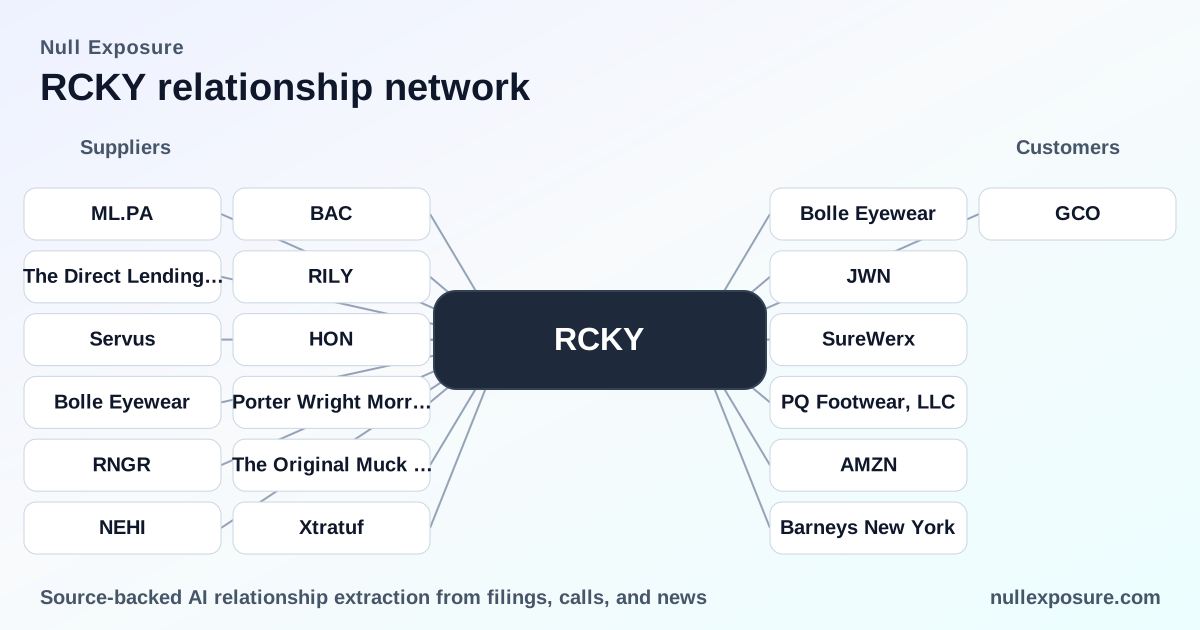
Rocky Brands (RCKY): Customer Map and Commercial Risks for Investors
Rocky Brands designs, manufactures and markets footwear and apparel across owned and licensed labels and monetizes through wholesale distribution, direct-to-customer retail and contract manufacturing (including government supply). Revenue derives from branded retail sales, large wholesale accounts, and contracted manufacturing agreements that include minimum payment commitments. For a concise institutional view of Rocky’s customer relationships and implications for underwriting, see Null Exposure: https://nullexposure.com/.
How Rocky’s customer model drives cash flow and constraints
Rocky operates a hybrid commercial model: manufacturing contracts supply predictable revenue streams, while wholesale and retail channels deliver volume and margin mix. Company disclosures establish a dual contracting posture — a multi-year U.S. Military contract that provides baseline shipments through 2026 alongside a book of shorter-term commercial contracts and wholesale purchase patterns that reset annually. This mix translates into a payroll- and capex-light manufacturing cadence with periodic inventory rhythm linked to seasonal retail cycles.
Key operating characteristics:
- Contracting posture: Combination of long-term (multi-year military award) and short-term (one-year or less) contracts. The company reported a 2023 multi-year award to the U.S. Military, and separately recognizes contractual minimum payments under non-cancellable short-duration contracts.
- Concentration: Low counterparty concentration — Rocky reports that no single customer accounted for 10% of net trade receivables as of December 31, 2024 and 2023; this limits single-counterparty credit risk.
- Geographic scale: Distribution is North America-focused but global in reach; products are sold at over 10,000 retail locations across the U.S., Canada and select international markets.
- Role diversity: Rocky functions as seller, distributor and contract manufacturer, using wholesale channels and CustomFit direct-to-employer ordering for safety footwear.
- Segment mix: Revenue splits across manufacturing (contract manufacturing and private label) and distribution (wholesale and retail), which create different margin and working capital profiles.
These signals imply a business that balances stability from contractual floors with cyclical exposure through wholesale/retail channels and inventory seasonality.
Every documented customer relationship — what it means for operators and investors
Bolle Eyewear
Rocky flagged a new partnership with Bolle Eyewear that is driving incremental growth in prescription safety eyewear as an extension of its management PPE program. This is an active product-extension relationship referenced in the Q4 2025 earnings call (reported March 2026). (Source: Rocky Brands Q4 2025 earnings call, Mar 2026.)
PQ Footwear, LLC
Rocky sold its Servus boot brand to PQ Footwear, LLC — a PetroQuim subsidiary — as part of portfolio rationalization; the transaction was reported relating to FY2023 activity. The divestiture reduces Rocky’s brand footprint while generating liquidity and simplifying the wholesale mix. (Source: Yahoo News report on the Servus sale, March 2026.)
SureWerx
Rocky disclosed the sale of its Neos Overshoe brand to SureWerx, a global manufacturer of safety and tool products; the disposition was discussed in connection with FY2022/FY2023 reporting. This sale signals selective brand exits and a focus on core product lines. (Source: Sourcing Journal coverage, reported in March 2026 referencing the earlier sale.)
JWN (Creative Recreation / retail channel references)
Historical reporting indicates Rocky’s acquisition of Creative Recreation was positioned to gain access to retail partners such as Nordstrom and Journeys; the subsequent sale was covered in a Dispatch article in 2017. These retail relationships impacted Rocky’s attempt to broaden its retail footprint at that time. (Source: The Dispatch, Nov 2017.)
Nordstrom
Nordstrom was cited as one of the retail partners Rocky accessed through its Creative Recreation efforts; the reference comes from the same 2017 Dispatch coverage of that divestiture. This reflects past channel exposure to department store accounts. (Source: The Dispatch, Nov 2017.)
Amazon (AMZN)
Rocky has publicly stated that it drives traffic to its websites but does not discourage customers from buying through Amazon; the company’s channel strategy tolerates marketplace sales alongside direct and wholesale channels. This commentary was captured in a 2019 company interview and reported in Manufacturing Today. (Source: Manufacturing Today profile, FY2019.)
Barneys New York
Barneys New York was listed among the retail partners associated with Rocky’s Creative Recreation strategy described in 2017 reporting; this reference documents historical premium retail placement rather than current concentration. (Source: The Dispatch, Nov 2017.)
Journeys (GCO)
Journeys was listed by Rocky as a retail partner tied to its Creative Recreation positioning; this retail relationship is noted in the 2017 Dispatch story and reflects past distribution efforts into youth/sneaker channels. (Source: The Dispatch, Nov 2017.)
What the relationship list collectively signals
- Active portfolio management. Multiple brand sales (Servus, Neos Overshoe, Creative Recreation) indicate Rocky executes strategic divestitures to sharpen focus on core brands like Georgia Boot and Durango; those moves affect wholesale placements and inventory strategy.
- Channel breadth with low single-buyer dependency. Rocky sells through department stores, specialty retailers, mass merchants and online marketplaces including Amazon; no single customer dominates receivables, which reduces counterparty credit concentration.
- Product and customer diversification. The partnership with Bolle Eyewear demonstrates an expansion into PPE-adjacent categories, while the CustomFit employer channels and government contract broaden end-market exposures.
Risk considerations for premium finance and operator due diligence
- Contract maturity profile: The existence of a multi-year U.S. Military contract provides a near-term revenue floor through 2026, but a mix of short-term commercial contracts keeps renewal risk active in the earnings cycle. (Evidence: company contract disclosures referencing 2023 award and contractual minimum payments for short-term contracts.)
- Working capital volatility: Wholesale seasonality and retail inventory pivoting generate periodic inventory and receivables swings, which require careful covenant and advance structuring.
- Liquidity from divestitures: Asset sales have generated proceeds and simplified brand exposure; lenders should track the cadence and uses of proceeds for debt coverage.
- Low customer concentration but channel execution risk: While no buyer is individually material, execution risk in key wholesale channels (e.g., large retailers, e‑commerce platforms) can compress demand quickly.
What to watch next
- Renewal or extension of the U.S. Military contract beyond 2026 and any associated purchase minima.
- Inventory and receivables trends across retail seasons, especially if retail partners listed historically (department stores, specialty chains) show demand shifts.
- Any further brand disposals or acquisitions that alter the wholesale footprint and working-capital profile.
For a structured, investor-grade map of Rocky Brands’ counterparty relationships and operating constraints, Null Exposure’s platform provides deeper cross-company context and credit signals: https://nullexposure.com/.
Bold takeaway: Rocky balances stability from contract manufacturing (including a government floor) with cyclical wholesale retail exposure — underwriting should reflect predictable minimums but also seasonal and channel execution risk.