Recon Technology Ltd (RCON): Customer Concentration, State-Oil Exposure, and What It Means for Investors
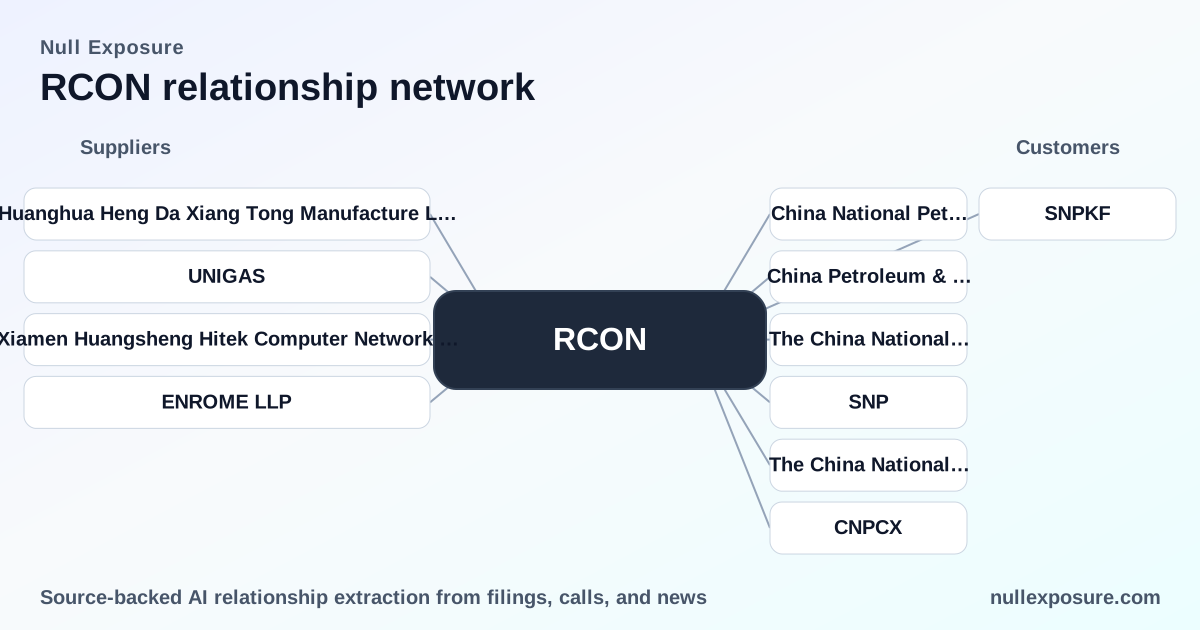
Recon Technology operates as an equipment, software and on‑site service provider to China’s petroleum extraction sector and monetizes through the sale and installation of hardware, recurring field services and licensed software tied to oilfield automation and production optimization. Revenue is concentrated in large state oil companies, delivered under a mix of short-term project contracts and licensing agreements, which creates both predictable top‑line funnels and high counterparty concentration risk. For a deeper look at relationship-level signals, see https://nullexposure.com/.
How Recon earns money and the commercial posture investors should price in
Recon sells three product families — hardware, software and on-site services — to oilfield operators and their service networks in the PRC. Hardware and field services drive near-term cash receipts; software is monetized via signed license agreements that restrict resale and carry acceptance-based recognition, per company disclosures. Pricing and contract terms skew toward project-based, short-duration agreements for services and software; licensing creates recurring intellectual‑property control but not broad resale channels. These facts imply a service-heavy, project-driven revenue profile with embedded licensing protections rather than wide software distribution.
Operating constraints and business-model characteristics investors must weigh
- Concentration and criticality: Recon’s revenue is materially concentrated in a small number of large state oil enterprises, which the company itself identifies as critical customers; loss of those relationships would materially harm operations. This elevates single‑counterparty risk and makes customer retention central to value realization. (Company Form 10‑K, FY2016.)
- Contracting posture: Evidence shows Recon uses short‑term, terminable contracts for many projects (Sinopec contracts are described as terminable without notice), while software is distributed under restrictive license agreements that prevent sublicensing or resale. That combination produces revenue volatility from project churn and legal control over software IP. (10‑K excerpts on contract terms and licensing.)
- Counterparty profile: The client base is dominated by government‑controlled large enterprises (CNPC and Sinopec), which positions Recon as a supplier to state oil players and aligns revenue cycles with their procurement cadence. (10‑K; company description.)
- Geography and segment: Operations are PRC‑centric with product mix across hardware, services and software, supplemented by limited onshore manufacturing capacity. (Company filings.)
- Relationship maturity: The company began providing services to CNPC in 2000, indicating long‑standing commercial ties with at least one anchor customer. (10‑K.)
Collectively, these signals point to an operator that is strategically embedded with state majors, sells projectized services, and protects its software via license terms — a business that trades off scalability for deep anchoring with a few high‑value clients.
The customer map — relationship-by-relationship summaries
Below are all customer relationships identified in filings and press coverage. Each entry contains a one‑to‑two sentence plain‑English summary and a source citation.
China National Petroleum Corporation (CNPC / CNPCX)
CNPC is Recon’s largest historical customer, accounting for approximately 75.36% of revenues in FY2016 and 43.09% in FY2015, and the company explicitly warns that termination of CNPC business would materially harm operations. According to Recon’s FY2016 Form 10‑K, the CNPC relationship is long‑running (services began in 2000) and is a strategic revenue anchor. (Recon FY2016 Form 10‑K; FY2016 disclosure.)
China Petroleum & Chemical Corporation Limited (Sinopec / SNP / SNPKF)
Sinopec represented 8.85% of revenues in FY2016 (6.82% in FY2015) and is cited alongside CNPC as a principal buyer of Recon’s equipment, automation and stimulation technologies; some Sinopec agreements are terminable without notice, underscoring project-term commercial dynamics. (Recon FY2016 Form 10‑K; FY2016 disclosure.)
The China National Petroleum Corporation (press references)
Press coverage reiterates that Recon supplies CNPC with automated technologies and extraction equipment to improve production efficiency and reduce impurities; this messaging appears in multiple 2025–2026 articles highlighting Recon’s role to major oil explorers. (See SahmCapital news item, August 25, 2025; Yahoo Finance coverage, May 3, 2026.)
Sinopec (press references and market notices)
Recent news releases and third‑party summaries repeat Recon’s commercial relationship with Sinopec as a buyer of automation and field equipment, reinforcing the public narrative that Recon serves China’s two largest oil majors. (See SahmCapital, Tirto.id FY2025 coverage and Yahoo Finance release, 2025–2026.)
Nanjing Recon Technology Co., Ltd.
Nanjing Recon is one of the PRC domestic companies controlled by Recon through contractual arrangements; Recon serves as the center of strategic management, financial control and HR allocation and supplies equipment and automation solutions through these domestic entities. This structure is described in Recon’s shelf prospectus materials. (MarketScreener coverage of the company’s FY2026 shelf prospectus filing.)
Beijing BHD Petroleum Technology Co., Ltd. (BHD)
Beijing BHD is a domestic company that Recon controls by contract and uses as a local operating vehicle to provide equipment, tools and industrial automation solutions to PRC oilfield operators. Recon’s FY2026 prospectus materials detail the contractual control and role of BHD. (MarketScreener FY2026 prospectus reporting.)
Hui Tong Tian Xia Petrochemical (Dalian) Co. Ltd
Huitong Dalian is a commercial counterparty referenced in relation to fleet fuel management and platform development agreements; press reporting around 2021 describes a technology collaboration where Recon’s related units were engaged to provide customized development and maintenance services. (MarketScreener news item, FY2021.)
Why these relationships drive both upside and risk
- Upside: Long tenures with CNPC and recurring purchases from Sinopec create a high‑value sales base that supports near‑term revenue and cross‑sell of automation and chemicals; restrictive software licensing protects IP value and provides a form of recurring annuity when accepted. Longstanding CNPC ties constitute a de‑facto moat for procurement access to major Chinese fields.
- Risk: Severe customer concentration is the dominant risk: a single state major exceeded 75% of revenues in a recent reported year. Short‑term contract terms for services and some software recognition conditioned on acceptance create variability in cash flow timing. Government counterparty dependence also concentrates political and procurement risk. (Recon FY2016 10‑K; FY2026 prospectus reporting.)
Financial and valuation context for investors
Recon’s public financial snapshot shows small market capitalization (~$82.2M) against trailing revenue of roughly $109.3M, a negative EBITDA and EPS, and a negative profit margin (-25.5%), underlining that profitability turnaround is needed to justify higher multiples. The combination of concentrated revenue, project-style recognition and negative margins requires investors to price recovery scenarios around improved margin capture, diversification away from a single customer and more predictable licensing revenue.
Bottom line and recommended next steps
Recon is a niche supplier embedded with China’s state oil majors: that positioning delivers meaningful revenue today but concentrates execution and political risk in a handful of counterparties. Investors should track contract renewal cadence with CNPC and Sinopec, progress on diversifying end markets beyond the two majors, and whether software licensing can be scaled into more recurring revenue.
For a granular view of Recon’s relationship signals and to compare counterparties across energy suppliers, visit https://nullexposure.com/.