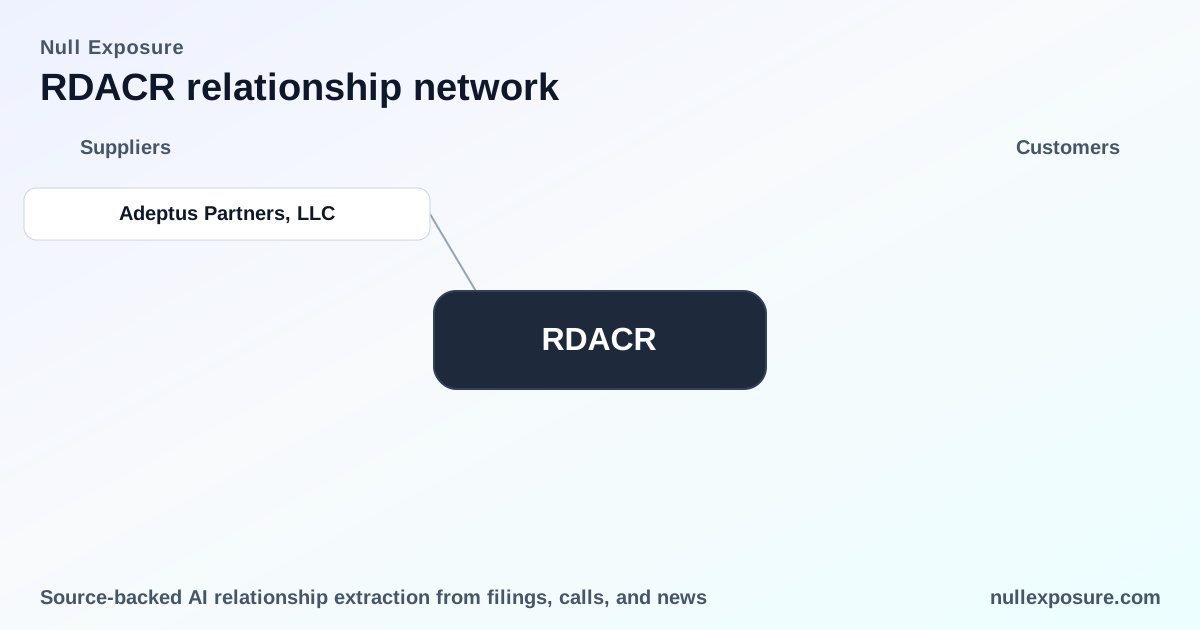
RDACR (Rising Dragon Acquisition Corp. Rights): Merger Counterparty Snapshot and Commercial Implications
Rising Dragon Acquisition Corp. Rights (RDACR) are tradable SPAC rights that derive value from a single corporate event pathway — a business combination with a named counterparty — and from short-term capital markets dynamics around extension financings and deadlines. RDACR monetizes through market trading of rights tied to the success or failure of the planned merger; the primary value driver for holders today is progress against the merger timetable and any extension financings. For focused counterparty diligence and event monitoring, see https://nullexposure.com/.
Quick investor thesis: simple structure, event-driven upside, event-driven risk
RDACR is not an operating company; its instrument value is entirely event-driven. Rights are effectively a levered claim on the SPAC’s completion of a merger. That makes counterparty performance, extension financings, and regulatory timelines the dominant determinants of investor outcomes. The firm’s public filings show no operating revenues and a negative book value, underscoring the transactional nature of the position rather than an ongoing commercial business.
The named relationship: HZJL Cayman Limited and what investors should know
HZJL Cayman Limited is the announced merger counterparty to Rising Dragon. According to an SEC-filings news item published on Investing.com on May 3, 2026, HZJL Cayman Limited is identified as the counterparty to a previously announced merger agreement with Rising Dragon, and the SPAC issued a small extension note to push the deadline. (Investing.com, SEC filings, May 3, 2026.)
- HZJL Cayman Limited is the counterparty named in the announced business combination with Rising Dragon, and that counterparty status is the single corporate relationship currently driving RDACR’s value. (Investing.com, May 3, 2026.)
- The same filing noted Rising Dragon issued $100,000 in notes to extend its merger deadline, an operational detail that directly affects rights holders because extensions preserve the possibility of deal completion. (Investing.com, SEC filings, May 3, 2026.)
Why this single relationship matters for rights holders
A SPAC rights instrument is binary in character: one counterparty and one closing event can create almost all of the upside or wipe out value entirely. With HZJL Cayman as the named target, the commercial and execution qualities of that counterparty — capitalization, regulatory preparedness, and willingness to close — become the central credit and operational risk for rights holders. The extension note issuance is a near-term signal that management chose to preserve deal optionality rather than liquidate.
Company-level constraints and operating model signals
There are no explicit contractual constraint disclosures in the available relationship-level data for RDACR. That absence is itself an informative company-level signal:
- Contracting posture — transactional and short-dated. RDACR’s obligations and value hinge on time-limited merger mechanics rather than long-term customer contracts. The issuance of a small extension note fits a short-duration funding posture focused on preserving optionality.
- Counterparty concentration — extreme. With a single named counterparty publicly recognized, concentration risk is elevated; the rights’ fate is tied to the success of one negotiation.
- Criticality — high for holders, low for the counterparty. The merger’s completion is mission-critical for rights value; for the counterparty, the commercial calculus can include alternative pathways (private funding, different acquirers).
- Maturity — transactional stage. The business model maturity is pre-closing and non-operational: no revenue, no operating margin, and negative book equity metrics in public summaries indicate the instrument is not an operating enterprise.
These characteristics combine into a classic SPAC-rights risk profile: event dependency, high concentration, and compressed timelines.
Financial signals you should price in now
Public summary metrics reinforce the event-driven, fragile economic profile:
- Zero reported revenue and zero operating margin indicate RDACR does not run a commercial operation; value is tied entirely to a merger outcome.
- Negative book value (noted in the summary data) signals liability towards holders if the combination fails and liquidation economics come into play.
- Small extension financing ($100,000) is a tactical measure to preserve deal timing; it is not large capital backing and should not be interpreted as a full underwrite of the target.
Price the rights as a leveraged, short-duration spec on completion probability and on whether the counterparty will satisfy regulatory and closing conditions.
Risk checklist for operators and research teams
- Execution risk: the success of the HZJL transaction is the single strongest determinant of value.
- Funding risk: the extension funding level is modest; additional capital or sponsor support could be necessary to close.
- Jurisdiction and regulatory complexity: Rising Dragon lists a China address; cross-border approvals and regulatory review add procedural risk.
- Liquidity and market risk: rights trade in secondary markets and can be volatile around deadlines and news.
Tactical monitoring — what moves the needle next
- Filings that confirm a new merger deadline, successful closing, abandonment, or further extensions.
- Any sponsor or target disclosures about financing commitments beyond the $100,000 note reported in early May 2026.
- Regulatory filings from either party in relevant jurisdictions and any evidence of required approvals being obtained.
For continuous, event-centric counterparty monitoring and to integrate these relationship signals into portfolio risk models, visit https://nullexposure.com/.
Bottom line — investment posture and key takeaways
- RDACR is a pure event play: the rights' value is controlled by the HZJL counterparty’s ability to close a business combination with Rising Dragon.
- Concentration and timeline risk dominate: one counterparty and a near-term deadline create binary outcomes for holders.
- Financial backing reflected in public notes is limited: the $100,000 extension note preserves the deal window but is not substitute for robust closing capital.
For investors and operators, treat RDACR as a high-variance instrument: the upside is tied to deal completion, while downside reflects scarce operational buffers and concentrated counterparty risk.