Redfin (RDFN): Customer Relationships That Drive Distribution, Revenue and Regulatory Risk
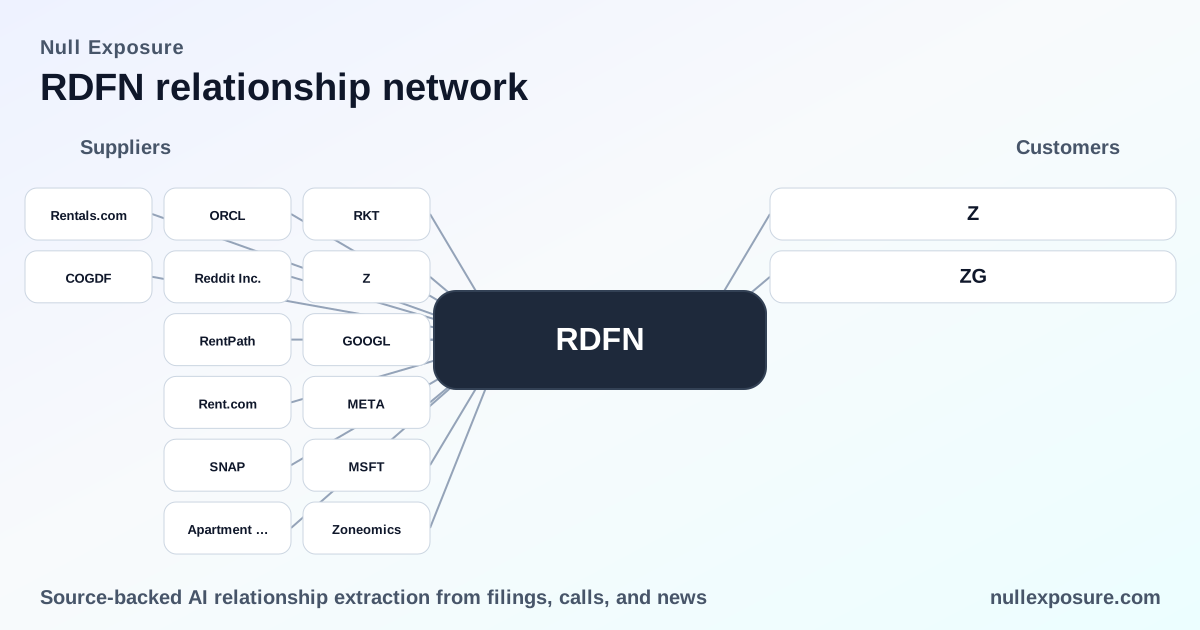
Redfin operates as a vertically integrated, tech-enabled real estate brokerage and marketplace that monetizes through agent commissions, referral fees, lead syndication and selective commercial agreements; its customer relationships—both with broker partners and marketplace rivals—are direct channels for buyer and renter leads and therefore central to revenue and competitive positioning. Understanding Redfin’s partner network is essential to value the company’s distribution moat and to quantify concentration and regulatory exposure. For deeper context on partner intelligence and relationship monitoring, visit https://nullexposure.com/.
What these relationships tell investors about how Redfin contracts and competes
Redfin’s commercial posture blends direct brokerage services with an increasingly important partner-referral and lead-licensing model. From the evidence in public reports, Redfin relies on a mix of referral partnerships and lead-sharing agreements that are commercially material and operationally sensitive: large, headline-grabbing payments (see the Zillow case) show that deals can be one-time and material; referral flows to outside brokerages (RE/MAX) and lead access to rival agents (Compass) demonstrate a willingness to outsource fulfillment where Redfin lacks capacity.
- Contracting posture: a hybrid of proprietary services plus negotiated commercial agreements; partners can be paid for distribution rights or receive access to Redfin leads.
- Concentration: partner deals with major marketplace players create single-counterparty concentration risks when agreements are material in size.
- Criticality: partners function as alternate sales channels and can materially affect Redfin’s lead funnel and revenue cadence.
- Maturity: relationships span multi-year press coverage (2019–2026), indicating an evolution from referral experiments to large-scale commercial arrangements and regulatory scrutiny.
Detailed relationship breakdown — the business implications, one by one
Zillow (ZG / Z / Zillow)
Redfin’s relationship with Zillow is commercially significant and legally consequential: multiple reports state that Zillow agreed to pay Redfin $100 million under a February 6, 2025 agreement tied to a rental listings partnership, and that federal regulators subsequently filed an antitrust suit alleging that the payment was intended to limit competition in multifamily rental advertising. According to news coverage (AOL, March 10, 2026) and FTC-related reporting (GlobeNewswire, November 4, 2025; Scotsman Guide, May 3, 2026), the payment and partnership have become the center of regulatory action and consolidated litigation. Key takeaway: a single large counterparty arrangement has triggered regulatory risk that directly implicates Redfin’s commercial model.
RE/MAX (RMAX)
Redfin operates a formal referral mechanism that routes customers to approved partner agents when Redfin lacks local capacity; RE/MAX agents are explicitly named among those partner agents in company announcements. A Redfin/RE/MAX press release (Newswire, FY2019) describes how Redfin refers customers to participating RE/MAX agents in markets where Redfin does not serve directly. Key takeaway: referral relationships extend Redfin’s effective footprint but create dependency on partner agent networks for fulfillment.
Compass (COMP)
Redfin has monetized its buyer lead flow by granting outside broker networks access to those leads: one report states a deal that gives Compass agents access to more than 1 million Redfin buyer inquiries. According to coverage in StockTitan (March 9, 2026), this arrangement represents direct lead-sharing with a major competitor’s agent network. Key takeaway: lead syndication to Compass expands Redfin’s commercial reach but also turns proprietary demand into a monetizable commodity that can dilute Redfin’s own agent conversion potential.
Rocket Companies (RKT)
An earnings-call excerpt (RKT Q4 2025) includes the line “We acquired Redfin, we acquired Mr. Cooper,” recorded in the public transcript for that quarter. The excerpt indicates that the topic of Redfin was discussed on Rocket’s call (source: RKT 2025Q4 earnings call transcript, March 7, 2026). Key takeaway: mentions of Redfin on a Rocket Companies call signal investor-level interest from mortgage and services conglomerates and highlight the company’s relevance to broader real-estate services consolidation themes.
How these relationships translate into investment risks and levers
- Revenue leverage and monetization: Redfin converts platform demand into fees both directly (commissions/referral fees) and indirectly (lead access sold or shared), giving the company multiple monetization levers. Positive: diversified revenue channels beyond pure brokerage commissions.
- Regulatory and legal concentration risk: the Zillow matter demonstrates that a single, large commercial agreement can create outsized legal exposure that affects near-term valuation and management bandwidth.
- Operational dependency on partners: referral and lead-share arrangements reduce Redfin’s customer fulfillment burden but increase counterparty operational risk—partner performance and policy changes can materially alter Redfin’s conversion rates.
- Strategic signaling to acquirers and competitors: public mentions on earnings calls and large partner deals make Redfin a strategic asset in the wider mortgage and brokerage consolidation story.
Investor implications and monitoring checklist
- Track legal filings in the Zillow/Redfin FTC matter and any court outcomes; resolution will materially affect liability, cost and reputational risk.
- Monitor published partner agreements and announced lead volumes (e.g., Compass access figures) to quantify recurring vs. one-time revenue.
- Watch referral network activations (RE/MAX-style relationships) in key markets to assess fulfillment capacity and commission-share dynamics.
For a consolidated feed of partner relationships and event-driven tracking, see our platform overview at https://nullexposure.com/.
Final read — tradeoffs for the thesis
Redfin’s partner ecosystem is a strategic asset that both expands reach and introduces concentration, regulatory and counterparty risk. The Zillow payment episode elevates legal risk to an investment-critical variable; meanwhile, referral and lead-sharing deals with RE/MAX and Compass underscore Redfin’s pragmatic approach to scaling distribution. For investors, the core analytic task is to quantify how much of Redfin’s growth and margin improvement depends on partner flows versus in-house agent conversion, and to price in the legal and counterparty concentration risks accordingly.