Ridgetech (RDGT) — customer relationships that define distribution and short-term funding options
Ridgetech operates as a China-based pharmaceutical retailer and wholesale distributor, generating the bulk of revenue from its physical retail drugstores while running an online pharmacy channel that lists products on third-party marketplaces. The company monetizes through retail margin capture at store level and through marketplace sales volume; it also uses capital-market instruments such as sales agreements with broker-dealers for near-term financing. For investors, the essential frame is a retailer with omnichannel distribution but limited public-market scale and lean institutional ownership, with marketplace partners providing channel breadth while sales agreements provide liquidity flexibility. Visit our homepage for more coverage: https://nullexposure.com/
Why these customer and counterparty ties matter for investors
Ridgetech’s distribution mix is built around two vectors: brick-and-mortar drugstores as the primary profit engine and third-party e-commerce platforms as supplemental reach. That combination shapes contracting posture, revenue concentration, and channel risk:
- Contracting posture: Use of major marketplaces implies standardized seller terms and limited negotiating leverage versus platform owners, while retail stores operate under direct supplier and landlord contracts.
- Concentration: Company disclosures attribute most revenue to retail drugstores, indicating revenue concentration in physical retail even as e-commerce provides scale.
- Criticality: Large platforms are important for customer acquisition and geographic reach, but the company’s core cash generation is tied to its own stores.
- Maturity signal: Public filings show modest market capitalization relative to trailing revenue and uneven profitability metrics; this signals an operating company still managing growth and capital structure.
These are company-level signals drawn from the relationship set and public figures; there are no explicit operational constraints flagged in the customer dataset.
Customer relationships and counterparties you need on your radar
Alibaba’s Tmall (BABA) — platform channel for the online pharmacy
Ridgetech lists online-pharmacy SKUs on Alibaba’s Tmall as part of its third-party e-commerce distribution, which extends the company’s digital reach beyond its retail footprint. A Sahm Capital note in April 2026 specifically identified Tmall as a marketplace channel used by the company for its online pharmacy business (FY2026).
Amazon.com (AMZN) — an international marketplace touchpoint
The company sells through Amazon.com in addition to domestic Chinese platforms, which provides access to cross-border e-commerce customers and can smooth demand volatility tied to local retail traffic. The use of Amazon as a third-party sales channel was cited in the same Sahm Capital write-up (FY2026).
JD.com (JD) — domestic platform distribution in China
JD.com is noted alongside Tmall as a primary third-party platform for Ridgetech’s online pharmacy operations, offering additional domestic e-commerce scale and logistics capability. Sahm Capital’s April 2026 coverage lists JD.com as a channel for the company’s online pharmacy (FY2026).
AC Sunshine Securities — sales agreement for capital or liquidity
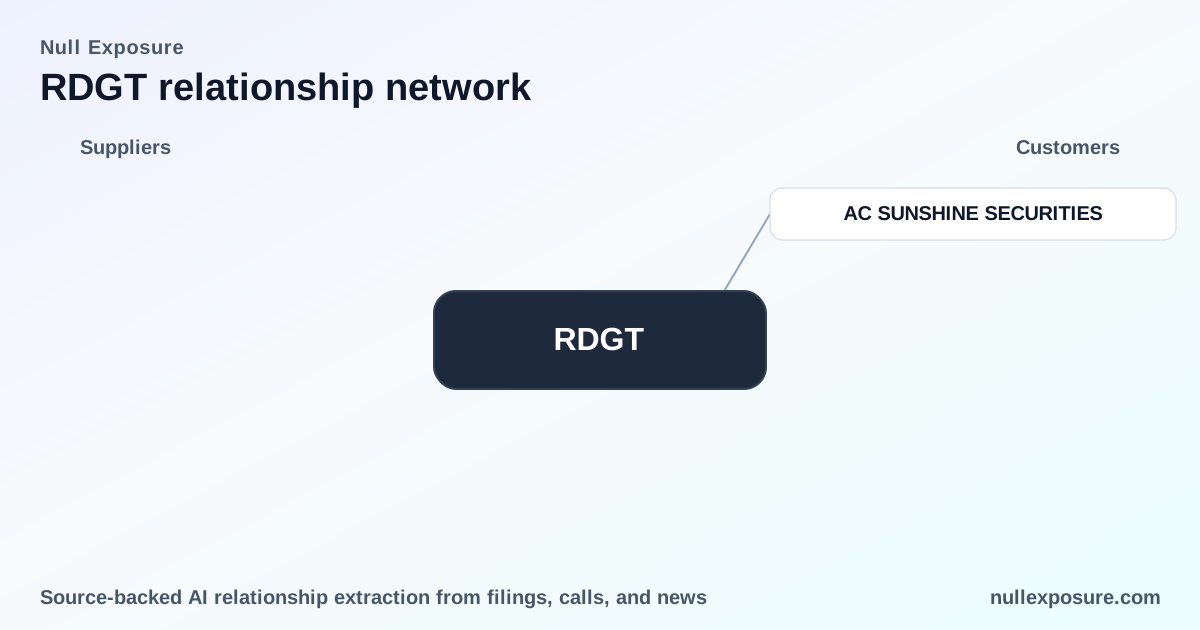
Ridgetech entered into a sales agreement with AC Sunshine Securities on December 29, 2025, according to an SEC filing reported by MarketScreener and Webull; this is a direct counterparty relationship tied to the company’s financing and capital markets activity (FY2025). The sales agreement represents an explicit, documented capital-market arrangement outside of standard customer-supplier commerce and is relevant for short-term funding and equity distribution strategy.
What these relationships imply for risk and operational leverage
- Distribution diversification vs. dependency: Presence on Tmall, JD.com, and Amazon provides distribution diversification; however, the company still derives most revenue from its drugstores, so retail operational risk remains the dominant exposure.
- Platform negotiating power: Selling through major marketplaces introduces standardized fee schedules and algorithmic visibility, limiting merchant pricing power and increasing dependence on platform-driven customer acquisition.
- Capital structure flexibility: The sales agreement with AC Sunshine Securities signals active use of brokerage-led equity or securities transactions for liquidity, which investors should monitor for dilution or short-term funding pressure. The December 2025 sales agreement is documented in Ridgetech’s SEC filing as reported by MarketScreener and Webull (FY2025).
Financial context that colors these relationships
Ridgetech’s trailing revenue (roughly $119.9M TTM) against a modest reported market capitalization (per provided figures) and mixed profitability metrics indicates a business whose operating scale in the market is meaningful but whose public valuation and earnings are uneven. That dynamic amplifies the importance of marketplace channels for volume and of financing arrangements for balance-sheet management.
Investment implications and watchlist items
- Monitor marketplace metrics: units sold on Tmall/JD/Amazon, take-rates, and fulfillment costs—these drive online channel margin. The Sahm Capital note (April 2026) confirms the reliance on those marketplaces for online sales.
- Track SEC filings tied to broker-dealer deals: the sales agreement with AC Sunshine Securities (filed Dec 29, 2025; reported via MarketScreener and Webull) is a direct line to potential share issuance or convertible financing that affects dilution and liquidity.
- Retail footprint performance: given that the retail drugstores segment produces most revenue, same-store sales, occupancy cost trends, and inventory turns are primary drivers of earnings stability.
Explore deeper research and comparable peer analysis on our site: https://nullexposure.com/
Bottom line for investors
Ridgetech’s customer and counterparty landscape combines dominant physical retail revenue generation with strategic use of large third-party marketplaces for online reach, and explicit broker-dealer sales agreements for capital flexibility. For equity analysts and operators, the central questions are whether online channel scale can materially improve margins and whether capital-market arrangements will stabilize or dilute shareholder value. The reported sales agreement with AC Sunshine Securities is a near-term corporate action that investors should treat as material to liquidity analysis; marketplace exposure to Tmall, JD.com, and Amazon is material to revenue-growth scenarios and margin compression risk.