RedHill Biopharma (RDHL): commercial relationships that define a turnaround
RedHill Biopharma operates as a specialty pharmaceutical company focused on gastrointestinal and infectious-disease therapies and monetizes through a hybrid model of direct product sales, licensing deals and co-commercialization partnerships. The company drives near-term revenue from marketed assets such as Talicia while outsourcing geographic commercialization for legacy products (RHB-102/Bekinda) to licensees and using strategic investments to share commercialization economics and reduce cash burn. For investors, the commercial strategy is simple: scale Talicia in the U.S. via insurance coverage and a co-commercial partner, and extract value from non‑U.S. licenses and milestone payments. For further context and tracking of these counterparty relationships visit https://nullexposure.com/.
Why the partner map matters more than the balance sheet right now
RedHill’s product set is small, and its commercial progress is therefore highly leverageable to a few counterparties. The company’s ability to generate recurring sales depends on formulary placements and co-commercial execution in the United States, while licensing agreements outside North America convert development assets into milestone and royalty streams. These commercial levers translate to asymmetric upside if payors and commercial partners perform, and material downside if a partner pulls back or a license underperforms.
If you follow one link today, track Talicia coverage and the Cumberland co-commercial arrangement — those two items explain most near-term revenue dynamics.
The counterparty list — every relationship from the record, explained
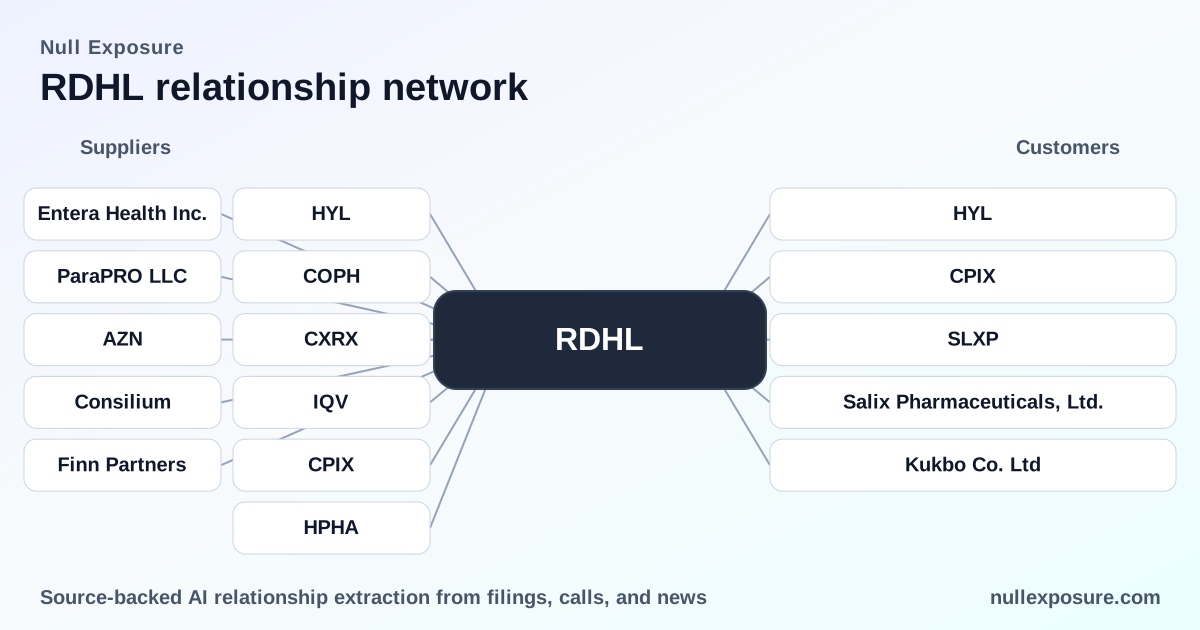
Below are plain-English summaries for every counterparty identified in available reporting, with source context for each claim.
-
Humana
Humana added Talicia to its Medicare Part D formulary, expanding theoretical coverage by roughly eight million lives and materially improving reimbursement access for the U.S. market. This placement is cited in company releases and press coverage during the FY2026 reporting cycle (PR Newswire; BriefGlance, May 2026). Takeaway: improved formulary access materially supports Talicia demand. -
Hyloris Pharma / HYL / Hyloris Pharmaceuticals
RedHill licensed ex‑North American rights to RHB‑102 (Bekinda) to Hyloris under a deal that includes up to $60 million in potential milestone payments plus royalties, transferring worldwide (outside North America) development and commercialization responsibility to Hyloris. Multiple company press releases and external reports reference the Hyloris transaction across FY2025–FY2026 (PR Newswire; Finviz reporting in March 2026; BriefGlance, May 2026). Takeaway: licensing converts a development asset into contingent cash and shifts commercialization risk off RedHill’s balance sheet. -
Cumberland Pharmaceuticals / CPIX
RedHill entered a U.S. co‑commercialization partnership with Cumberland Pharmaceuticals for Talicia and captured a $4 million strategic investment tied to that arrangement; the parties also reference a joint vehicle (Talicia Holdings, Inc.) formed to coordinate U.S. commercialization. PR Newswire described the strategic investment and partnership (FY2026 disclosure), and Cumberland’s own Q4 2025 commentary confirms the joint commercial arrangements (Globe and Mail / earnings transcript, FY2026). Takeaway: Cumberland supplies U.S. commercial capacity and capital; execution here determines near‑term sales trajectory. -
Salix Pharmaceuticals, Ltd. / SLXP
Historical licensing activity shows RedHill licensed RHB‑106 (an encapsulated bowel preparation) to Salix Pharmaceuticals under earlier agreements; this relationship is documented in the company’s historical press materials and investor disclosures from the 2015–2017 timeframe (GlobeNewswire 2015; EMJ Reviews summary, 2017). Takeaway: legacy licensing demonstrates RedHill’s recurring strategy of monetizing non‑core assets through partners. -
Kukbo Co. Ltd
A New York Supreme Court ruling upheld a summary judgment against Kukbo for breach of subscription and exclusive license agreements, resulting in enforcement steps in favour of RedHill and a judgment-level recovery. The court outcome and subsequent enforcement activity are detailed in RedHill’s press releases in March 2026 (PR Newswire, March 2026). Takeaway: litigation recoveries are a non-commercial but material source of value capture in recent cycles.
What the relationship set reveals about operating posture and risk
There are no structured constraint excerpts supplied in the record that limit attribution of contractual terms to a specific partner; however, the counterparty evidence itself presents clear company-level operating signals:
- Contracting posture: RedHill uses licensing and co‑commercial deals to de-risk development and amplify reach — the company consistently monetizes ex‑North American rights and partners for U.S. scale rather than building a large in‑house global commercial infrastructure.
- Concentration: Commercial outcomes are concentrated — Talicia plus a few licensing milestones account for the bulk of observable near‑term commercial value, creating binary performance sensitivity.
- Criticality: Counterparties are operationally critical — Humana’s formulary decision and the Cumberland co‑commercial partnership materially change U.S. addressable patients and distribution execution.
- Maturity: The business remains in an early commercial stage with limited trailing revenue and negative operating margins; according to RedHill’s most recent reported quarter (latest quarter to 2025‑06‑30), revenue TTM was $286,000 and the firm’s operating margin remains negative, reinforcing reliance on partner funding and milestone monetization.
Investment implications and risk checklist
- Upside drivers: expanded Medicare Part D coverage for Talicia and active U.S. co‑commercial execution with Cumberland can deliver meaningful revenue lift without heavy incremental capex.
- Value capture mechanisms: ex‑U.S. licensing (Hyloris) and milestone payments provide non‑dilutive upside and reduce development cost.
- Key risks: revenue concentration on small product set, execution dependency on Cumberland for U.S. uptake, and legal/regulatory outcomes in legacy disputes. Litigation outcomes can create episodic cash injections but are not a sustainable revenue source.
Visit https://nullexposure.com/ for ongoing tracking of contractual events, press releases and counterparties that materially affect RDHL valuation.
Bottom line
RedHill’s commercial blueprint is deliberate: leverage partners to commercialize where scale is required, monetize non‑U.S. rights, and concentrate scarce capital on pipeline moments that unlock milestones. For diligence, focus on Talicia’s formulary and uptake metrics, Cumberland’s execution cadence, and milestone receipts from Hyloris — those three threads explain most of the company’s near‑term value trajectory.