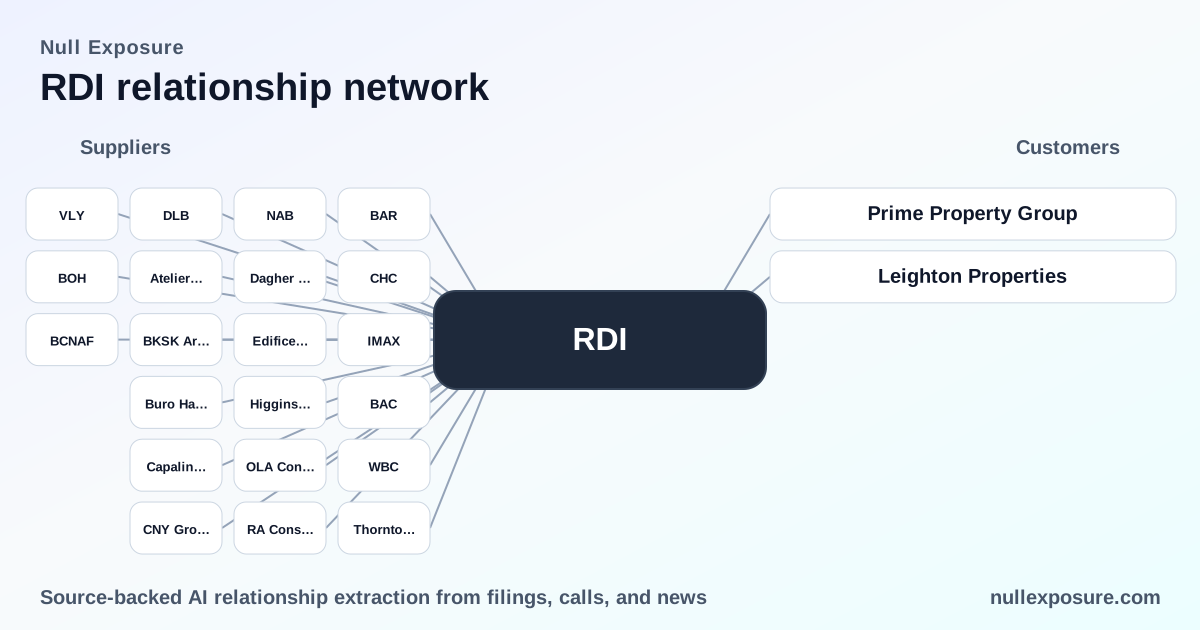
Reading International (RDI): Customer Relationships That Drive Cash Flow and Real Estate Value
Reading International operates and monetizes a dual business model: cinema exhibition and live-theatre licensing complemented by strategic real estate ownership, leasing and selective asset sales. The company generates cash from box office and concessions (the bulk of operating revenue), fixed and variable license fees from live theatre operations, subscription programs in Australia, and opportunistic property dispositions and long-term leases that convert real estate into recurring income or one‑time capital. For investors, the core question is how consumer-driven operating cash flow and real‑estate transactions balance to produce durable free cash flow and downside protection.
Explore more about our coverage at https://nullexposure.com/.
How to read the customer map: what relationships reveal about the model
Reading International’s customer relationships illustrate a company that runs a hospitality-style, consumer-facing business layered on a property portfolio. The relationships in the public record point to four structural characteristics:
- Contracting posture and maturity: The company executes long‑term leases and licensing arrangements, which create predictable operating relationships and platform-level revenue streams rather than spot transactions. Evidence in filings cites a long-term lease for its 10-screen cinema at Courtenay Central (Wellington).
- Revenue mix and counterparty concentration: The business remains consumer-centric, with box office receipts accounting for a majority of cinema revenue (cited as ~57% of 2024 cinema revenue), while licensing and ancillary services add institutional counterparties.
- Geographic diversification: Reading operates across North America and APAC (Australia and New Zealand), exposing investors to both developed-market attendance trends and property-market cyclicality in APAC.
- Role diversity and monetization levers: The company acts as operator, licensor, landlord/seller and service provider — generating fixed license fees, variable box office/concession share, subscription revenues (newer, recurring), and occasional capital gains from property sales.
Investment implication: long-term leases and licensing provide stability, while consumer-dependence and real estate activity inject both upside (repositioning, sales) and concentration risk (local property markets and attendance cycles).
Relationship-by-relationship: what matters for investors
GXO — logistics partner mention in a UK diagnostics program
A GlobeNewswire release (March 30, 2026) describing GXO’s expanded NHS England partnership notes that GXO will manage FIT kit distribution “working with best-in-class partners, MAST, the world’s largest distributor of FITs and RDi, the UK’s leading end‑to‑end diagnostic kitting partner.” This reference names an entity called “RDi” as a logistics/kit partner in the GXO arrangement; the release frames the entity as a specialist in diagnostic kitting for the NHS rollout. (GlobeNewswire, March 30, 2026)
Prime Property Group — Wellington property sale
Reading disclosed that on January 31, 2025 it sold all properties in Wellington, New Zealand (including the Courtenay Central building) to Prime for NZ$38.0 million, demonstrating a deliberate use of asset sales to recycle capital and de‑risk regional property exposure. The company reported this in its Q1 2025 results announcement. (Reading International, Q1 2025 results release, May 16, 2025)
Amazon — production partner driving theater-level cash flow
In an earnings call transcript covering Q3 2025, Reading attributed a large portion of the attendance and theater-level cash flow increase at Minetta Lane Theater to shows produced by Audible and the Amazon company and their licensee; the Audible/Amazon content materially lifted attendance and cash flow for that venue. This underscores the value of content partnerships that drive box office and ancillary spend. (Earnings call transcript, Q3 2025)
Audible — live-theatre license extension at Minetta Lane
The same Q3 2025 earnings-call transcript reports that Audible exercised its option to extend its license at Minetta Lane through March 2027, reflecting a multi-year licensing relationship that delivers fixed license fees plus variable upside tied to production success. This contract-level extension supports theater cash flow stability and calendar visibility. (Earnings call transcript, Q3 2025)
Leighton Properties — historic land sale in Australia
A RealEstateSource article recounts that Reading sold a 1.34 hectare block north‑west of the city to Leighton Properties for $23 million (transaction reported in 2019), illustrating the company’s historical use of land dispositions to monetize non-core parcels. The example shows how Reading selectively harvests property value when market conditions suit. (RealEstateSource, transaction report, 2019)
Constraints and operating signals that affect customer risk and value
The public excerpts provide company-level signals that shape counterparty risk and revenue durability:
- Long-term contracting posture: Filings reference a long-term lease to redevelop and operate a 10-screen cinema at Courtenay Central, indicating a tilt toward durable property-backed operating commitments rather than short-term site exposure. This increases revenue visibility but ties firm performance to local property redevelopment cycles.
- Subscription adoption: Reading launched a paid subscription program in Australia in Q4 2024, introducing recurring-retention mechanics to counter cyclic attendance volatility and increase lifetime value per patron.
- Consumer-first counterparty mix: The company explicitly prioritizes the guest experience and notes that a majority of cinema revenue is box office driven; this makes Reading sensitive to consumer demand and content-driven attendance.
- Geographic diversification: Operations span North America, Australia and New Zealand — a diversification hedge against single-market shocks, but it also introduces exposure to APAC property and regulatory dynamics.
- Multi-role business model: Reading functions as a buyer (consumer), licensor (theatre licensing), seller (asset dispositions), and service provider (box office/concessions services to licensees); this complexity supports multiple monetization levers but requires cross-disciplinary execution.
- Relationship stage and segment focus: Relationships are largely active and sit within the company’s services/entertainment segment, reinforcing that current cash flow is generated from ongoing operations rather than one-off monetizations.
What investors should watch next
- Attendance vs. subscription growth: Track Australian subscription adoption and whether it meaningfully shifts the mix away from one-time box office receipts (currently a majority of revenue).
- Real-estate recycling: Monitor property dispositions and leaseback activity as sources of capital and timing risk in APAC markets.
- Content partnerships: Evaluate the cadence and scale of institutional content partners (like Audible/Amazon) that can spike attendance at individual venues.
- Counterparty clarity: The public record contains references to similarly named partners in other sectors (for example, an entity styled “RDi” in UK diagnostics news). Confirming counterparties and their business lines is important for accurate exposure mapping.
Bottom line: Reading International combines consumer-driven cinema economics with a balance-sheet approach to real estate that both stabilizes and complicates investor returns. Long-term leases and licensing provide recurring revenue, while property sales and content partnerships create episodic upside — a profile that rewards active monitoring of attendance trends, subscription penetration, and asset recycling.
For deeper relationship mapping and continuous monitoring, visit https://nullexposure.com/ to see how we track counterparties and contractual signals across portfolios.