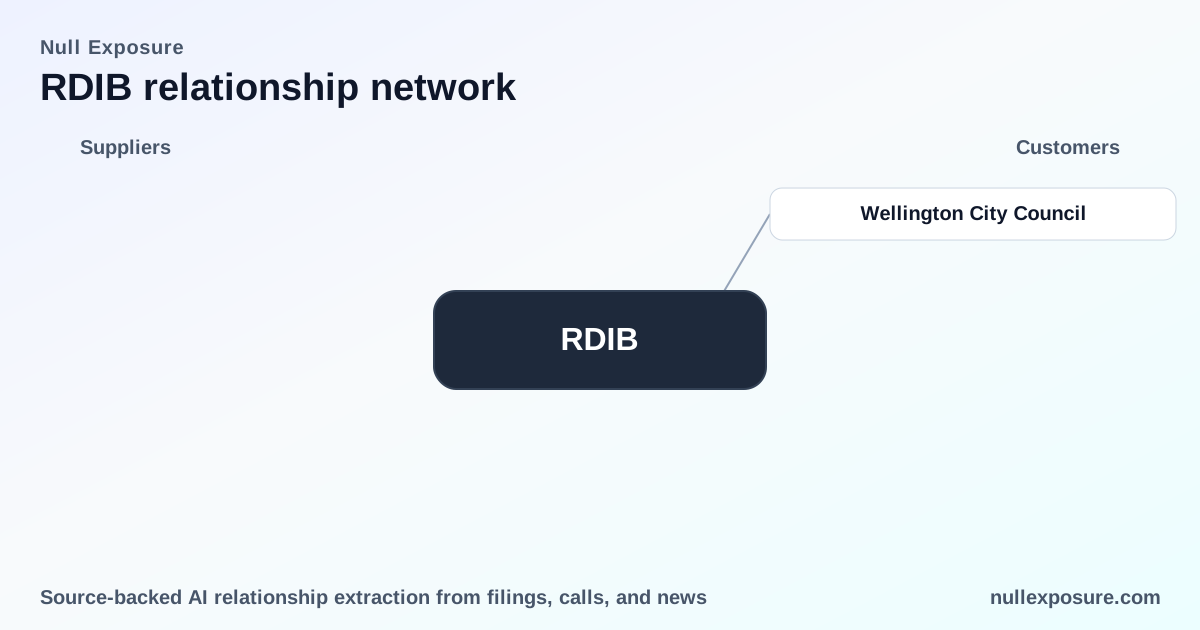
Reading International (RDIB): Customer relationships under the microscope
Reading International operates and monetizes a portfolio of cinema and real-estate assets across the United States, Australia and New Zealand through a mix of property rentals, long-term leases, licensing of live theatres, and ancillary revenue from concessions and box office services. The company generates recurring cash flow from tenant leases and license fees while retaining upside in real-estate value and ancillary services; that hybrid operating model places the firm between a landlord and an entertainment operator. For investors tracking counterparty exposure and municipal risk in its New Zealand footprint, the interaction with Wellington City Council is the highest-profile customer-related event in the public record this cycle. Learn more about how we surface and interpret these customer signals at https://nullexposure.com/.
How Reading makes money — a concise investor view
Reading runs a two-pronged revenue engine. First, it leases and operates cinema and retail properties, recognizing rental revenue on a straight-line basis for leases where it retains ownership risk; second, it acts as a licensor and service provider for live theatres, collecting fixed license fees plus variable income for box office and concessions while licensees assume production risk. This structural split creates a mix of stable, lease-like cash flows and earnings that are sensitive to theatre attendance and local government decisions that affect site access and redevelopment. Company filings show Reading’s most recent trailing revenue around $203 million with operating margins compressed but positive gross profit, which underscores why counterparty stability and lease tenure matter for credit and valuation analysis.
Quick financial context: Market capitalization roughly $215 million, trailing revenue $202.99M, diluted EPS negative at -$0.63, and substantial insider ownership reported — all signals that operational alignment and counterparty outcomes materially influence shareholder value.
Operational posture and business-model constraints investors should factor
Reading’s public disclosures and management commentary establish several company-level operating signals that shape customer risk:
- Long-term contracting posture: Reading discloses long-term leases (for example, a January 27, 2022 long-term lease with a national tenant for multiple floors), indicating a tilt toward durable landlord-style cash flows rather than short-term turnover.
- Geographic diversification with APAC importance: The business is explicitly diversified across the United States, Australia and New Zealand, making municipal and regional policy decisions in APAC jurisdictions material to localized revenue and reopening outcomes.
- Dual role: licensor and service provider: For live theatres the company functions as a licensor, generating fixed licensing fees plus variable service revenues; for property rentals it retains ownership economics and accounts for tenant leases as operating leases, creating a landlord-service hybrid profile.
- Segment orientation toward services and real estate: The core business lines are cinema operations, live theatre licensing and the development/rental of retail/commercial real estate — a mix that combines steady rental cash flows with attendance-dependent service revenue.
These constraints imply a contracting profile that favors long-tenor counterparty agreements, moderate concentration risk at the venue level, and operational exposure to municipal decisions and real-estate markets in APAC and North America.
The Wellington City Council relationship — what happened and why it matters
Wellington City Council — a municipal counterparty in New Zealand — was in negotiations to acquire the land under Reading’s Courtenay Place cinema site as part of an effort to reopen and sustain the theatre operation. A March 10, 2026 report in the New Zealand Herald notes the council ended negotiations after evaluating a $32 million valuation for the land purchase, removing an anticipated municipal solution to reopen Reading Cinemas in Courtenay Place (NZ Herald, March 10, 2026: https://www.nzherald.co.nz/nz/wellington-city-council-ends-negotiations-to-reopen-reading-cinemas-in-courtenay-place/SWUXOWZ2DVAPDIO6QUDXNBZU74/). This outcome directly affects Reading’s NZ operations because municipal acquisition and facilitation had been the most visible pathway to restoring the site’s commercial viability.
- The council’s withdrawal reduces the near-term probability of a municipally enabled reopening and leaves Reading exposed to either private redevelopment timelines or continued closure, with direct revenue and community-value consequences (NZ Herald, March 2026).
What each relationship signal implies for investors
The Wellington City Council interaction is the only customer-level relationship surfaced in the public results set. Treat it as a case study in how municipal counterparties interact with Reading’s hybrid model:
- Criticality: Municipal decisions can be decisive for site-level operating outcomes — a council buyout would have been a structural solution to reopen a theatre; the failed negotiations materially increase execution risk for that location.
- Concentration and local dependency: Individual site closures or redevelopment delays have disproportionate impact on localized revenue and ancillary income, given the company’s venue-level economics (concessions, box office and license fees).
- Contract profile relevance: The company’s stated preference for long-term leases and licensing contracts reduces churn risk on intact sites but does not insulate Reading from municipal-level changes that can curtail operations or trigger redevelopment.
Investment implications and recommended analytic focus for operators and analysts
For investors and corporate operators evaluating RDIB customer relationships, prioritize the following actions:
- Assess municipal exposure across the APAC portfolio. The Wellington example demonstrates how local government decisions can flip the economics of a site; map other sites with similar municipal interfaces and quantify revenue at risk.
- Model lease-versus-license mix at the venue level. Different contract roles (landlord for retail tenants, licensor for live theatres) mean different cash-flow stability and recovery profiles after disruptions.
- Monitor insider ownership and governance impacts. High reported insider ownership concentrates control and can accelerate strategic responses but also concentrates execution risk if operational challenges persist.
- Stress-test reopening scenarios. Scenario analysis should include the timing and probability of municipal interventions, private sale timelines, and the impact of extended closures on ancillary concessions and license revenues.
Key takeaway: The Wellington City Council negotiation illustrates that while Reading’s long-term leases provide base cash flows, municipal counterparty decisions in APAC can be the decisive variable for site reactivation and localized earnings recovery.
If you want a structured, subscription-grade brief on RDIB counterparty exposure and event-driven scenarios, start here: https://nullexposure.com/. For a deeper, bespoke analysis of venue-level municipal risk across Reading’s APAC portfolio, request a tailored report through our site.
Final read — risk vs. optionality
Reading’s hybrid landlord/operator model creates both resilient recurring income and event-driven upside tied to site-level reopenings and redevelopments. The Wellington City Council episode is a clear reminder that municipal counterparties can swiftly change the investment calculus for individual assets, and investors should treat local government negotiations as first-order risks when valuing RDIB’s APAC operations.