Radian Group (RDN): Customer relationships, operating posture, and what investors should know
Radian is a mortgage insurance and real estate services holding company that monetizes by underwriting private mortgage insurance (PMI), providing underwriting and credit-risk services to mortgage originators and investors, and originating/servicing mortgage assets through approved seller/servicer programs. The business generates recurring premium streams and fee income while relying on capital adequacy to retain access to the Government-Sponsored Enterprises (GSEs) and to return excess capital to shareholders. For a concise vendor and counterparty view, visit https://nullexposure.com/.
Market-facing summary Radian’s economics are driven by underwriting margin, investment income on insurance float, and recurring premium and servicing fees. The company operates with framework-style master policies and recurring premium contracts, sells principally to mortgage lenders and retail borrowers in the U.S., and preserves strategic optionality by maintaining eligibility with Fannie Mae and Freddie Mac.
Why those relationships matter Radian’s counterparty map is a mix of large institutional counterparties (the GSEs and mortgage originators) and dispersed retail exposure. That combination produces predictable premium revenue but requires disciplined capital and regulatory compliance; access to the GSEs is strategic for distribution and capacity. Below I walk through each relationship documented in the source material and then synthesize company-level operating constraints and investment implications.
Who Radian does business with — the documented counterparties
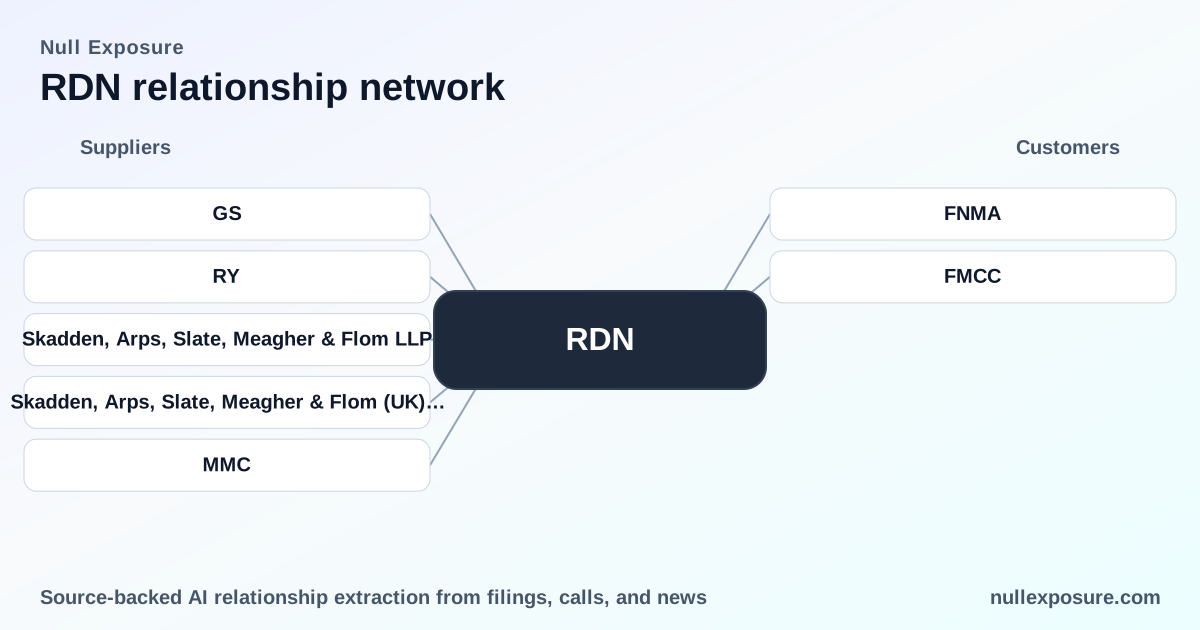
Fannie Mae (FNMA)
Radian operates with capital ratios above required minima and has structured returns of capital while keeping eligibility with Fannie Mae intact. According to an Ad-Hoc News summary from March 10, 2026, Radian’s capital position has allowed it to return excess capital and remain eligible with Fannie Mae. (Ad-Hoc News, March 10, 2026)
Freddie Mac (FMCC)
The same reporting notes that Radian’s capital posture also preserves eligibility with Freddie Mac, a key distribution and counterparty relationship for mortgage insurers. Maintaining GSE eligibility supports Radian’s ability to write and price insurance tied to conforming mortgage volumes. (Ad-Hoc News, March 10, 2026)
Axonics (AXNX)
A March 9, 2026 MassDevice article reported that Axonics acquired lead-placement technology from a company named Radian to speed placement of implantable leads. This reference uses the brand name “Radian” in a non-financial product context and indicates product licensing or IP transfer outside the core mortgage business. (MassDevice, March 9, 2026)
SWBI (Smith & Wesson Brands or equivalent) — product mention
A product release on March 10, 2026 referenced a “Radian® Raptor™ charging handle,” indicating a commercial product line that shares the Radian name in the outdoor/firearm accessory space; this is a product mention rather than a core mortgage-insurance customer relationship. (TheOutdoorWire, March 10, 2026)
Note on name collisions: some press mentions point to companies or products that use the “Radian” brand outside of Radian Group’s mortgage-insurance business; investor analysis should distinguish brand mentions from confirmed counterparty contracts with Radian Group Inc. For portfolio diligence and counterparty verification, see https://nullexposure.com/.
Operating model and contracting posture — what the constraints tell investors
The company-level signals derived from public excerpts and filings reveal the following operational characteristics:
-
Recurring, long-term revenue model. Premiums for mortgage insurance are written on a recurring basis — monthly or annual — and can also be issued as single, multi-year premiums. This creates predictable premium revenue and supports valuation multiple stability relative to one-off businesses. (Company filings and policy descriptions)
-
Subscription-style cash flow with framework master policies. The core relationship is governed by Master Policies with customers (lenders and investors), producing a framework contract posture that standardizes coverage terms and pricing across portfolios rather than bespoke, transaction-by-transaction contracts.
-
Counterparty mix includes individuals and institutions. Radian sells services directly to mortgage originators, mortgage investors, GSEs and, where relevant, consumers. The firm therefore runs both institutional distribution and retail-exposed underwriting channels, increasing diversification across counterparty types.
-
U.S.-centric geography and scale. Radian is authorized to write mortgage guaranty insurance in all 50 states, D.C., and Guam, and the Mortgage Insurance segment explicitly aggregates and distributes U.S. mortgage credit risk — a clear North American focus that reduces geographic political risk but concentrates exposure to U.S. housing market cycles.
-
Low customer concentration. Filings indicate no single customer exceeded 10% of consolidated revenue (excluding certain investment gains) or of newly insured written (NIW) across 2022–2024, signaling immaterial customer concentration and a broad, diversified premium base.
-
Dual role as seller and service provider. Radian functions as a mortgage-insurance seller (providing credit protection) and as a service provider offering underwriting, contract underwriting and risk-management solutions; the holding company also allocates certain corporate-level services to subsidiaries, reflecting integrated operating control.
-
Maturity and active operations. Evidence of timely reimbursement between subsidiaries and the parent suggests active intercompany activity consistent with a mature holding-company structure with centralized cost allocations.
-
Spend signals consistent with material corporate operations. Allocated expenses and interest expense line items in public excerpts indicate sizable allocated costs in corporate reporting, consistent with a large-scale insurer and capital market operator.
What this means for investors — distilled implications
-
Capital adequacy is the central performance lever. Eligibility with Fannie Mae and Freddie Mac is both a commercial and regulatory constraint; Radian’s ability to return capital while staying eligible is a structural advantage that supports shareholder returns but requires continuous capital discipline. (Ad-Hoc News, March 10, 2026)
-
Revenue durability with underwriting cyclicality. The recurring premium model and master-policy framework create durable top-line cash flows, while underwriting gain/loss and reserve dynamics drive earnings volatility across housing cycles.
-
Low counterparty concentration reduces single-client risk. With no customer >10% of revenue historically, the business is not dependent on a handful of counterparties — a favorable sign for credit and revenue stability.
-
Brand-name noise requires careful counterparty validation. Press references to products using the “Radian” name (Axonics technology purchase; Radian® Raptor™ charging handle) are not, on their face, proof of material commercial relationships with Radian Group Inc.’s mortgage business — analysts must validate whether such mentions reflect the corporate group or unrelated brand owners. (MassDevice, March 9, 2026; TheOutdoorWire, March 10, 2026)
-
Investor vigilance on capital allocation and regulatory access. Given the business model, investor returns are tied to prudent capital deployment and maintaining GSE access; track capital ratios, regulatory filings, and GSE eligibility notices for updates.
If you want a structured counterparty mapping or a deeper diligence brief on Radian’s GSE contracts and master-policy terms, start with the company’s filings and our counterparty tools at https://nullexposure.com/.
Bottom line Radian is a capital-intensive, recurring-revenue enabler for the U.S. mortgage market. Its value hinges on underwriting discipline, capital adequacy, and preserved access to the GSE distribution ecosystem. Press mentions sharing the “Radian” name should be treated as informational until validated against corporate disclosures and counterparty agreements.