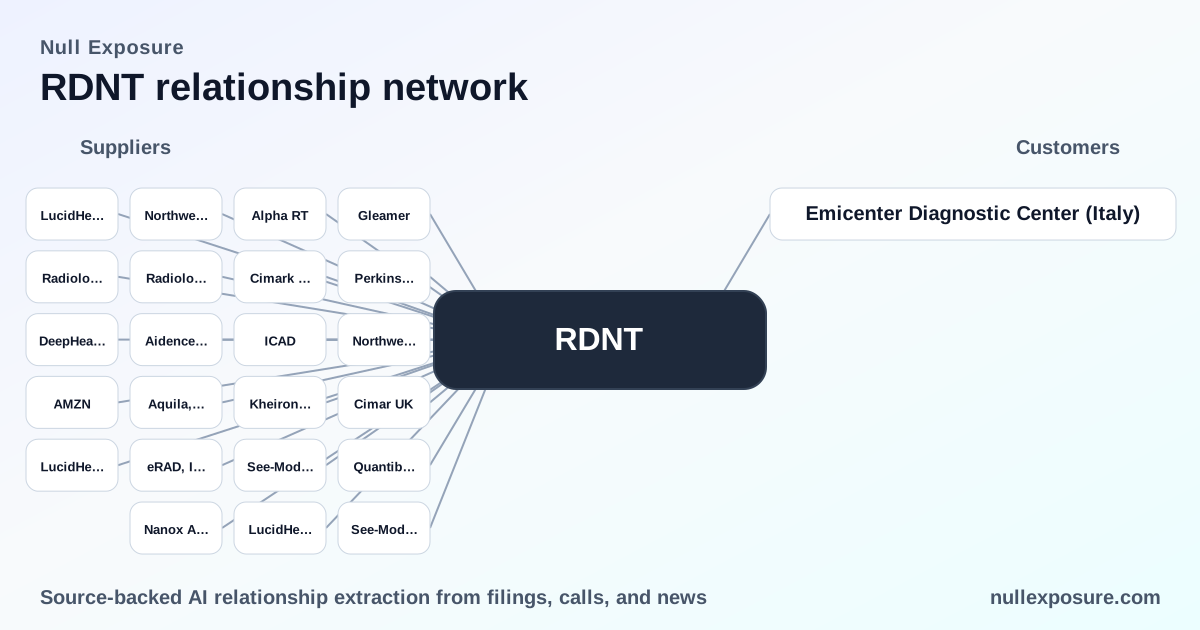
RadNet (RDNT): Customer relationships that turn imaging scale into recurring software revenue
RadNet operates as a national outpatient imaging services operator while growing a digital health software franchise that it sells to health systems and OEM partners. The company monetizes through fee-for-service imaging at its roughly 398 centers and through licensing, deployment and joint-venture arrangements for its eRad RIS/PACS and DeepHealth cloud-native platform—creating a dual revenue stream of high-volume service cash flows and higher-margin, scalable software sales (Revenue TTM: $2.04B). For investors, the thesis is straightforward: leverage fixed costs and clinical scale to fund a platform roll‑out that converts customers into recurring software revenue and strategic joint ventures. For more context on deal flow and relationship signals, see https://nullexposure.com/.
Why these customer ties matter to returns
RadNet’s relationships are not merely customer lists; they map to commercial channels, clinical scale and distribution physics:
- Contracting posture: RadNet’s service business operates with a high proportion of short-term payor contracts, which drives both pricing flexibility and revenue volatility. This is a company-level signal from RadNet’s disclosures stating many third‑party payor contracts are short‑term in nature.
- Revenue mix and counterparty concentration: Government payors account for a meaningful share of imaging revenue (about 22% Medicare, 2% Medicaid in 2024), creating predictable baseline volumes but exposure to reimbursement policy. RadNet discloses this in its filings.
- Platform reach and geography: The digital health segment already services over 400 customers across the U.S., Europe and Israel, signaling international distribution for DeepHealth beyond RadNet’s North American imaging footprint.
- Business model split: The firm runs a services-first operating model with an embedded software arm (eRad/DeepHealth); service revenue drives cash and software drives margin expansion and long-term customer lock-in.
These constraints—short-term service contracts, a sizable government payor base, and an expanding global software footprint—should frame valuations and model scenarios for both cyclical downside and secular upside.
The customer relationships you need to know about
Trinity Health’s Saint Alphonsus Health System — a JV that scales DeepHealth
RadNet launched a multi-site joint venture with Trinity Health’s Saint Alphonsus to operate outpatient imaging in Boise, Idaho, and the agreement includes a broad deployment of DeepHealth solutions across the JV sites. According to a GlobeNewswire release in April 2026, the JV explicitly packages operational services with DeepHealth’s Diagnostics Suite to centralize reporting and interpretation. (Source: GlobeNewswire, April 30, 2026)
Saint Alphonsus Health System — DeepHealth Diagnostics Suite installed
Saint Alphonsus will receive radiology interpretation and reporting from Gem State Radiology using DeepHealth’s cloud-first Diagnostics Suite, which RadNet highlights as a clinical imaging management and viewing platform to speed interpretation workflows. This deployment was described in the same April 2026 GlobeNewswire announcement detailing the Boise JV. (Source: GlobeNewswire, April 30, 2026)
Gem State Radiology — local practice partner for interpretation and DeepHealth workflows
Gem State Radiology, a 30-radiologist practice, will deliver radiology interpretation and reporting to Saint Alphonsus and will utilize DeepHealth solutions for reporting and interpretations, positioning the practice as the clinical engine for the JV while using RadNet’s software to scale operations. This arrangement was reported in a Radiology Business piece on RadNet’s transaction activity in 2026. (Source: Radiology Business, M&A coverage, 2026)
GE HealthCare — OEM integration expands distribution for RadNet’s AI
GE HealthCare and RadNet extended a partnership that began in 2024, integrating RadNet’s AI-powered breast cancer screening into GEHC mammography systems to improve interpretations and workflow efficiency; this OEM channel directly expands commercial distribution of RadNet’s algorithms and demonstrates enterprise-level interoperability. Radiology Business covered this partnership in 2026 as part of GEHC’s broader market messaging. (Source: Radiology Business, AI/mammography coverage, 2026)
Emicenter Diagnostic Center (Italy) — an international DeepHealth reference
European adoption is evidenced by Emicenter Diagnostic Center in Italy, whose medical leadership publicly stated that DeepHealth's unified platform has fundamentally changed how they serve patients, indicating international clinical validation for RadNet’s software offerings. This customer quote ran in FinViz’s coverage of DeepHealth’s ECR 2026 presentation. (Source: FinViz summary of ECR 2026, March 2026)
What the relationships imply about RadNet’s operating model
- Concentration and criticality: The JV with Trinity/Saint Alphonsus and the Gem State Radiology arrangement show RadNet is converting local hospital relationships into operational control plus software installs, increasing criticality of DeepHealth inside partner workflows without transferring full clinical risk. These are company-level signals driven by RadNet’s strategy to pair services with software.
- Maturity and commercial cadence: DeepHealth’s presence in more than 400 customers across the U.S. and Europe indicates commercial scale for the software segment, yet the core imaging service business remains the primary cash engine. RadNet’s disclosures present this as a deliberate, staged approach.
- Contract profile: Short-term payor contracts in the imaging business create negotiating leverage but also revenue variability; software and JV income provide longer-duration economic benefits that temper cyclicality. RadNet’s filings explicitly note the short-term nature of many third‑party contracts and describe managed‑care capitated and per‑member models in its relationships with large medical groups and IPAs.
Investment implications and risks investors should watch
- Upside: OEM deals (GE HealthCare) and JVs with health systems provide channels for accelerated software adoption and potential margin expansion as software revenue scales. DeepHealth adoption inside operational JVs is an engine for recurring, higher-margin revenue.
- Downside: Imaging revenue retains exposure to payor reimbursement dynamics and short-term contracts, and the company still derives material revenue from government payors (22% Medicare, 2% Medicaid in 2024), which caps pricing power.
- Execution risks: Successful conversion from software installations to sustained SaaS-like revenue hinges on clinical outcomes, interoperability, and hospital procurement cycles—factors that require continued sales discipline and product maturity.
- Geographic diversification: European references (Emicenter) show traction overseas, reducing single‑market risk for the digital segment, but international scaling brings regulatory and service delivery complexity.
For an investor evaluating RDNT, the thesis is that service cash flows fund a growing, increasingly sticky software platform, but valuation should price both cyclical exposure in imaging and the optionality of platform monetization. For deeper signals on customer relationships and deal flow—visit https://nullexposure.com/ for curated relationship intelligence and timeline context.