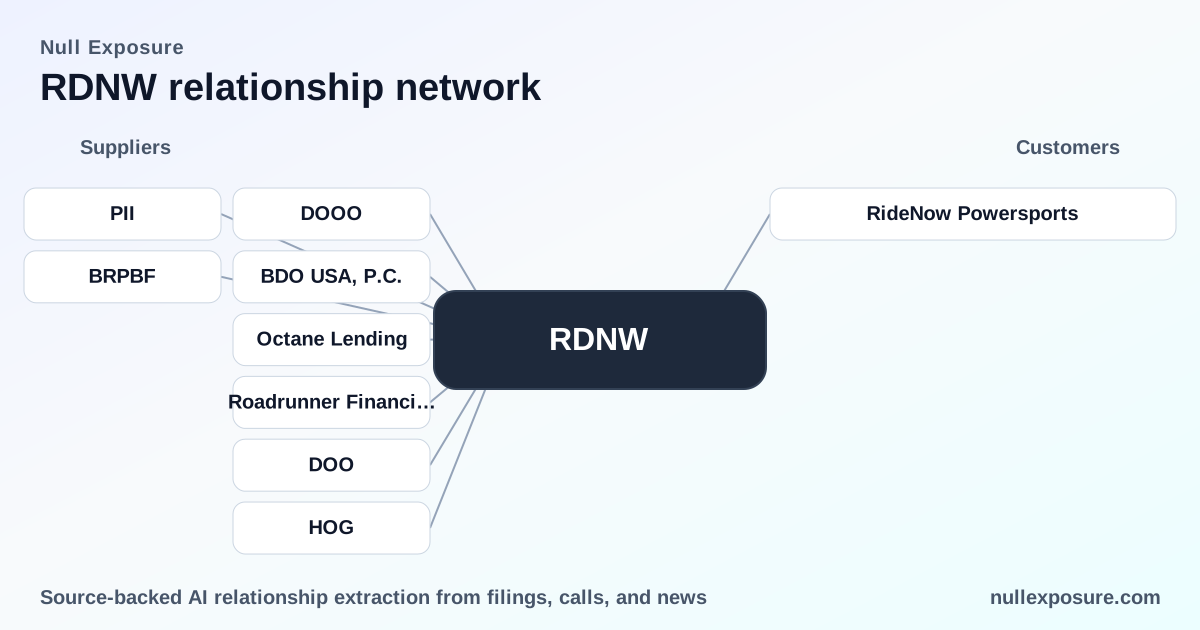
RideNow Group (RDNW): Customer relationships and what they reveal about the business
RideNow Group operates and monetizes through a dual retail-services model: it sells new and pre-owned powersports vehicles through a network of dealerships and captures incremental revenue from finance & insurance, parts and service, accessories, and an asset-light vehicle transportation brokerage. Revenue is primarily transactional and retail-driven, with vehicle sales constituting the core profit engine and transportation services operating as a services adjacencies business. According to the company’s latest reporting through the quarter ending 2025-12-31, RideNow delivers roughly $1.0825 billion in trailing revenue with $41.7 million of EBITDA, underscoring a high-topline, thin-margin retail profile.
For a compact view of relationship exposure and the practical implications for investors and operators, see the full coverage at NullExposure.
Why customer relationships matter for RideNow: a one-sentence thesis
Customer contracts and sourcing strategies determine inventory cost, sales cadence and service throughput; in short, the company’s credit profile and margin stability track directly to the transactional nature and geographic breadth of these customer relationships.
The core commercial model in plain terms
RideNow sells vehicles to individual consumers and to wholesale/retail dealers, sources pre-owned inventory from consumers through a proprietary cash-offer technology, and moves vehicles nationwide via its Express brokerage. That combination creates a business where point-in-time sales dominate revenue recognition, and logistics/services provide recurring, lower-margin streams. Company filings through FY2025 confirm this split between retail vehicle sales (core product) and transportation/aftermarket services.
What the relationships in the public record say
Below I cover every customer relationship disclosed in the scraped results and cite the original source.
RideNow Powersports — expansion of the cash-offer program
RideNow Powersports will have RumbleOn’s rebranded pre-owned cash-offer system expanded into its store footprint, covering 54 RideNow Powersports dealerships as part of the program rollout. This is a commercial partnership that strengthens RideNow’s direct-to-consumer sourcing channel for pre-owned inventory. Source: PowersportsBusiness report, March 14, 2024 (news article covering the RumbleOn program rebrand and expansion into RideNow Powersports locations).
How these relationships map to RideNow’s operating constraints and business characteristics
The public evidence and filing excerpts generate clear, company-level signals about how RideNow runs its operations and what investors should watch.
-
Contracting posture — short-term and spot: Contracts with end customers are transactional; payments for services are due on completion and vehicle sales transfer control at delivery, indicating a predominance of short-term, point-in-time revenue recognition and low contractual revenue tenure. This structure yields fast cash conversion on retail sales but limited forward visibility for revenue beyond promotional cycles. Evidence is drawn from company disclosures about payment timing and transfer of control.
-
Counterparty profile — individuals and dealers: RideNow sources pre-owned inventory directly from consumers via its cash-offer technology and transports vehicles for dealers and private parties. The counterparty mix is therefore split between retail consumers (high volume, low concentration) and dealer/distributor customers for transportation services (b2b, transactional).
-
Geographic reach — national footprint, regional concentration risk exists: The company operates 56 dealerships across 13 states and provides nationwide transportation brokerage. That scale creates diversified market access but leaves room for regional demand swings to influence performance in a retail-heavy model.
-
Relationship role and revenue criticality — seller first, services are complementary: The firm’s core is selling powersports vehicles; service and transportation are meaningful adjuncts. Vehicle sales are mission-critical to revenue and margin outcomes, while Express transportation works as an asset-light, lower-margin business that supports inventory flow and lease/resale timing.
-
Relationship maturity and stage — active transactional flows: The firm’s customer relationships are active and ongoing but mostly transactional rather than contractual-subscription in nature; this reduces locking power but preserves inventory turnover and flexibility.
These constraints combine into a business that is resilient when consumer demand and used-vehicle pricing are healthy, and vulnerable to rapid shifts in retail demand and wholesale pricing for pre-owned inventory.
Investment implications and risk checklist
- Revenue visibility is limited: Because the model is dominated by spot, point-in-time sales, quarter-to-quarter results will reflect inventory availability, consumer demand and promotional cadence more than long-term contracted revenue streams.
- Inventory sourcing is a strategic lever: The expansion of a cash-offer program into RideNow Powersports strengthens pre-owned procurement and can reduce acquisition costs for retail-ready inventory, improving margins if resale pricing holds.
- Logistics as earnings stabilizer: Express transportation is an asset-light service that can dampen volatility but will not offset sharp declines in retail vehicle sales.
- Concentration and seasonality risk: A national footprint spreads market risk but seasonal demand and regional economic cycles still drive performance variability.
- Operational leverage: Fixed costs tied to retail locations and parts/service operations create leverage — good for upside in demand cycles, painful in downturns.
What operators should prioritize
- Tighten inventory sourcing economics by leveraging cash-offer channels to reduce days-to-ready and acquisition cost.
- Improve service revenue capture post-sale, where higher margin F&I and maintenance can smooth top-line volatility.
- Optimize the Express brokerage routing to preserve margins while supporting inventory replenishment.
If you want a broader mapping of RideNow’s customer exposure and contract characteristics, visit NullExposure for the full relationship view and supporting filings.
Bottom line
RideNow’s customer relationships paint the picture of a transactional retail operator with an asset-light services arm that supports but does not substitute for vehicle sales. Expansion of consumer-facing inventory sourcing tools—like the cash-offer program deployed across RideNow Powersports locations—improves control over procurement and can be a meaningful margin lever. Investors should underwrite the stock with an understanding that top-line performance is closely tied to retail demand cycles and used-vehicle pricing dynamics, while operational improvements in sourcing and service mix present the clearest path to better margin stability.
Relationship cited: RideNow Powersports expansion of cash-offer program — PowersportsBusiness, March 14, 2024.