RDVT: Forewarn’s channel push into REALTOR® associations and what it signals for revenue durability
Red Violet (RDVT) monetizes identity intelligence primarily through licensing and subscription arrangements centered on its FOREWARN and CORE products, selling to professional associations, MLS organizations and public-sector customers in the United States. The company combines annual auto‑renewing pricing contracts with usage‑based fees, creating a blended revenue stream that emphasizes predictability while preserving upside from higher utilization. Investors should view recent agreements with multiple regional REALTOR® groups as low‑risk, volume‑driven adoption that reinforces recurring licensing revenue and expands Forewarn’s addressable base among field agents.
If you want a concise, sortable view of these customer announcements, visit https://nullexposure.com/ for our investor briefs.
Why these REALTOR® partnerships matter for the growth story
Red Violet’s go‑to‑market in the real‑estate channel is strategic: signing MLS and association partners gives Forewarn a distribution multiplier—one contract turns into thousands of engaged end users. These relationships are not large single customers in revenue terms (no individual customer exceeded 10% of sales in recent years), but they are highly scalable and sticky because the product is positioned as an agent safety and identity‑verification utility that is rarely a one‑time purchase.
The customer relationships in plain English
Las Vegas REALTORS® (LVR)
Las Vegas REALTORS® will offer FOREWARN services to its 16,000+ members, making Forewarn the identity‑verification provider for a major regional association and increasing the company’s reach in a high‑volume market. This was announced in a GlobeNewswire press release on March 26, 2026.
Greater Tulsa Association of REALTORS® (GTAR)
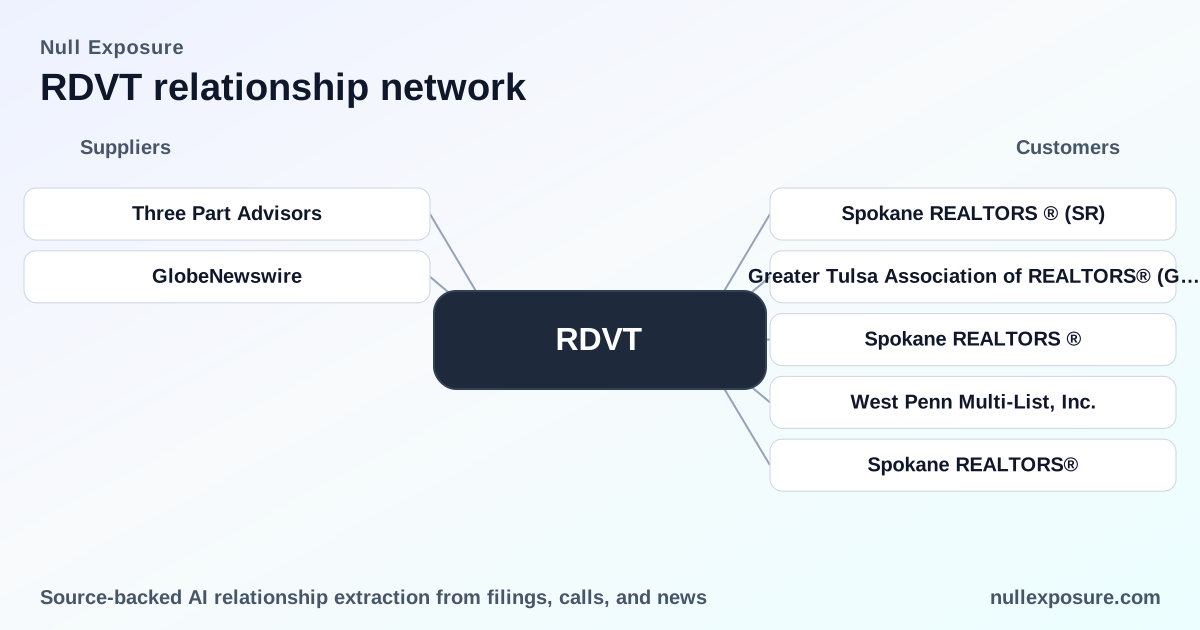
Greater Tulsa Association of REALTORS® agreed to provide FOREWARN services to its ~5,000 members, extending Forewarn’s footprint into the Tulsa metro and anchoring regional adoption among local agents. The announcement was reported by Sahm Capital on March 4, 2026.
Spokane REALTORS® (SR)
Spokane REALTORS® selected FOREWARN to provide identity verification for roughly 2,400 agents in the Spokane area, a smaller but strategically meaningful regional adoption that enhances network effects in the Pacific Northwest. GlobeNewswire published this release on January 15, 2026.
West Penn Multi‑List, Inc. (WPMLS)
West Penn Multi‑List will offer FOREWARN to its ~8,000 members across Pittsburgh and western Pennsylvania, a deal that broadens Forewarn’s coverage among mid‑Atlantic MLS participants. GlobeNewswire reported this on February 13, 2026 (also carried by Sahm Capital).
Buffalo Niagara Association of REALTORS
The Buffalo Niagara Association of REALTORS engaged FOREWARN to promote agent safety, adding another regional association to Forewarn’s roster and increasing penetration in upstate New York markets. This was included in Red Violet’s March 26, 2026 communications distributed through GlobeNewswire.
(Each of the above announcements is tied to FY2026 activity and appeared in company press releases or syndicated investor news in early 2026.)
The operating model realities investors should incorporate
Red Violet’s customer posture and contract profile create predictable, recurring economics with measured growth levers:
- Contracting posture — Annual, auto‑renewing licensing: According to company filings for the years ended December 31, 2024 and 2023, 77% and 79% of revenue, respectively, came from customers on pricing contracts that are generally annual or longer and auto‑renew. That structure pushes revenue toward renewal‑driven retention rather than one‑off sales.
- Pricing and revenue mix — Licensing + subscription + usage: The company states it generates substantially all revenue from licensing, with recognition either ratably over contract periods for monthly fees or on a transactional, usage basis when applicable. This hybrid model combines base subscription income with incremental usage fees that scale with agent activity.
- Customer concentration — Broad, not concentrated: Red Violet reported that no single customer represented more than 10% of revenue in recent years, making these regional association deals additive rather than dependent on a handful of large corporates.
- Geography and end markets — U.S.-centric, industry focused: Revenue is concentrated in the United States across industries, and the company deliberately targets real‑estate associations and multiple listing services as high‑leverage channels.
- Role and product maturity — Licensor with enterprise software pedigree: The firm positions its CORE platform and FOREWARN service as AI/ML‑driven identity intelligence offered under licensing arrangements—indicating a mature software licensing posture rather than a services‑heavy model.
- Counterparty mix — Public and private sector reach: While the recent press focus is on REALTOR® and MLS customers, the company’s product set serves both public and private institutions, reflecting a cross‑sector target list for growth.
These characteristics produce predictable renewal economics with expansion potential through additional association signings and increased usage by agents.
What this means for revenue durability and risk
The combination of annual auto‑renew contracts, licensing revenue dominance and low customer concentration implies a revenue base that is stable and resistant to single‑client shocks. At the same time, growth is incremental—market expansion comes from adding associations (each delivering thousands of potential users) and converting free or low‑usage accounts into paid, higher‑usage tiers. The main risks are concentrated in U.S. market dynamics and competition for agent‑facing tools, but the contractual model and recent push into REALTOR® associations mitigate churn risk and accelerate user adoption.
If you’d like a concise investor pack that maps each announced association to projected agent adoption curves, see https://nullexposure.com/.
Bottom line for investors
Red Violet is executing a distribution‑led expansion through FOREWARN: small, additive contracts with associations that convert into recurring license revenue and usage upside. The company’s contract structure and U.S. focus deliver predictable cashflows, while continued association signings expand the TAM in a measurable way. For investors, the thesis is straightforward: durable recurring revenue today, measurable adoption runway tomorrow—with the caveat that growth requires steady execution in channel sales and product positioning.