Redwire (RDW): Customer Map and What FY2026 Wins Mean for Investors
Redwire monetizes high-reliability space infrastructure by selling hardware and services—optical sensors, solar arrays, avionics, and robotics—to government agencies and large prime contractors under long-duration contracts and purchase orders. Revenue converts from a sizeable contracted backlog and follow‑on orders, while growth comes from cross‑selling new product platforms (ELSA solar arrays, Hammerhead spacecraft) into national security and commercial missions. For a concise intelligence brief on counterparties and contract exposure, visit https://nullexposure.com/.
Executive takeaways for investors
Redwire’s FY2026 narrative is dominated by government and prime-contractor relationships that drive backlog and near-term revenue recognition, while commercial wins (Moog, Blue Origin, Thales Alenia) diversify the addressable market. Key short-term catalysts are ESA’s QKDSat award and >$20M in Navy/Marine follow‑on orders for Stalker UAS; key risks are counterparty concentration and government procurement timing.
How Redwire’s operating model shapes revenue and risk
Redwire sells mission‑critical systems through long-duration contracts and multi‑year purchase orders. The firm is highly exposed to government customers and large primes, which provides contract stability and higher margin potential on engineering content but introduces audit and program‑funding timing risk. Geographic revenue is broadly global (NA + EMEA)—2024 revenue split shows meaningful European and U.S. shares—so political procurement cycles and export controls are relevant to forecast models. The company reports material concentration: two customers represented roughly 10% and 35% of 2024 revenues, indicating meaningful dependence on a small number of large programs. Remaining performance obligations and contracted backlog (reported near $280M as of year‑end 2024) support revenue visibility into FY2026.
Customer relationships in FY2026 — what the market is citing
Below are the relationships surfaced in public reporting, each with a concise plain‑English summary and source.
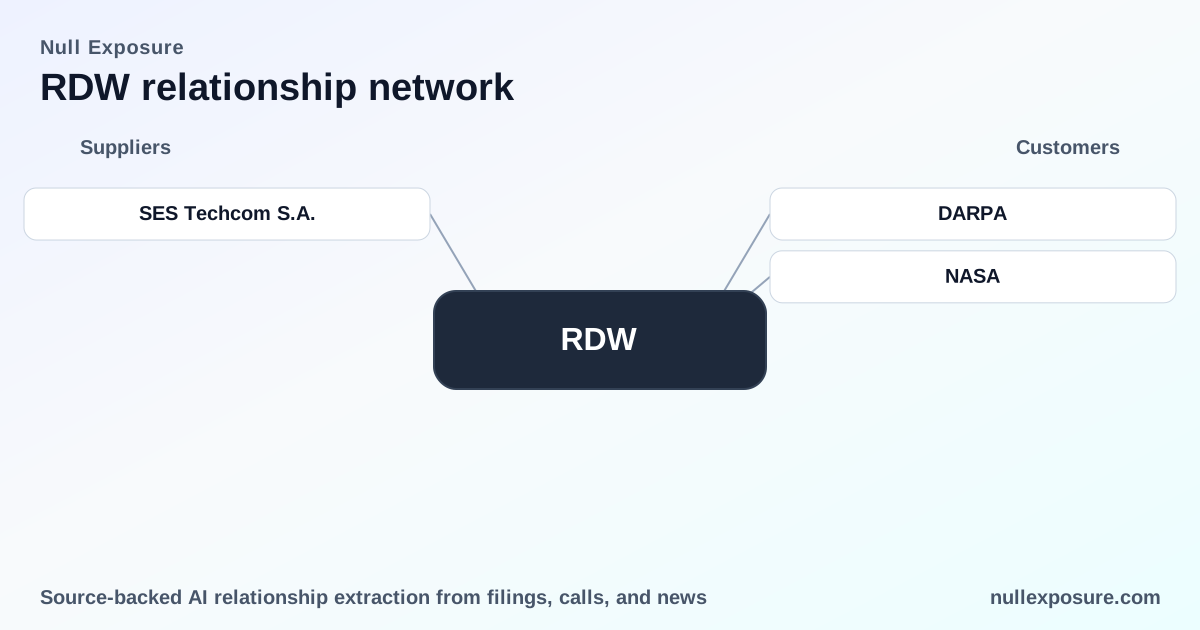
NASA
Redwire supplies optical imaging systems, sun sensors, and the Orion Camera System across Artemis missions I–V, a thread of work that anchors the company as a supplier to the U.S. civil space program and supports backlog conversion. This role is cited in multiple FY2026 news reports and company disclosures, including coverage on SimplyWallSt and Stockstotrade (FY2026).
European Space Agency (ESA)
Redwire won an ARTES Partnership Projects contract to supply the Hammerhead spacecraft and avionics for ESA’s Quantum Key Distribution Satellite (QKDSat), positioning the company in a strategic European quantum‑secure communications program. Coverage of the ESA award ran across FinancialContent, CyprusShippingNews and SimplyWallSt (April–May 2026).
U.S. Space Force
Redwire counts Space Force programs among its government backlog, a component cited as contributing to contracted backlog growth and national security product demand. This linkage was referenced in business combination coverage in Ad‑Hoc News (FY2026).
Department of Defense
The company derives significant revenue from U.S. government defense programs (DoD), which underwrite demand for high‑reliability components and systems and subject cost elements to audit and negotiation. That position is noted in FY2026 reporting summarized by Ad‑Hoc News and other outlets.
U.S. Navy
Redwire received follow‑on purchase orders supporting Navy programs—part of a >$20M award for Stalker Block 30 UAS—delivered through DLA procurement vehicles, underlining recurring defense demand. StockTwits and Business Wire reporting flagged these orders in Q1 FY2026.
U.S. Marine Corps
The Marine Corps placed follow‑on orders for Stalker Block 30 systems via DLA, contributing to the >$20M in first‑quarter purchase orders and reinforcing Redwire’s tactical UAS revenue stream (SimplyWallSt, Stockstotrade; FY2026).
Lockheed Martin (LMT)
Redwire supplied the Orion Camera System to Lockheed Martin, prime contractor for Orion, covering Artemis I–V production and test responsibilities—an endorsement from a major prime that supports long‑term program continuity (TradingView, Markets FinancialContent; FY2026).
Airbus (AIR)
Redwire provided sensor assemblies for the European Service Module and related spacecraft systems under Airbus contracts, integrating the company into international crewed spacecraft supply chains (TradingView, Stockstotrade; FY2026).
Moog Inc.
Redwire secured a $12.8M contract to deliver Extensible Low‑Profile Solar Array (ELSA) wings to Moog for a classified national‑security LEO mission using the METEOR bus, representing the first commercial sale of its ELSA product line (SimplyWallSt, SpaceConnect, Investing.com; Mar–Apr 2026).
RDWU
RDWU is a listed instrument that uses swap agreements and call options to take bullish exposure to RDW shares; coverage notes the fund’s use of derivatives and occasional direct RDW investment (TradingView; FY2026).
The Exploration Company
Redwire was awarded work to provide spacecraft docking systems for The Exploration Company’s European space capsule, reflecting commercial partnerships in crewed/crew‑adjacent systems (Finviz/Business Wire; FY2026).
Blue Origin
Redwire is manufacturing arrays for Blue Origin’s Blue Ring multi‑orbit mobility platform, demonstrating commercial orbital support relationships beyond government primes (SpaceConnect, CyprusShippingNews; FY2026).
Thales Alenia Space
Redwire manufactures multiple solar arrays for Thales Alenia Space’s Space INSPIRE satellites, expanding the firm’s OEM customer base in European commercial and institutional programs (SpaceConnect, CyprusShippingNews; FY2026).
DARPA
Redwire’s engineering divisions continue to deliver hardware for DARPA programs, underlining involvement in advanced research and high‑innovation defense projects (Finviz and InsiderMonkey commentary; FY2026).
Atlantic Diving Supply (ADS)
ADS served as the prime contractor on the DLA TLS IDIQ order that funneled >$20M in Stalker Block 30 purchase orders to Redwire, indicating use of distribution or prime partners to access DLA/DoD procurement channels (SUAS News; FY2026).
Navy and Marine Corps Small Tactical Unmanned Aircraft Systems Program Office (PMA‑263)
PMA‑263 is the program office ultimately served by the DLA procurement route for the Stalker UAS orders, linking Redwire’s product to formal program delivery channels (Yahoo Finance / Business Wire reporting; FY2026).
Washington Commanders
Redwire announced a multi‑year drone technology partnership with the Washington Commanders to showcase its systems in a public‑facing program that supports brand and commercial outreach (SimplyWallSt, Yahoo Finance; FY2026).
Ministry of Defence (UK)
Redwire opened a UK office to support Ministry of Defence programs with local engineering and lifecycle teams, signalling investment in the British defence market and localized contract capture (SimplyWallSt; FY2026).
Investment implications and risk summary
- Revenue visibility is strengthened by a sizeable contracted backlog and multi‑year government/prime contracts, but timing risk remains due to program funding cycles and contract audits.
- Concentration is material—two large customers comprised roughly 10% and 35% of 2024 revenues—so model sensitivity to a small number of programs is necessary.
- Geographic footprint is balanced between North America and Europe, offering diversification but exposing Redwire to transatlantic procurement dynamics and export control complexities.
- Commercial productization (ELSA, Hammerhead) brings margin expansion potential and optionality beyond government programs, as evidenced by Moog, Blue Origin and Thales Alenia wins.
For investors and operators tracking counterparty risk, program duration, and revenue conversion timing, Redwire presents a classic aerospace profile: highly technical content, long contract tails, prime‑driven credibility, and concentration‑sensitive upside. For an in‑depth counterparty and contractual risk brief, visit https://nullexposure.com/.