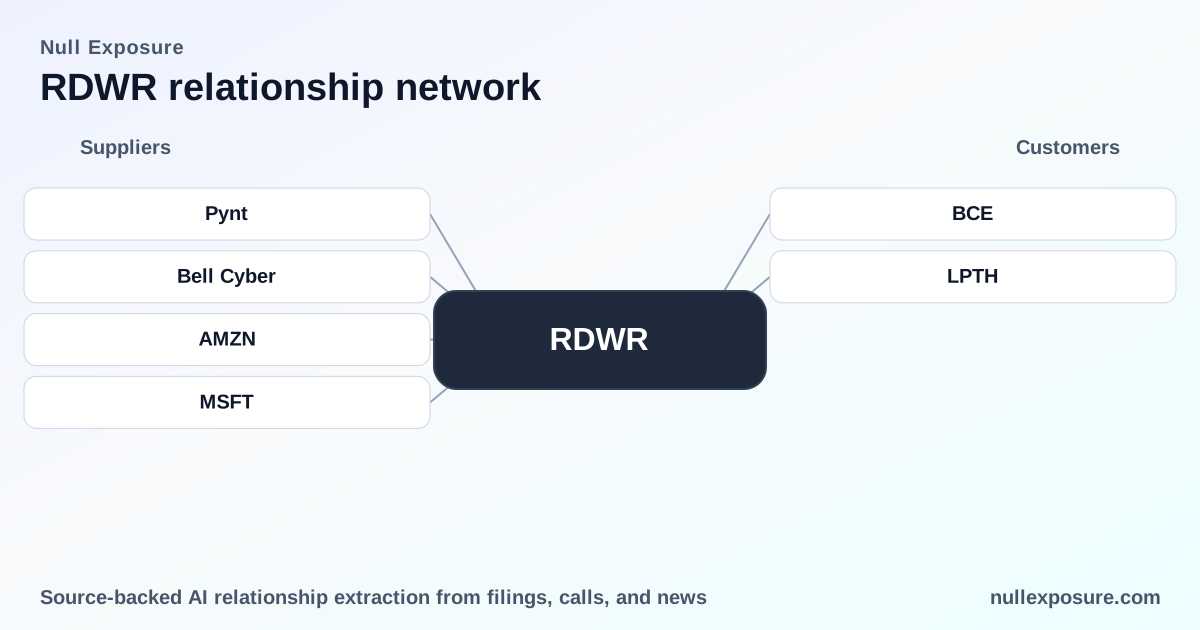
Radware (RDWR): Partner-led security sales are the growth lever investors should track
Radware sells cybersecurity and application delivery products and services—on-premises appliances, cloud-delivered managed services, and subscription software—monetizing through license and subscription revenue plus carrier and managed-service channel deals that embed Radware’s DDoS, WAF, bot mitigation and API security into third‑party offerings. Partnerships with carriers and service providers function as both distribution and recurring-revenue engines, expanding addressable markets in North America while shifting monetization toward cloud-managed services. For deeper coverage of partner-driven security vendors, visit https://nullexposure.com/.
Why carrier and MSP partnerships change the investment calculus
Radware’s go-to-market is channel-intensive rather than purely direct enterprise sales, which means contracting posture, renewal cadence, and partner economics are material to revenue durability. Carrier and managed-service integrations boost scale quickly but concentrate commercial exposure: partner performance, co-selling execution, and product integration timelines translate directly into Radware’s growth trajectory. The public relationship signals available for FY2026 show expansion of cloud-delivered, AI-enabled managed services sold through large telco partners, indicating a strategically mature approach to recurring revenue and market coverage.
Company-level signals derived from the relationship record:
- Contracting posture: Partner-first for cloud-managed security; Radware operates as a technology vendor to carriers/MSPs rather than a sole enterprise seller.
- Concentration: Geographic and channel concentration is increasing in North America via a small set of large partners.
- Criticality: Radware’s capabilities (DDoS, WAF, bot mitigation, API security) are integrated into partner service stacks, making the vendor critical to partner offerings and therefore to recurring revenue.
- Maturity: Partnerships emphasize cloud-delivered, AI-driven services—indicative of product and commercial maturity shifting away from hardware-only sales.
Note: no formal constraints were extracted from the dataset; these operating model assessments are company-level signals inferred from the documented partner activity.
What the public record shows about customer relationships (source-by-source)
Bell Cyber / BCE — North American managed-security expansion
Radware expanded a partnership with Bell Cyber to launch an AI-driven, cloud-delivered managed security service that bundles web application protection, API security, bot mitigation and DDoS protection for Canadian and U.S. organizations. According to a Simply Wall St report summarizing the February 17, 2026 announcement, this deal deepens Radware’s North American footprint through Bell Cyber’s channel and managed-services operations (Simply Wall St, reporting on 17 February 2026; first seen Mar 10, 2026: https://simplywall.st/stocks/us/software/nasdaq-rdwr/radware/news/bell-cyber-partnership-deepens-rdwrs-north-american-footprin).
Bell Cyber — Radware restates the expansion in secondary press
Radware’s expanded relationship with Bell Cyber was reiterated in a separate news release highlighting the same AI-driven, cloud-delivered service expansion and positioning Radware technology at the core of the joint offering. A Bitget news post dated May 3, 2026 reiterates Radware’s role in enhancing Bell Cyber’s managed security service stack for North America (Bitget News, May 3, 2026: https://www.bitget.com/news/detail/12560605203993).
Lightpath (LPTH) — Carrier-grade DDoS protection embedded in service portfolio
Radware is powering Lightpath’s new AI-driven DDoS protection service, enabling Lightpath to offer carrier-grade mitigation as part of its managed security products; this underscores Radware’s role as an OEM/technology provider to service providers. Telecom Reseller covered the partnership and the product positioning in early February 2026 (Telecom Reseller, Feb 3, 2026: https://telecomreseller.com/2026/02/03/radware-unveils-agentic-ai-protection-solution-to-shield-enterprises-from-new-agentic-threats/).
LPTH — alternative naming for the same Lightpath relationship
The Lightpath relationship also appears under the ticker-like reference LPTH in the record, reinforcing that Radware’s service integrations are recognized across multiple industry outlets and ticker mappings. The same Telecom Reseller piece documents Radware’s role powering Lightpath’s AI-driven DDoS offering (Telecom Reseller, Feb 3, 2026: https://telecomreseller.com/2026/02/03/radware-unveils-agentic-ai-protection-solution-to-shield-enterprises-from-new-agentic-threats/).
What investors should take away from these partnerships
- Revenue levers: Carrier/MSP integrations accelerate recurring subscription and managed-service revenue rather than one-off appliance sales; this supports higher revenue visibility and potential margin expansion over time as services scale.
- Distribution scale: Tying Radware into Bell Cyber and Lightpath service stacks materially increases distribution reach in North America without proportionate direct sales investment.
- Execution dependency: Growth depends on partner deployment schedules, co-marketing and operational alignment; partner execution will be a leading indicator for Radware’s subscription ARR growth.
- Product positioning: AI-driven and cloud-delivered capabilities are now the primary product narrative—this positions Radware competitively in a market favoring cloud-native security but requires continuous R&D investment to defend differentiation.
Quantitative context (selected financial signals)
Radware’s FY metrics frame the partner story: Revenue TTM $301.85M, Market Cap ~$1.15B, Forward P/E ~24.9, and Operating Margin ~4.13%. These figures show a mid‑cap security vendor transitioning to higher-quality recurring revenue while trading at a premium that prices in execution on partner-led growth.
Investment checklist and risks
- Monitor quarterly disclosures and partner press for metrics on managed-service adoption and ARR contribution.
- Watch renewal economics and gross-margin trajectory as cloud-managed services scale.
- Evaluate revenue concentration: new large partners can materially move growth but create counterparty risk if adoption lags.
- Product risk: sustained investment in AI-driven detection and automated mitigation is essential to preserve competitive positioning.
For a concise overview of Radware’s partner-centric growth model and comparable vendor strategies, see our site: https://nullexposure.com/.
Bottom line
Radware is executing a channel-first shift into cloud-managed, AI-enabled security services by embedding its technology into carrier and MSP offerings. These partnerships materially expand distribution and recurring revenue potential but transfer execution risk to partner deployment and go-to-market alignment. Investors should treat partner announcements as primary signals—monitor adoption, ARR disclosures, and margin progression to confirm that Radware converts improved distribution into sustainable, higher-margin recurring revenue.