Real Brokerage (REAX): Agent rollups and platform licensing drive growth; monetization layered across commissions and software
Real Brokerage operates an asset-light, technology-first residential brokerage that recruits teams and independent brokerages onto a single platform while monetizing through agent commissions, subscription and platform fees, and enterprise licensing of its transaction and workflow tools. Investors should view REAX as a growth-through-acquisition and partnership play where agent network expansion and platform distribution (including private‑label and enterprise deals) are the primary value drivers. For a closer look at how these customer relationships are building scale and optionality, see more at https://nullexposure.com/.
Why the customer list matters: business model in plain English
Real’s economics rely on two connected strands: (1) scaling gross transaction volume by adding agent teams and brokerages that generate commission revenue, and (2) extracting higher-margin recurring revenue by selling technology and branded private‑label services to those same partners. The company reports $1.968 billion in trailing revenue and a negative diluted EPS of -$0.04 as of the latest quarter (2025-12-31), which underlines that growth is prioritized over near‑term profitability while the platform expands its agent footprint and product reach.
A mid‑cycle proof point: Real’s platform is now being offered to large franchise networks for licensing, a structural step toward recurring income beyond commission splits. Track the company’s distribution momentum at https://nullexposure.com/.
Recent FY2026 customer wins — who joined Real and what it means
The following summaries cover every customer relationship reported in the available feed. Each entry is a concise, plain‑English take and a source reference.
-
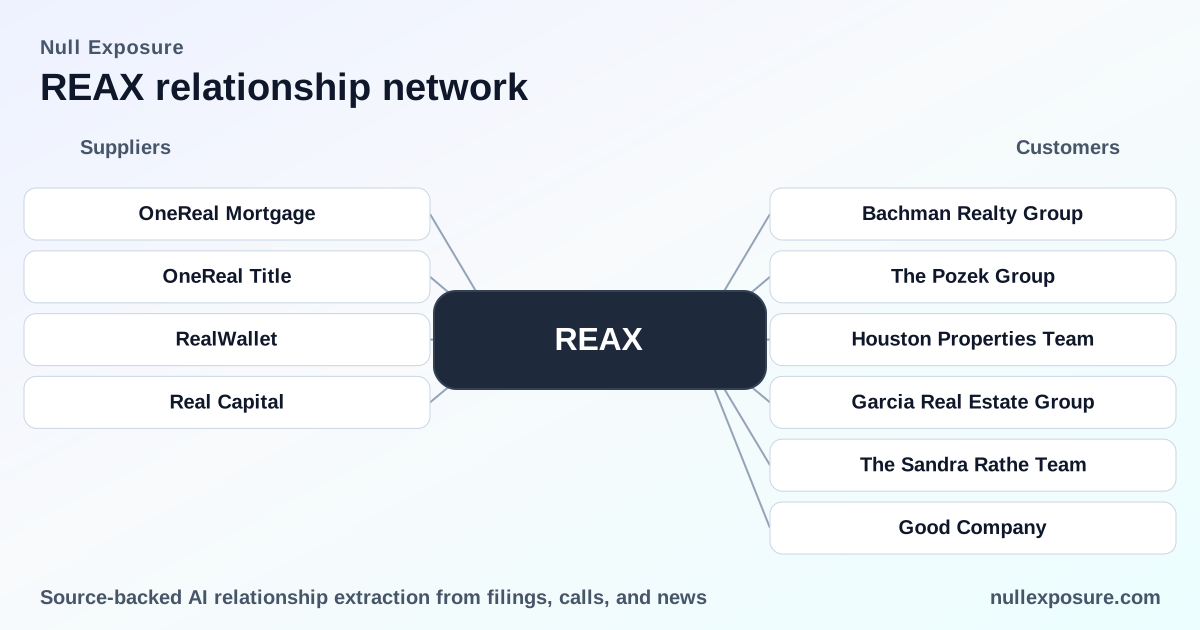
Bachman Realty Group — A 65‑agent team covering Dallas–Fort Worth and Houston joined Real, strengthening the company’s Texas expansion and contributing immediate transaction volume from a mid‑sized team. According to WRE News (March 10, 2026), Bachman’s addition is part of Real’s targeted team recruitment in major metros (https://wrenews.com/texas-bachman-realty-group-joins-the-real-brokerage/).
-
Houston Properties Team — The Houston Properties Team joined Real as part of a strategic push to expand Real’s presence in Texas, adding local market share and listings flow from a known regional team. CityBiz and WRE News reported the move in March 2026 (https://www.citybiz.co/article/798868/houston-properties-team-led-by-paige-and-bob-martin-joins-the-real-brokerage/; https://wrenews.com/houston-properties-team-joins-the-real-brokerage/).
-
Garcia Real Estate Group (Haley Garcia) — Haley Garcia moved her luxury residential team into Real Luxury, extending the company’s reach into higher‑end inventory and referral channels in Houston. Local reporting highlighted the team’s luxury focus and brand fit with Real’s premium offering (Hello Woodlands, March 2026: https://hellowoodlands.com/haley-garcia-brings-garcia-real-estate-group-to-real-luxury-of-the-real-brokerage/).
-
The Sandra Rathe Team — Sandra Rathe and her team joined Real to accelerate agent network growth and market penetration; the recruitment is cited by multiple coverage items as part of ongoing expansion efforts. Financial media and investor‑oriented outlets documented the announcement in early 2026 (Finviz and TradersUnion coverage, March–May 2026: https://finviz.com/news/273634/the-real-brokerage-reax-buy-sell-or-hold-post-q3-earnings; https://tradersunion.com/news/companies/show/1816672-real-brokerage-culture-network/).
-
Showcase Real Estate — Showcase Real Estate joined Real’s platform, a move that produced short‑term positive price reaction in markets and contributes incremental listings and commission streams. FinancialContent reported market reaction to the announcement in May 2026 (Markets FinancialContent, May 3, 2026: https://markets.financialcontent.com/stocks/quote/news?ChannelType=NEWS&Symbol=NQ%3AREAX&CurrentPage=2).
-
The Pozek Group (Ken Pozek) — Ken Pozek rejoined Real with his 18‑agent Orlando team; Pozek’s return is notable because it also coincided with his appointment to Real’s board, tying agent leadership directly to corporate governance and distribution strategy. The Globe and Mail reported the development in its 2026 coverage (The Globe and Mail, March 2026: https://www.theglobeandmail.com/investing/markets/markets-news/Business/153520/the-real-brokerage-announces-that-agent-leader-ken-pozek-has-joined-its-board-of-directors/).
-
Good Company (Jim Shaffer) — Detroit metro leader Jim Shaffer brought his independent brokerage, Good Company (172 agents), to Real through the Private Label program, which illustrates how Real converts full brokerages into platform customers while preserving local branding. The announcement and private‑label mechanics were published in March 2026 (WRE News and Real press release, March 2026: https://wrenews.com/the-real-brokerage-expands-michigan-footprint-with-172-agent-good-company/; https://www.theglobeandmail.com/investing/markets/stocks/REAX/pressreleases/37015103/real-expands-michigan-footprint-as-jim-shaffer-and-172-agent-brokerage-good-company-join-through-private-label-program/).
-
RE/MAX Holdings, Inc. (RMAX) — Coverage indicates Real’s platform, including the ReZen workflow and commission‑tracking tool, will be made available to RE/MAX agents and franchisees as part of a strategic distribution arrangement tied to a larger acquisition conversation. That kind of enterprise licensing materially increases the TAM for Real’s software beyond the company’s own agent roster (RealEstateMagazine report, May 2026: https://realestatemagazine.ca/real-to-acquire-remax-in-us880m-deal/).
-
The Onyx Realty Group — A Dallas‑based 55‑agent team joined Real, reinforcing the company’s Dallas–Fort Worth recruiting momentum and adding local transaction volume from an established team. WRE News covered the addition in May 2026 (WRE News, May 3, 2026: https://wrenews.com/dallas-based-onyx-realty-group-joins-the-real-brokerage/).
What these relationships imply for growth and risk
-
Growth vector: The pipeline of team and brokerage signings shows Real is executing an agent‑acquisition playbook that scales transaction volume without heavy property‑level investment. Team additions in Texas, Michigan, Florida and other markets deliver incremental revenue and local market intelligence.
-
Platform monetization upside: Private‑label deals (Good Company) and enterprise distribution signals (RE/MAX coverage) indicate Real is progressing from pure commission splits toward recurring software and licensing revenue, which improves margin profile if executed at scale.
-
Concentration and criticality: The company’s model is oriented to low capital intensity and broad distribution; customer concentration risk is diluted by many small and mid‑sized team signings, but the strategic value of a large enterprise deal (e.g., making ReZen available to RE/MAX) would raise platform criticality for the company’s revenue mix.
-
Profitability stance and maturity: Company filings show substantial revenue ($1.968B TTM) but negative profitability metrics, signaling a growth‑first posture where platform scale and agent recruitment are prioritized over immediate net income.
Constraints and operating posture — what the record shows
The feed returned no explicit constraints or contractual excerpts. As a company‑level signal, the absence of published constraints in this sample suggests transparent outward recruiting and partnership activity rather than heavyweight, closed strategic dependencies disclosed publicly in the same window. Investors should still evaluate contract terms, revenue share mechanics and retention economics in company filings and investor presentations to understand margin convertibility from recruited teams.
Bottom line for investors
Real’s FY2026 customer activity confirms a repeatable playbook: recruit teams and brokerages to grow transaction volume, then sell platform capabilities and private‑label services to extract higher‑margin recurring revenue. The strategic distribution move toward RE/MAX‑level licensing, if realized, materially enlarges the addressable market for Real’s software stack. Monitor agent retention, conversion of recruited teams to long‑term revenue contributors, and the cadence of enterprise licensing as the key next inflection points. For ongoing monitoring and deeper relationship mapping visit https://nullexposure.com/.