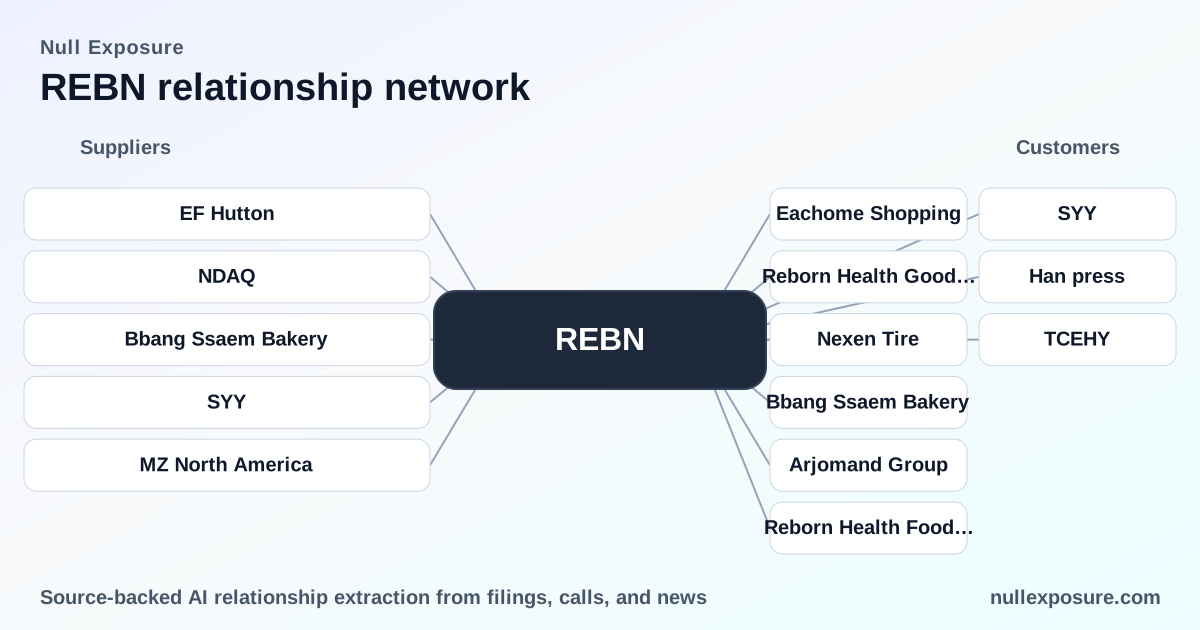
Reborn Coffee (REBN): Customer relationships power a retail-first, licensing-led growth push
Reborn Coffee operates a dual retail and licensing model: the company roasts and sells specialty coffee through company-owned stores and kiosks in North America while monetizing international scale via master licensing, franchise relationships and distribution partnerships. Revenue is concentrated in point-of-sale retail and wholesale coffee sales, with expansion driven by licensing agreements and regional distribution deals that convert intellectual property and roasted-product margins into recurring royalties and wholesale volumes. For a concise intelligence briefing on relationship exposure and counterparty risk, visit https://nullexposure.com/.
Business model signals and operational constraints
- Contracting posture: spot-oriented retail — retail revenue is recognized at the point of sale, consistent with a spot, cash-driven revenue profile rather than long-term subscription contracts.
- Customer mix: enterprise and individual — the company sells to individual retail customers through stores and to large enterprise buyers via B2B channels for hotels, offices and hospitality groups.
- Geographic concentration with rapid APAC expansion — North America remains the revenue core, but franchise and master license agreements are concentrating growth efforts in APAC (China and Korea) and other international regions.
- Materiality and dependency: retail-critical — retail store revenue accounts for roughly 96% of total revenue, making physical store and franchise performance critical to consolidated results.
- Role and maturity: manufacturer/seller with active relationships — Reborn operates an in-house roasting and distribution center and describes active sales and licensing stages; new logistics and licensing subsidiaries indicate an early-growth but accelerating maturity curve.
Customer relationships and what they mean for investors
Eachome Shopping — China retail platform partnership
Reborn announced a strategic partnership with Eachome Shopping, a retail arm of Shenzhen Media Group, to extend Reborn’s retail footprint across China. This aligns with the company’s master-license strategy to use local retail platforms to scale store openings and brand presence in APAC (Comunicaffe, March 10, 2026: https://www.comunicaffe.com/reborn-coffee-and-eachome-shopping-forge-strategic-partnership-to-revolutionize-coffee-retail-in-china/).
Sysco (SYY) — U.S. distribution agreement
Reborn publicly disclosed a distribution partnership with Sysco to broaden wholesale channels for its roasted coffee and foodservice products, giving the brand access to Sysco’s national distribution network and institutional customers in FY2026 (Reuters/TradingView, March 10, 2026: https://www.tradingview.com/news/reuters.com,2026:newsml_TUAJT8GX:0-reborn-coffee-announces-distribution-partnership-with-sysco/).
Nexen Tire — logistics volume partner for Reborn Logistics
As Reborn establishes Reborn Logistics, Nexen Tire was named among Korean corporate partners providing initial volume, supporting an estimated combined monthly unit throughput and contributing to projected logistics revenue upside in Korea (Comunicaffe, March 10, 2026: https://www.comunicaffe.com/reborn-coffee-establishes-new-subsidiary-reborn-logistics-to-strengthen-supply-chain-infrastructure/).
Bbang Ssaem Bakery — Korean acquisition and distribution channel
Following Reborn’s acquisition of the Korean baking brand Bbang Ssaem, the bakery will shift to distributing Reborn’s proprietary roasted coffee across its Korean locations, converting an acquisition into an owned wholesale channel (FoodBusinessNews, FY2024 reporting: https://www.foodbusinessnews.net/articles/26439-reborn-coffee-to-acquire-korean-baking-brand).
Arjomand Group — regional development agreement for MEA/EU
Reborn signed a US$1.7 million agreement with the Arjomand Group to develop Reborn brands across the Middle East, Europe and MENA, using a regional developer model to accelerate openings and licensing revenues outside the U.S. (GCR Magazine, FY2025 reporting: https://www.gcrmag.com/reborn-coffee-to-tackle-new-chinese-markets/).
Reborn Health Foods (Shenzen) Co. Ltd. — master licensee for mainland China
Reborn entered a US$1.3 million master licensing agreement with Reborn Health Foods (Shenzen), granting exclusive rights to develop and sublicense Reborn Coffee locations throughout mainland China and anchoring the company’s APAC expansion strategy (GCR Magazine, FY2025 reporting: https://www.gcrmag.com/reborn-coffee-to-tackle-new-chinese-markets/).
Reborn Health Goods (Shenzhen) — operator of flagship Tencent location
Reborn’s exclusive China master licensee, referenced as Reborn Health Goods (Shenzhen), led development of a flagship store inside Tencent’s new Shenzhen campus, providing a high-visibility proof point for the brand’s China rollout (GlobeNewswire/FY2026 release, January 29, 2026: https://www.globenewswire.com/news-release/2026/01/29/3228603/0/en/Reborn-Coffee-Advances-China-Growth-Through-Completion-of-Flagship-Presence-at-Tencent-s-New-Headquarters-Campus-in-Shenzhen.html). Multiple trade outlets reported the same development (Yahoo Finance, QSR Media, Barchart links across Jan–Mar 2026).
Han press — Korean logistics partner
Han press is listed among the initial partners for Reborn Logistics’ operations in Korea, contributing to the monthly volume assumptions underpinning the logistics initiative and its near-term revenue potential (Comunicaffe, March 10, 2026: https://www.comunicaffe.com/reborn-coffee-establishes-new-subsidiary-reborn-logistics-to-strengthen-supply-chain-infrastructure/).
Tencent (TCEHY) — strategic placement inside a major tech campus
Reborn’s flagship in Tencent’s new Shenzhen headquarters supplies direct access to large corporate foot traffic and acts as a marketing and proof point for franchisees and master licensees; the store was cited in Reborn’s shareholder communications topping its stated international expansion milestones (Company shareholder update/GlobeNewswire, FY2025: https://www.globenewswire.com/news-release/2025/12/09/3202118/0/en/Reborn-Coffee-Issues-Shareholder-Update-Highlighting-Premium-Financing-Strengthened-Equity-Position-Technology-Transformation-Global-Licensing-Momentum-and-Expected-Return-to-Susta.html).
Operational implications for investors
- Concentration risk is material. With roughly 96% of revenue tied to retail store sales, any disruption to point-of-sale performance, franchise rollouts, or master-license executions will disproportionately impact cash flow and margins.
- Contracting and cash flow profile is working-capital intensive but immediate. Point-of-sale recognition and spot retail contracts provide predictable daily cash, yet international licensing and logistics investments create timing and capital deployment risks before royalty streams fully ramp.
- Channel diversification is deliberate. The Sysco distribution deal and the Bbang Ssaem acquisition convert brand and roasted product into broader wholesale and institutional channels, lowering single-channel dependency over time.
- Geographic expansion increases operational complexity and counterparty concentration. Multiple master licensees and regional developers (China, Korea, MENA/EU) accelerate store openings but concentrate execution risk with local partners.
Key takeaways for portfolio managers
- Reborn is a retail-first specialty coffee operator leveraging licensing and distribution to scale internationally; investors should weigh high retail concentration against the benefits of recent distribution and licensing agreements that broaden channels.
- Catalysts include Sysco distribution roll-out, master license execution in China (Tencent flagship), and logistics commercialization in Korea. Risks center on execution of franchise partners, store economics consistency, and the capital intensity of international rollout.
For a detailed relationship map and continuous monitoring of counterparty events, see our platform at https://nullexposure.com/.