REE Automotive: Customer Relationships, Commercial Levers, and What Investors Should Price In
REE Automotive builds and sells a modular, x-by-wire electric vehicle platform that integrates drive and steering modules into a flat, highly configurable architecture. The company monetizes through vehicle chassis sales to OEMs and fleet body partners, licensing and royalty arrangements for its REEcorner and EDU technologies, and expansion of a dealer network for direct P7 product orders. For ongoing coverage and relationship-level signals, see https://nullexposure.com/.
Why the partnership map matters to valuation
REE’s commercialization strategy is not a broad retail roll‑out: it is a selective industrial play that trades volume today for platform leverage tomorrow. Revenue today comes from initial P7 unit orders through dealers and partner integrations; the long‑term earnings vector is licensing, royalty streams, and OEM-scale EDU (electric drive unit) manufacturing arrangements. That mix creates a distinctive investor risk/reward: near-term revenue is small and concentrated, while upside scales nonlinearly if a few strategic partners convert MOUs into production programs.
Operating model characteristics investors should treat as firm-level signals
- Contracting posture: REE executes MOUs, dealer-authorizations, and royalty-bearing commercial plans rather than broad production contracts; this signals an exploratory, partnership-first commercial approach rather than turnkey volume commitments.
- Concentration: Customer relationships are concentrated among OEMs, strategic suppliers, and a small network of dealer launch partners, implying revenue and execution risk if one partner stalls.
- Criticality: REEcorner and the P7 chassis are central intellectual property: partners are positioning them as core components of future EDUs and SDV platforms, indicating high technical criticality to partner roadmaps.
- Maturity: Most relationships are early-stage — MOUs, evaluation phases, and initial dealer orders — so commercial conversion is a gating factor for revenue scale.
If you want a concise relationship map for modeling scenarios, visit https://nullexposure.com/ for structured investor briefs.
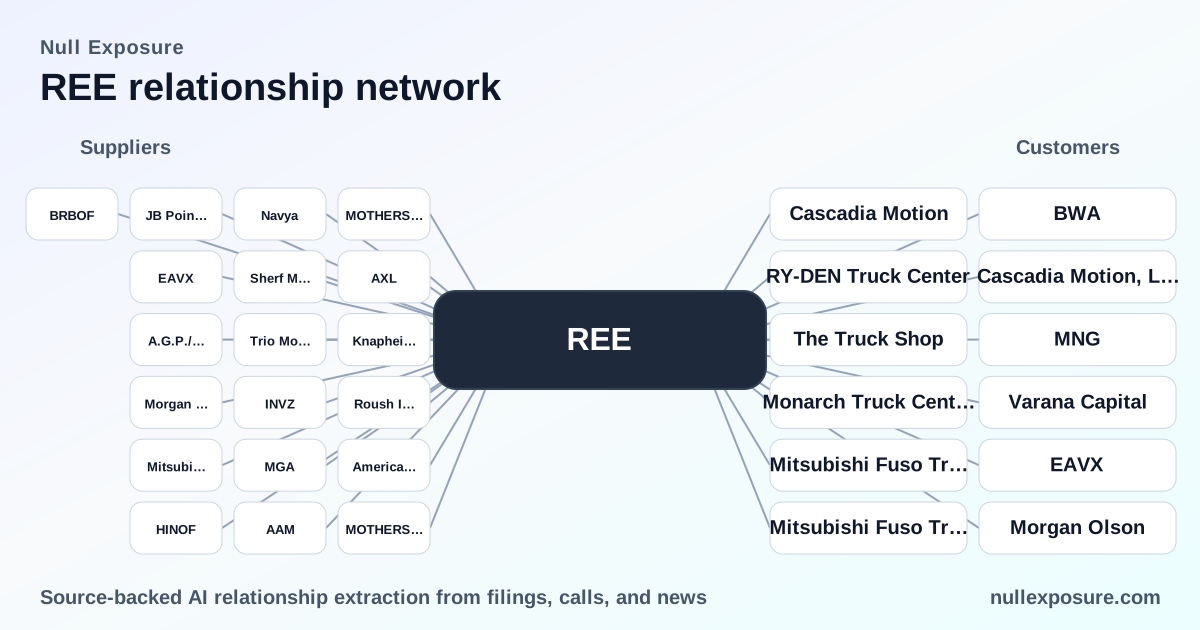
Customer and partner relationships (each one covered)
Cascadia Motion / Cascadia Motion, LLC
REE signed an MOU to co‑develop and commercialize a next‑generation electric drive unit built on REEcorner technology and plans a phased commercial plan that gives Cascadia Motion an exclusive, time‑limited distribution option for a packaged EDU; the commercial plan will include royalty arrangements. This was disclosed in REE’s first‑half 2025 earnings release and reported in late‑December 2025 coverage. (Source: REE H1 2025 earnings release via GlobeNewswire; SahmCapital news coverage, Dec 2025.)
BorgWarner Inc. (BWA)
BorgWarner, via its wholly‑owned subsidiary Cascadia Motion, is positioned to manufacture and distribute REEcorner‑based EDUs under a royalty‑bearing framework — a strategic supplier relationship linking REE’s corner technology to a major automotive tier‑one manufacturer. (Source: SahmCapital write‑up on Courted arrangements, Dec 29, 2025.)
Mitsubishi Fuso Truck and Bus Corporation (Mitsubishi Fuso)
REE entered an MOU with Mitsubishi Fuso to evaluate REE’s software‑defined vehicle (SDV) capabilities and x‑by‑wire technologies for commercial trucks, including a one‑year evaluation to convert a Mitsubishi Fuso eCanter using REE technology; the collaboration is positioned as an evaluation‑to‑supply pathway. (Source: REE H1 2025 earnings release via GlobeNewswire, Nov 2025 MOU announcement; also reported in Investing.com coverage, May 2026.)
RY‑DEN Truck Center
RY‑DEN joined REE’s authorized U.S. dealer network and placed initial orders for the P7 product line, representing the company’s dealer‑channel strategy to seed commercial deployments and field validation in local markets. (Source: REE dealer network announcement via GlobeNewswire, May 2, 2023; Fleetpoint coverage.)
The Truck Shop
The Truck Shop is an authorized U.S. dealer that placed an initial P7 order and is accepting customer orders, reflecting REE’s strategy to scale through specialty commercial truck dealers. (Source: REE dealer network announcement via GlobeNewswire, May 2, 2023; Fleetpoint coverage.)
Monarch Truck Center
Monarch Truck Center was added to REE’s U.S. dealer network and placed initial orders for the P7 lineup, reinforcing the company’s early sales focus on regional commercial dealers to drive first deliveries and certification feedback. (Source: REE dealer network announcement via GlobeNewswire, May 2, 2023; Fleetpoint coverage.)
EAVX
EAVX appears in partner descriptions tied to the Proxima walk‑in van project: REE’s P7 stripped chassis powers the Class 5 Proxima body in collaboration with EAVX, indicating body‑builder integration channels for REE’s platform in last‑mile and delivery vehicle segments. (Source: Fleetpoint and WorkTruckOnline coverage on Proxima and P7 integrations, FY2022–FY2023.)
JB Poindexter’s Morgan Olson (Morgan Olson)
Morgan Olson worked with REE and EAVX on the Proxima Powered by REE, pairing the Proxima body with REE’s P7 stripped chassis for walk‑in vans — a classic OEM‑bodybuilder use case that validates REE’s platform fit for the light‑commercial vehicle market. (Source: WorkTruckOnline coverage on the Proxima and REE P7 collaboration, FY2022–FY2023; Fleetpoint reporting.)
Varana Capital
Varana Capital participated as a strategic investor in a registered direct offering where REE sold ordinary shares in FY2025 to raise gross proceeds of roughly $27 million, signaling institutional strategic investor support for near‑term funding needs. (Source: Finance.yahoo reporting on the registered direct offering, FY2025.)
M&G Investments (MNG)
M&G Investments was named among institutional and strategic investors in the same FY2025 registered direct offering that raised up to approximately $27 million, reflecting continued external capital injections to fund commercialization and R&D. (Source: Finance.yahoo reporting on the securities purchase agreements, FY2025.)
What this partner set means for risk and upside
- Upside pathway: Licensing/royaltying REEcorner technology into EDUs manufactured by tier‑one suppliers (BorgWarner/Cascadia Motion) is the clearest route to scalable, high‑margin recurring revenue. The Mitsubishi Fuso MOU introduces the possibility of platform adoption by legacy OEMs.
- Execution risk: The portfolio is early‑stage and concentrated: MOUs and dealer launch orders are positive validation points but not production contracts. Failure to convert evaluations into production programs will keep revenues immaterial relative to capital needs.
- Funding dynamics: Institutional placements (M&G, Varana) provide working capital runway but signify reliance on equity financing while unit economics ramp.
Investment implications and tactical considerations
REE’s partner map reads like a deliberate industrialization play: small, concentrated dealer order flow for immediate validation and strategic MOUs with OEMs and tier‑ones to capture platform licensing upside. Model scenarios should distinguish between a conservative case (no OEM production wins — continued equity raises and limited dealer sales) and an upside case (BorgWarner/Cascadia Motion and Mitsubishi Fuso convert to production, delivering royalties and license fees).
For investors and operators tracking conversion milestones, focus on three indicators: signed commercial supply agreements (not just MOUs), EDU manufacturing commitments, and sustained order flow from dealer partners. For deeper relationship analytics and ongoing signal tracking, visit https://nullexposure.com/.
Bold takeaway: REE’s valuation is a binary trade between early validation and scale‑conversion — partnerships are strategically promising but still require material commercial follow‑through.