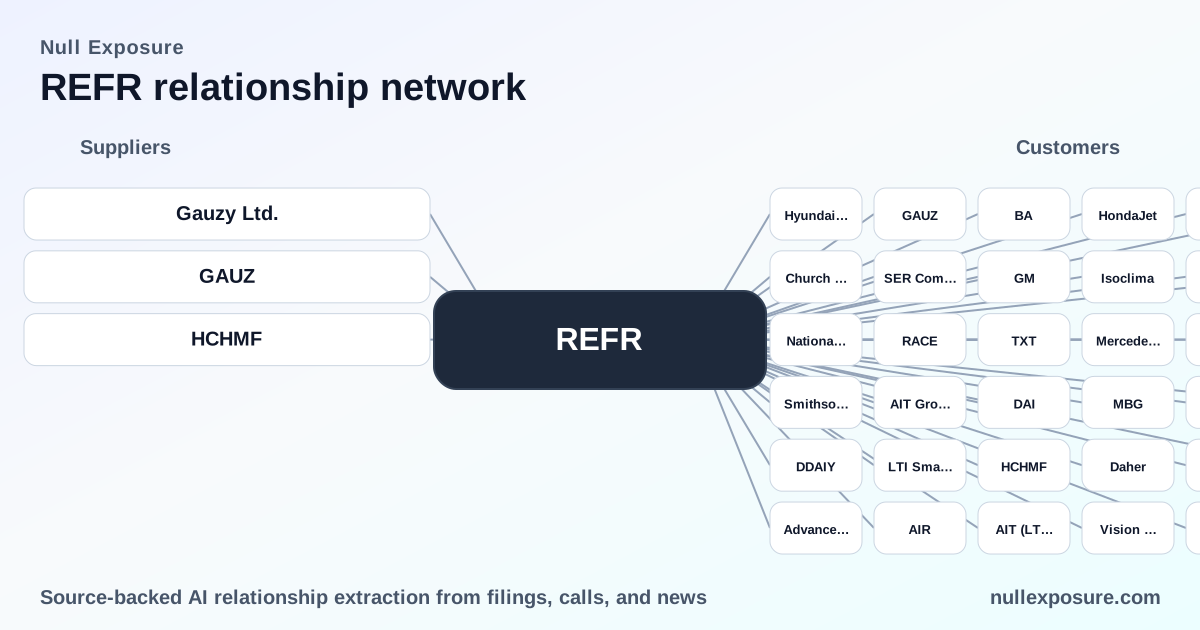
Research Frontiers (REFR): how SPD licensing drives revenue and where the customers sit
Research Frontiers develops and licenses SPD‑Smart light‑control technology — it does not manufacture finished glass at scale; the company monetizes through licensing fees and royalties from more than 40 licensees that embed SPD film into automotive, aerospace, architectural and industrial products. Investors should read the customer map as a licensing ecosystem: revenue is driven by a handful of high‑value licensees while adoption is geographically broad. Learn more at https://nullexposure.com/
Quick take: what the customer picture means for investors
Research Frontiers runs a classic IP‑licensing business. The operating posture is contractual and license‑centric: most commercial relationships are with licensees that manufacture or integrate SPD film and pay royalties or fees. That structure produces several investment‑relevant attributes:
- Concentration risk: the 2024 filing shows four licensees contributed 34%, 28%, 11% and 11% of fee income in 2024 — a small number of partners generate material revenue (Form 10‑K, FY2024).
- Long horizon licensing: many licenses are non‑exclusive and generally last as long as patents remain in force, implying multi‑year revenue visibility from successful programs (Form 10‑K, FY2024).
- Global distribution with regional pockets of manufacturing: licensees and supply chains span North America, EMEA and APAC, enabling diversified end‑markets but creating cross‑jurisdictional counterparty complexity (Form 10‑K, FY2024).
- Product and segment focus: Research Frontiers operates in a single core segment — development and licensing of light‑control technology — so customer success directly drives top‑line performance (Form 10‑K, FY2024).
If you want a compact view of the company’s external relationships and how they translate to royalty channels, see the detailed ledger below. For a fuller platform-level analysis, visit https://nullexposure.com/
Detailed relationship ledger — every reported customer relationship
- Church History Museum — The Church History Museum installed 22 exhibit cases using Research Frontiers’ VariGuard SmartGlass panels to protect and display artifacts, signalling architectural/institutional use of SPD technology (Form 10‑K, FY2024).
- Nationalmuseum — The Nationalmuseum selected an ArtRatio display case engineered with VariGuard SmartGlass so visitors could experience objects under controlled lighting (Form 10‑K, FY2024).
- Smithsonian’s National Postal Museum — The Smithsonian’s National Postal Museum chose VariGuard panels to protect the 1856 British Guiana One Cent Magenta, demonstrating high‑security museum adoption (Form 10‑K, FY2024).
- Hyundai Motor Company — Hyundai is cited in company filings and earnings discussion as a strategic OEM engagement (delays noted historically tied to product timing and black SPD preferences) and as an investor in Gauzy’s earlier financing rounds (Form 10‑K; earnings call coverage, FY2025).
- Daimler AG (Mercedes‑Benz origins) — Daimler was an early automotive adopter, launching the MAGIC SKY CONTROL sunroof that brought SPD into high‑volume OEM production beginning in late 2011 (Form 10‑K, FY2024; NBC historical coverage).
- AIT Group / LTI SmartGlass — AIT (and its affiliate LTI SmartGlass) is a licensee and manufacturing partner; Research Frontiers and AIT jointly debuted a retrofittable SPD‑SmartGlass window for buildings, underscoring architectural retrofit opportunities (GlobeNewswire / Yahoo Finance, 2024–2025).
- Gauzy Ltd. — Gauzy is a strategic licensee and investor and manufactures SPD film and laminated stacks; Gauzy supplied serial SPD SmartGlass for GM’s Cadillac Celestiq and is a central production partner for automotive programs (PR releases and market coverage, 2025).
- SER Company — SER became a licensee to produce SPD‑SmartGlass for Brazil, expanding regional manufacturing capacity for armored/industrial glass applications (GlassOnWeb news, 2019).
- General Motors (and Cadillac) — GM’s Cadillac Celestiq entered serial production with SPD roofs supplied via licensee partners, representing Research Frontiers’ first North American OEM serial production program (company press releases and Globe and Mail coverage, FY2025–FY2026).
- Ferrari — Ferrari’s Purosangue program produced royalties; during 2025 the royalty relationship transitioned between European licensees but production volumes exceeded minimum annual royalty thresholds in late‑2025 (press releases and earnings commentary, FY2025–FY2026).
- Textron Beechcraft (Textron) — Research Frontiers lists Textron Beechcraft among aerospace customers; SPD windows are flying on several business and specialty models (company releases summarizing aircraft programs, FY2025–FY2026).
- Boeing — Boeing appears among aircraft programs where SPD windows are used (select 737 configurations), indicating penetration into commercial retrofit or factory options (press release summary, FY2026).
- Airbus — Airbus ACJ TwoTwenty and other Airbus programs use SPD windows in business aviation variants, validating aerospace OEM adoption (company announcements and press releases, FY2025–FY2026).
- Honda Aircraft / HondaJet — HondaJet is noted as an aircraft program using SPD electronically dimmable windows, part of the aerospace adoption base (press release summary, FY2026).
- Epic Aircraft — Epic E1000 is listed among aircraft models that have adopted SPD windows, showing franchise across small commercial and business‑jet OEMs (press release summary, FY2026).
- Daher — Daher TBM 960 is cited as another aircraft program using SPD‑SmartGlass, expanding the aerospace footprint (press release summary, FY2026).
- McLaren Automotive — McLaren appears in historical and recent program lists as an OEM using SPD roofs in production models, illustrating premium automotive adoption (company filings and industry coverage, 2019–2025).
- Mercedes‑Benz (brand and concept programs) — Mercedes has integrated SPD widely (MAGIC SKY CONTROL and Vision V concept), pointing to potential for larger glass‑area adoption in future vehicles (press and earnings commentary, 2011–2026).
- Hitachi Chemical Company — Historical licensing for SPD film manufacturing (Hitachi’s film was licensed and then processed into laminated roofs), a supply‑chain antecedent to current manufacturing partners (NBC historical coverage).
- Pilkington — Pilkington and similar glass processors have historically laminated SPD film into automotive glass, reflecting the role of glass processors in the value chain (NBC historical coverage).
- Nippon Sheet Glass — Nippon Sheet Glass is noted as a processing partner in historical implementations, demonstrating international supply chain ties (NBC historical coverage).
- Vision Systems — Vision Systems is cited in earnings transcripts with receivable/payment issues subject to French regulator oversight, highlighting counterparty payment risk in Europe (earnings call transcript coverage, FY2026).
- AGP / AGPL — AGP and its European affiliate Soliver filed for bankruptcy protection in 2025, a counterparty event that required program transitions and affected short‑term royalty timing (earnings call transcript, FY2026).
- Soliver — Soliver, AGP’s European affiliate, was part of the bankruptcy filings that led to license transitions in 2025 (earnings call transcript, FY2026).
- Isoclima — Isoclima took over Ferrari manufacturing mid‑2025 and exceeded minimum annual royalty thresholds, restoring royalty recognition (earnings call transcript, FY2026).
- Ford — Management confirmed relationships and exploratory projects with Ford during investor Q&A, indicating OEM engagement beyond premium brands (earnings call transcript, FY2025).
- Global Glass — Global Glass filed a lawsuit alleging undisclosed royalty issues related to Mercedes projects; this is a legal counterparty event to monitor (Axios reporting, 2023).
- NPSGF / Nippon Sheet Glass (tickered mentions) — Nippon Sheet Glass appears in historical supply descriptions (NBC historical coverage).
- HCHMF / Hitachi Chemical Company (tickered mention) — historical reference to Hitachi‑manufactured SPD film and the particle‑suspension technology used in early automotive sunroofs (NBC historical coverage).
- Dassault — Dassault shows up in aerospace program lists, underlining further OEM adoption in business aviation lines (press coverage summarizing aerospace programs, FY2025).
- Epic (EPSC ticker references) — Epic appears across multiple program summaries in aviation coverage (press coverage, FY2026).
- Cadillac (brand references separate from GM) — Cadillac’s Celestiq adoption is explicitly cited as a material OEM program for serial production (press releases, FY2025–FY2026).
Operational constraints and what they signal about the business model
- Contracting posture: licensing first, manufacturing via licensees. Filings explicitly describe a portfolio of license agreements; Research Frontiers’ revenue is tied to licensee activity rather than finished‑goods sales (Form 10‑K).
- Duration and maturity: largely long‑running patents‑backed licenses. Most licenses persist for the life of the patents, providing multi‑year tail revenue if licensees sustain production (Form 10‑K).
- Geography: global market footprint with localized manufacturing partners. The company derives revenue from North America, Europe and Asia and counts licensees serving five major application areas worldwide (Form 10‑K).
- Concentration and materiality: revenue dependent on a few licensees. The top four licensees accounted for the majority of fee income in 2024, a structural concentration risk embedded in the licensing model (Form 10‑K).
- Relationship stage: active and program‑driven. Filings and recent press demonstrate active royalty recognition and program launches across automotive and aerospace in 2025–2026 (press releases and earnings transcripts).
Bottom line for investors
Research Frontiers is a patent‑centric licensing play with high operating leverage to a small set of manufacturing licensees; upside follows scaled OEM programs (GM/Cadillac, Ferrari, Mercedes, aerospace partners) while downside is concentrated around licensee execution, bankruptcies (AGP/Soliver) and receivables (Vision Systems/Gauzy exposure). For ongoing monitoring, prioritize licensee production milestones, royalty recognition timing, and counterparty credit events.
If you want a structured client‑relationship briefing or a visualization of the licensing map, see the company overview hub at https://nullexposure.com/ — our briefings identify the same counterparties and highlight program‑level exposure.