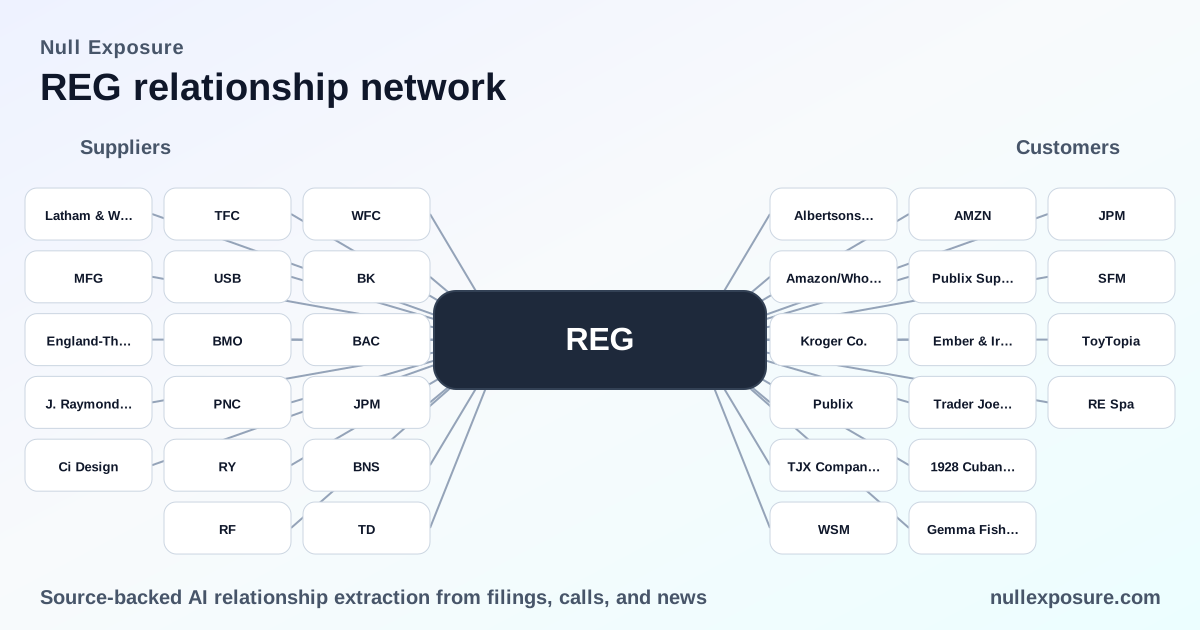
Regency Centers (REG): Tenant Relationships and What They Mean for Investors
Regency Centers is a grocery-anchored retail REIT that monetizes its suburban shopping-center portfolio primarily through long-term base rent, CAM reimbursements and selective development activity. The company’s operating model centers on necessity-based anchors (grocers) that produce predictable net operating income (NOI), while smaller shop leases and redevelopment capture rental upside and tenant mix improvements. For investors, the key lens is concentration and counterparty quality: Regency’s cash flow stability derives from grocery anchors, active renewals with positive rent spreads, and a U.S.-suburban footprint that reduces macro volatility. Learn more about how we source these relationship signals at NullExposure.
The grocer-centered cash engine — why tenant mix matters
Regency’s top-ten tenant roster is dominated by grocers, and that composition drives both income stability and leasing leverage. According to Regency’s FY2025 10‑K, four of the top five tenants by annualized base rent are grocery chains, a dynamic that secures foot traffic, reduces vacancy risk and supports stronger in-line shop performance. Anchor leases—typically over 10,000 sq ft—carry initial terms in excess of five years, while smaller shop spaces generally have three‑to‑seven year initial terms, creating a predictable income ladder that investors can model with confidence (FY2025 10‑K).
Top tenants reported in the FY2025 filing include:
- Publix
- Albertsons
- TJX Companies
- Whole Foods (Amazon)
- Kroger
This concentration creates high criticality in a small set of large tenants, which is a structural risk only partly offset by long-term leases and diversified geography across U.S. suburban markets.
Tenant-by-tenant ledger: what the relationships imply
Below is a concise, investor-focused note on each tenant relationship found in Regency’s public disclosures and press coverage. Each line links the tenant to the source context and the relevant filing or report.
Albertsons Companies, Inc.
Albertsons is listed among Regency’s most significant tenants by percentage of annualized base rent in the FY2025 10‑K, underscoring grocery anchors’ outsized contribution to base rent. (Regency FY2025 10‑K)
Amazon / Whole Foods
Whole Foods (Amazon) appears among top tenants in the FY2025 10‑K and is frequently cited in market commentary as a leasing win that supports customer traffic in Regency centers. (Regency FY2025 10‑K; Finviz market commentary, March 2026)
Kroger Co.
Kroger is reported in the FY2025 10‑K as one of the largest tenants by annualized base rent, reinforcing the grocery-anchored strategy that underpins Regency’s NOI. (Regency FY2025 10‑K)
Publix / Publix Super Markets Inc.
Publix is explicitly named in the FY2025 10‑K as a top tenant and also anchors new development projects—evidence of long-term partnership and recurring development demand. (Regency FY2025 10‑K; Jax Daily Record, Feb 18, 2026)
TJX Companies, Inc.
TJX (home to brands like T.J. Maxx and HomeGoods) is included in the FY2025 top-tenant table, providing a non‑grocery complement to anchor draws. (Regency FY2025 10‑K)
Safeway / ACI
Safeway anchors newly completed developments such as Oakley Shops at Laurel Fields, a 78k sq ft ground-up project in the Bay Area, signaling active development-to-lease execution in high-demand markets (GlobeNewswire press release, Apr 29, 2026; BriefGlance coverage, May 2026).
Amazon (AMZN) — market commentary
A March 2026 market comparison noted Whole Foods alongside Sprouts and Trader Joe’s as part of Regency’s recent leasing activity, highlighting broad grocer demand supporting Regency’s portfolio. (Finviz, March 2026)
Whole Foods (separate mention)
Market reporting reiterated Whole Foods as a material leasing presence in FY2026 leasing flows, reinforcing its role as an anchor contributor to occupancy and shopper frequency. (Finviz, March 2026)
Sprouts (SFM)
Sprouts is cited in third‑party coverage of Regency’s leasing successes, representing specialty grocery demand that complements the REIT’s anchor strategy. (Finviz, March 2026)
Trader Joe’s
Trader Joe’s is named by market coverage as part of Regency’s leasing activity, reflecting continued landlord interest from high-quality grocery formats. (Finviz, March 2026)
Williams Sonoma (WSM)
Williams Sonoma is listed as a tenant in the Village at Seven Pines development, indicating Regency’s ability to attract national retail brands to mixed-center retail projects. (Jax Daily Record, Feb 18, 2026)
Pottery Barn Kids
Pottery Barn Kids is reported among announced tenants for new Regency developments, supporting higher-end in-line retail mix at select centers. (Jax Daily Record, Feb 18, 2026)
Chase Bank / JPMorgan (JPM)
Chase is included in the tenant list for the Village at Seven Pines, illustrating the inclusion of financial services as stable service tenants in mixed-use center planning. (Jax Daily Record, Feb 18, 2026)
1928 Cuban Bistro
Local and regional food & beverage operators such as 1928 Cuban Bistro are being placed into new developments, demonstrating Regency’s tenant-mix strategy that combines national anchors with local experiential offerings. (Jax Daily Record, Feb 18, 2026)
Ember & Iron
Ember & Iron’s inclusion in new-center announcements shows Regency’s willingness to incorporate regional dining concepts that drive evening/weekend traffic. (Jax Daily Record, Feb 18, 2026)
Gemma Fish + Oyster
Regency’s portfolio already hosts Gemma Fish + Oyster at other centers, suggesting recurring relationships with local restaurateurs and a playbook for supporting premium F&B tenants. (Jax Daily Record, Feb 18, 2026)
Pottery Barn Kids / ToyTopia / RE Spa / ToyTopia
Specialty retail and service tenants such as ToyTopia and RE Spa are listed in development announcements, illustrating in-line diversification strategies that supplement anchor-driven traffic. (Jax Daily Record, Feb 18, 2026)
Operational constraints investors should price into value models
- Contracting posture: Regency’s revenue base is backed primarily by long‑term anchor leases (anchors generally >5‑year initial terms) and shorter shop leases (3–7 years), which creates predictable near-term cash flows while preserving rollover opportunities for rental growth (FY2025 10‑K).
- Counterparty mix: The portfolio blends large-enterprise grocers and national retailers with local tenants (~22% of annualized base rent are local tenants with <3 locations), so models should reflect a mix of high-credit anchors and smaller, more churn-prone shops (FY2025 10‑K).
- Geography and concentration: Operations are concentrated in U.S. suburban trade areas, reducing international macro exposure but increasing sensitivity to U.S. regional retail cycles and local demographic trends (FY2025 10‑K).
- Materiality of bankruptcies: Bankruptcy exposure is immaterial today—tenants in bankruptcy represent roughly 0.7% of Pro‑rata annual base rent—but the legal ability for a bankrupt tenant to reject leases is a structural downside to quantify in stress scenarios (FY2025 10‑K).
- Lifecycle and activity: Relationships are active and renewing; Regency reported strong renewal activity (2,032 new and renewal transactions in 2024 with positive rent spreads), supporting rent-roll momentum and portfolio re-leasing upside (FY2025 10‑K).
Investment implications and final takeaways
Regency’s model delivers stable, grocery-anchored cash flows with tangible upside from re-leasing and targeted development. The trade-off is concentration risk in a handful of grocery chains, which investors should balance against long-term leases, disciplined renewals, and consistent NOI generation. Regency’s FY2026 development completions (for example, the Safeway-anchored Oakley Shops) demonstrate repeatable execution of value-accretive projects that support growth in funds from operations.
For a pragmatic valuation view, pair Regency’s tenant composition and renewal cadence with its public financials—market capitalization, dividend yield, and forward P/E—when stress-testing occupancy scenarios and rent-roll migration. For more curated relationship insights and signal provenance, visit NullExposure.
Bold takeaway: Regency’s tenant roster—anchored by major grocers—provides predictable NOI and leasing leverage, but investors must account for concentrated counterparty exposure and local-tenant churn when modeling downside scenarios.