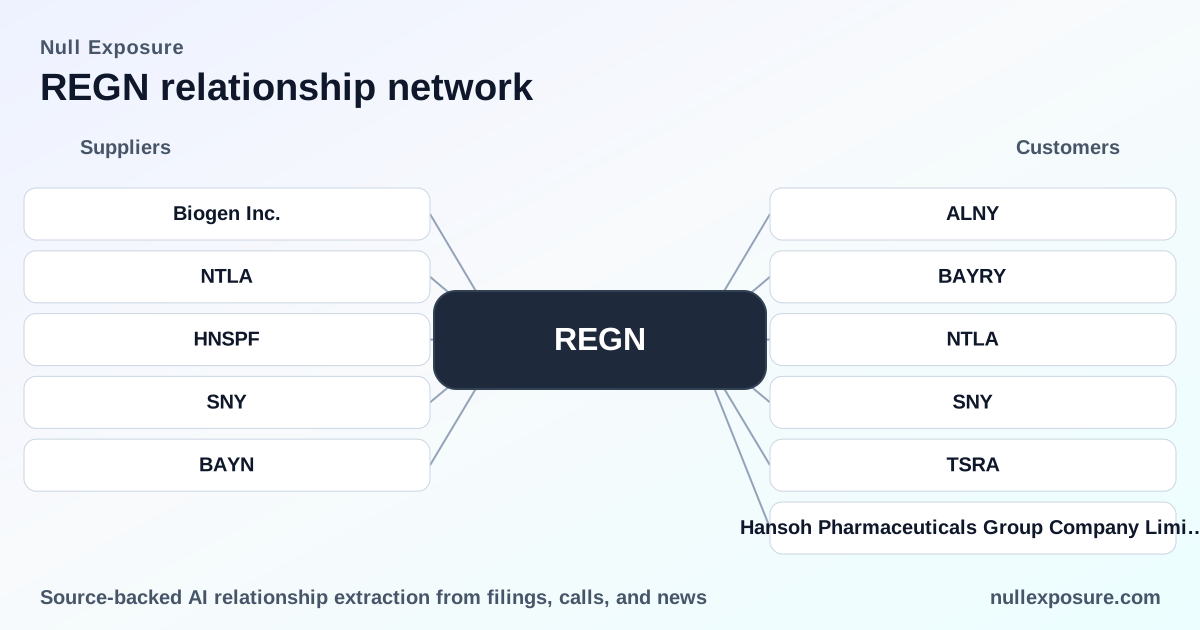
Regeneron (REGN): How its customer relationships shape revenue and risk
Regeneron is a fully integrated biopharmaceutical company that discovers, develops, manufactures and commercializes biologic medicines, and it monetizes primarily through product sales and collaboration revenues—notably a co-commercialization with Sanofi for Dupixent and licensing/collaboration receipts tied to partnered programs. For investors, the financial profile is driven by a small set of blockbuster products, high distributor concentration and a mix of strategic clinical and manufacturing relationships that both expand the pipeline and create operational dependencies. Learn more at https://nullexposure.com/.
The headline thesis for investors
Regeneron combines in-house R&D and manufacturing scale with selective external partnerships to accelerate pipeline programs and broaden commercial reach. Dupixent and EYLEA remain the revenue engines, while collaborations (Sanofi, Bayer) and targeted clinical supply or trial agreements (Decibel, Immuneering, Elicio, Telix, others) serve to derisk development and capture incremental royalties or milestone and supply economics. That model produces strong gross margins but concentrates counterparty risk around distributors and a handful of strategic partners.
How each external relationship plugs into Regeneron’s model
Below I list every customer/partner relationship flagged in the collected results and what it means for Regeneron investors. Each relationship summary is followed by its source.
Decibel Therapeutics (DBTX)
Regeneron granted Decibel broad access to its proprietary technology suite to support discovery of hearing medicines, reflecting a pre-commercial R&D collaboration rather than a pure commercial supply contract. This relationship signals Regeneron’s playbook of using platform assets to seed external innovation while retaining upside. Source: joint press release reported by Hearing Review (March 9, 2026).
Immuneering Corporation (IMRX)
Immuneering and Regeneron entered a clinical trial agreement to evaluate atebimetinib combined with Regeneron’s anti‑PD‑1 Libtayo in advanced non‑small cell lung cancer, a clinical collaboration to test combination regimens that could extend Libtayo’s label and commercial reach. Source: Immuneering press coverage and Quiver Quant summary (Feb 2025 / reported Mar 2026).
Elicio Therapeutics (ELTX)
Elicio entered a clinical supply agreement with Regeneron to combine ELI‑002, a KRAS‑targeted vaccine candidate, with Regeneron’s Libtayo (cemiplimab), indicating Regeneron’s willingness to supply and support combination trials that could enhance Libtayo’s oncology portfolio. Source: Elicio press release synopsis (reported Mar 2026).
Sanofi (SNY)
Sanofi is Regeneron’s largest collaboration counterparty and co‑commercialization partner for Dupixent; collaboration revenues constitute the majority of collaboration income, with Sanofi representing ~80% of collaboration revenue. This is a strategic commercialization partnership that drives a large portion of Regeneron’s top line. Source: MarketScreener reporting of FY2026 collaboration revenue mix (May 2026) and contemporaneous earnings commentary.
Bayer (BAYRY)
Bayer is a collaborator on EYLEA (including the 8 mg formulation) and accounted for a material portion of collaboration revenues outside of Sanofi’s share; the Bayer tie reflects product licensing and co‑development/commercialization economics in ophthalmology. Source: SimplyWall.St and MarketScreener references to license and collaboration agreements (FY2026 context).
Tessera Therapeutics (TSRA)
Tessera is mentioned as developing gene‑editing assets; the relationship note suggests potential strategic alignment around gene editing therapeutics but is listed as informational—Regeneron’s interaction appears oriented toward technology pairing or monitoring of adjacent gene‑editing advances that could inform its pipeline. Source: SimplyWall.St company summary (reported Mar 2026).
Telix (TLX)
Regeneron and Telix entered a broad collaboration pairing Regeneron antibodies with Telix’s radiopharmaceutical platform, signaling exploration of antibody‑directed radiotherapeutics and diagnostics across solid tumors, which could create new product modalities and addressable markets. Source: SimplyWall.St coverage of the Regeneron–Telix collaboration (May 2026).
Alnylam Pharmaceuticals (ALNY)
Alnylam is listed in context of discovery and development work for RNAi therapeutics; Regeneron’s mention alongside Alnylam indicates industry relevance and potential scientific collaboration vectors rather than a disclosed commercial customer relationship in the dataset. Source: SimplyWall.St company notes (Mar 2026).
Intellia Therapeutics (NTLA)
Intellia’s CRISPR/Cas9 platform is flagged in relation to in‑vivo gene editing efforts; Regeneron’s mention alongside Intellia signals technology surveillance and potential collaboration interest, consistent with Regeneron’s pattern of platform partnerships. Source: SimplyWall.St company summary (Mar 2026).
Kiniksa (KNSA)
Kiniksa disclosed that Regeneron is the sole source manufacturer of their ARCALYST drug substance until an alternate CDMO is qualified, highlighting Regeneron’s role as a contract manufacturer for third‑party products, which creates a commercial revenue line and an operational dependency for the counterparty. Source: Kiniksa 10‑K excerpt (FY2024 filing).
Rare (RARE)
Rare Disease Therapeutics reported that Evkeeza drug substance is manufactured by Regeneron at Regeneron’s Rensselaer facility, which is another example of third‑party drug substance manufacturing services provided by Regeneron and reflects its in‑house manufacturing monetization. Source: Rare 10‑K excerpt (FY2024 filing).
Hansoh Pharmaceuticals Group
Hansoh was referenced as acquiring rights for an asset (HS‑20094) with Regeneron mentioned in the context of broader company coverage; this entry indicates regional licensing activity and the international commercialization footprint that Regeneron supports through partner deals. Source: SimplyWall.St coverage (Mar 2026).
What the relationships collectively tell investors
- Concentration and criticality: Regeneron’s revenues are heavily concentrated in a few products and partnerships—Sanofi is the dominant collaboration counterparty and two distributor customers accounted for 77% of gross product revenue in 2025—creating high counterparty concentration risk that amplifies operational or pricing shocks.
- Vertical integration plus third‑party manufacturing: Regeneron’s model is both product‑centric and manufacturing‑capable, evidenced by Kiniksa and Rare using Regeneron as a drug substance manufacturer; manufacturing is a monetizable capability and a source of operational lock‑in for certain customers.
- Strategic clinical collaborations: Agreements with biotechs (Decibel, Immuneering, Elicio, Telix) demonstrate a deliberate strategy to extend commercial labels and enter new modalities via combination trials and technology pairing—a growth lever that leverages existing marketed immuno/antibody assets (Libtayo, Dupixent).
- Global exposure and payer complexity: Contract excerpts emphasize dependence on global reimbursement systems and government payors (Medicare/Medicaid), so market access and pricing dynamics across geographies are a persistent revenue constraint.
- Counterparty types and role: The company sells to distributors, wholesalers and specialty pharmacies and also contracts as a manufacturer for third parties—so Regeneron is simultaneously a seller, supplier and strategic partner across its relationship set.
Investment implications and risks
- Upside: Pipeline extension via collaborative trials (Libtayo combinations, radiopharmaceutical pairings) and monetized manufacturing for third parties provide diversified revenue paths beyond core product sales.
- Downside: High distributor concentration and dependence on a small set of partners (Sanofi foremost) create single‑entity exposure to demand, pricing and contractual terms—this requires active monitoring of partner litigation, payer negotiations and distributor contract renewals.
- Operational: Manufacturing third‑party drug substance increases utilization and margin stability but introduces customer operational obligations and quality/regulatory risk that scale with third‑party engagements.
For a structured dataset view and to monitor how these customer relationships evolve over time, visit https://nullexposure.com/ for ongoing coverage and curated signals.