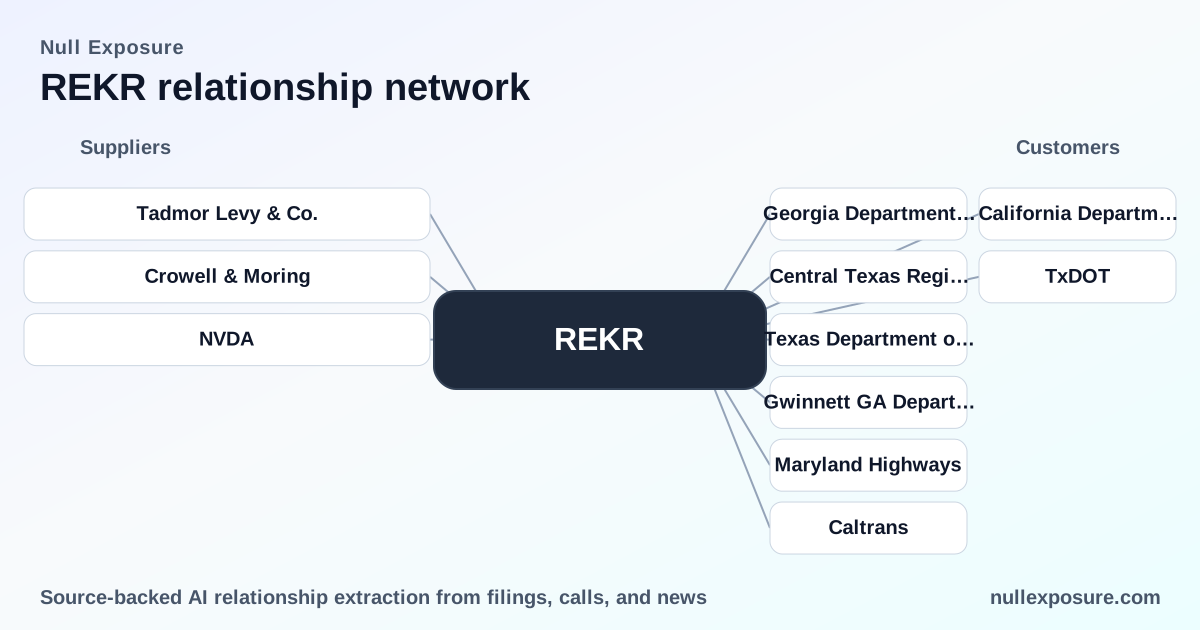
Rekor Systems (REKR) — State DOT deals drive the revenue runway
Rekor Systems sells AI-driven vehicle identification and roadway intelligence products to public-sector agencies and commercial operators, monetizing through a mix of SaaS subscriptions, long‑term licensing, hardware sales and implementation services. Recent wins with multiple state Departments of Transportation and municipal authorities convert pilots into scalable, recurring revenue opportunities and materially shift the company’s go‑to‑market from proof‑of‑concept work toward enterprise and statewide deployments. For a concise signal pack and deeper relationship mapping, visit https://nullexposure.com/.
Why investors should watch state DOT contracts now
Rekor’s business is structured to scale through large government procurements. Statewide blanket purchase orders and multi‑year DOT contracts (including a headline Georgia award) create durable addressable markets because they allow Rekor to layer SaaS, licensing and hardware across dozens of districts without re‑qualifying each sale. ITS International and multiple press releases document a recent acceleration in such awards, which is central to the company’s path to recurring revenue and margin improvement.
A mid‑cycle, investor‑facing conclusion: the transition from pilot projects to multi‑year state contracts is the key value inflection for REKR — supporting revenue visibility while concentrating counterparty risk in public agencies.
Customer relationships — what was reported and where it matters
Below are the distinct customer relationships reported in media and company transcripts. Each listing is a plain‑English one or two sentence summary with the source noted.
-
Texas Department of Transportation (TxDOT)
Rekor holds a statewide blanket purchase order enabling district‑level deployment of Rekor Command®, and announced a $2.1 million contract expansion for additional deployments. (See Markets FinancialContent press release and ITS International coverage, March 2026: https://markets.financialcontent.com/stocks/quote/news?ChannelType=PRESSRELEASES&Language=english&CurrentPage=1&Symbol=NQ%3AREKR; https://www.itsinternational.com/news/rekor-wins-50m-georgia-dot-deal) -
Georgia Department of Transportation (GDoT)
Rekor secured what the company described as its largest statewide multi‑year contract to date — announced with a floor value of at least $50 million and public commentary suggesting potential total value in excess of $100 million over the contract term. (ITS International and insider earnings transcript, Oct 2025; Yahoo Finance summary, March 2026: https://www.itsinternational.com/news/rekor-wins-50m-georgia-dot-deal; https://finance.yahoo.com/news/rekor-systems-rekr-14-9-090929701.html) -
Central Texas Regional Mobility Authority
The Central Texas Regional Mobility Authority is listed among recently signed customers, signaling Rekor’s footprint expansion across regional mobility agencies in Texas. (ValueWalk article, Oct 2025: https://www.valuewalk.com/news/heres-1-ai-penny-stock-to-put-on-your-radar/) -
Gwinnett GA Department of Transportation
Rekor announced a five‑year traffic counting contract with Gwinnett County — a localized, multi‑year procurement that complements larger statewide awards in Georgia. (Markets FinancialContent press release, March 2026: https://markets.financialcontent.com/stocks/quote/news?ChannelType=PRESSRELEASES&Language=english&CurrentPage=1&Symbol=NQ%3AREKR) -
Maryland Highways
Rekor launched a $1.5 million roadway intelligence program for Maryland highways, indicating state‑level demand beyond the large southern states referenced elsewhere. (Markets FinancialContent press release, March 2026: https://markets.financialcontent.com/stocks/quote/news?ChannelType=PRESSRELEASES&Language=english&CurrentPage=1&Symbol=NQ%3AREKR) -
California Department of Transportation (Caltrans)
Caltrans has commenced initial installations of Rekor Discover® across districts, positioning Rekor for scalable opportunities in the nation’s largest state DOT. (Company commentary and Yahoo Finance summary, March 2026: https://finance.yahoo.com/news/rekor-systems-rekr-14-9-090929701.html; Marketscreener report, March 2026: https://www.marketscreener.com/news/rekor-systems-expects-record-q3-revenue-ce7d5ad9df8ef721) -
SSTI / SoundThinking (PlateRanger™ powered by Rekor)
SoundThinking’s security products integrate PlateRanger powered by Rekor®, showing channel partnership and OEM licensing use cases where Rekor’s ALPR technology is embedded inside third‑party safety platforms. (GlobeNewswire/ManilaTimes/Globe and Mail releases referencing SoundThinking and PlateRanger, Oct 2025–Feb 2026: https://www.manilatimes.net/2025/10/17/tmt-newswire/globenewswire/...; https://www.theglobeandmail.com/investing/markets/markets-news/GlobeNewswire/) -
South Carolina (state deployments)
The company highlighted that Rekor technology powers South Carolina’s virtual way station network, demonstrating another state deployment beyond pilot stages. (Q3 2025 earnings call transcript coverage, InsiderMonkey, Oct 2025: https://www.insidermonkey.com/blog/rekor-systems-inc-nasdaqrekr-q3-2025-earnings-call-transcript-1647531/) -
City of Austin
Austin issued a purchase order under a local RFP, representing expanded municipal contracting and downstream procurement activity at the city level. (Earnings call transcript, InsiderMonkey, Oct 2025: https://www.insidermonkey.com/blog/rekor-systems-inc-nasdaqrekr-q3-2025-earnings-call-transcript-1647531/) -
Florida (state deployments)
The company reported new Discover deployments in Florida and other states, consistent with the broader rollout strategy for Rekor Discover®. (Earnings call transcript coverage, InsiderMonkey, Oct 2025: https://www.insidermonkey.com/blog/rekor-systems-inc-nasdaqrekr-q3-2025-earnings-call-transcript-1647531/)
What the relationship map signals about the operating model
Collectively, these reported relationships produce a clear set of company‑level operational signals:
-
Contracting posture: Rekor sells through a mix of SaaS subscriptions, long‑term licenses and hardware/service bundles, and often wins work via RFPs and blanket purchase orders that favor district‑by‑district rollout. (Company disclosures on sales strategy and press statements.)
-
Customer concentration and counterparty type: The company’s primary market is state and local government, with no single customer historically accounting for over 10% of revenue — yet several large state DOT engagements concentrate commercial exposure in public agencies. (Company financial disclosures.)
-
Criticality and role: For DOTs and mobility authorities, Rekor provides mission‑critical traffic counting, ALPR and roadway intelligence; the firm functions as both licensor and service provider, integrating software, hardware and ongoing support.
-
Maturity of engagements: The portfolio shows a mix of pilots and active, multi‑year contracts, indicating the business is in the scaling phase rather than purely experimental deployments.
-
Product mix: Revenue derives from software (SaaS), services (implementation/maintenance) and hardware, enabling multi‑line monetization but also requiring broader execution capability.
-
Geography: While Rekor reports a global presence, the primary revenue concentration is North America and U.S. state/local agencies.
These signals imply a go‑to‑market that is increasingly repeatable for large public sector buyers but remains execution‑sensitive given hardware rollouts and integration complexity.
Investment implications — risks and upside
-
Upside: Large, multi‑year DOT contracts are the clearest lever for recurring revenue and valuation re‑rating if Rekor converts installations to sustained subscription and support streams. The Georgia deal in particular validates the statewide playbook.
-
Risk: Revenue concentration in public sector procurement cycles and the operational complexity of hardware + software implementations create execution risk; state budgets and procurement timing can compress near‑term revenue recognition.
-
Operational watch items: retention rates on subscription licenses, margins on bundled hardware deployments, and the conversion rate from pilot to statewide contract rollouts.
For comprehensive relationship intelligence and to track newly reported contracts in real time, visit https://nullexposure.com/.
Bottom line
Rekor’s recent customer reporting shows a purposeful shift from isolated pilots to enterprise‑scale state contracts and regional deployments, combining SaaS, licensing and hardware into a single growth narrative. If execution on these DOT awards proceeds on schedule, recurring revenue and margin improvement follow; if rollouts stall, the same concentration that enables scale will become a short‑term headwind. Investors should track contract rollouts, subscription conversions and municipal adoption metrics as the primary drivers of company performance.