RELI: What the Employee Benefits Divestiture Reveals About Customer Strategy
Reliance Global Group (RELI) operates as a provider of insurance and risk services and monetizes through a mix of brokerage commissions, benefits administration fees, consulting engagements, and selective asset sales. The company’s strategic choice to divest a benefits brokerage unit signals a sharper focus on higher-margin or higher-scale lines of business and a preference for transactional, capital-light monetization over operating lower-return retail businesses. For a concise view of RELI’s customer posture and implications for counterparty risk, see our coverage at https://nullexposure.com/.
The deal in plain English: Employee Benefit Solutions purchase
Reliance Global Group sold substantially all assets of its Employee Benefits Solutions and US Benefits Alliance insurance brokerage business to Employee Benefit Solutions for $1.05 million in cash. According to a TradingView summary of the company announcement, the transaction was recorded in FY2025 and disclosed publicly on March 10, 2026. This was a clean asset sale, not an equity merger, transferring the brokerage assets to Employee Benefit Solutions in exchange for immediate cash consideration.
What this relationship says about RELI’s customer footprint
The asset sale to Employee Benefit Solutions reduces RELI’s direct exposure to the small-group and employee-benefits brokerage market. A $1.05 million cash sale price is a clear signal that the divested business was a modest contributor to enterprise value, implying low revenue run-rate or compressed margins in that unit. The transaction moves risk off RELI’s balance sheet and transfers customer servicing responsibilities to the buyer, altering RELI’s future customer revenue mix toward its retained lines.
- Source: TradingView reporting of the company release (March 10, 2026).
Why investors should care: revenue composition and counterparty implications
This divestiture is material for investors because it changes the composition of ongoing customer cash flows and counterparty risk:
- Revenue mix shift. By shedding an employee-benefits brokerage, RELI reduces reliance on commission-heavy, low-barrier retail businesses and concentrates on remaining segments where it expects better margins or scale economies.
- Capital redeployment and liquidity. The $1.05 million proceeds are immediate liquidity that can be redeployed toward core operations, debt reduction, or strategic investments; the modest size limits the near-term balance-sheet impact but signals prioritization.
- Counterparty transition. Customers formerly served by the divested unit become contractual clients of Employee Benefit Solutions, removing direct customer contact and servicing obligations from RELI and transferring retention risk to the buyer.
These outcomes are consistent with a deliberate pivot away from small, operationally intensive customer relationships toward more scalable, advisory or wholesale channels.
Operating model and business-model constraints — company-level view
There were no explicit constraint disclosures provided in the available materials for RELI’s customer relationships, which itself is informative. The absence of contract-level constraints or long-term customer commitments in public filings signals a business that often operates through transactional, commission-based arrangements rather than long-duration captive contracts. From an investor perspective:
- Contracting posture: RELI’s business posture is consistent with short-to-medium term brokerage and services agreements that allow the firm to spin off non-core books quickly through asset sales.
- Concentration and criticality: The modest sale price and the act of divestiture indicate the divested unit was not a critical or concentrated revenue source for RELI; the company can afford to transfer those customer relationships without threatening core operations.
- Maturity and refocus: The move fits a corporate lifecycle pattern where management consolidates around scalable offerings and sheds legacy or weak-margin segments to streamline operations and improve return on invested capital.
These are company-level signals drawn from transaction behavior and the lack of contract disclosures, not constraints tied to any named customer contract.
Customer relationships covered (complete list)
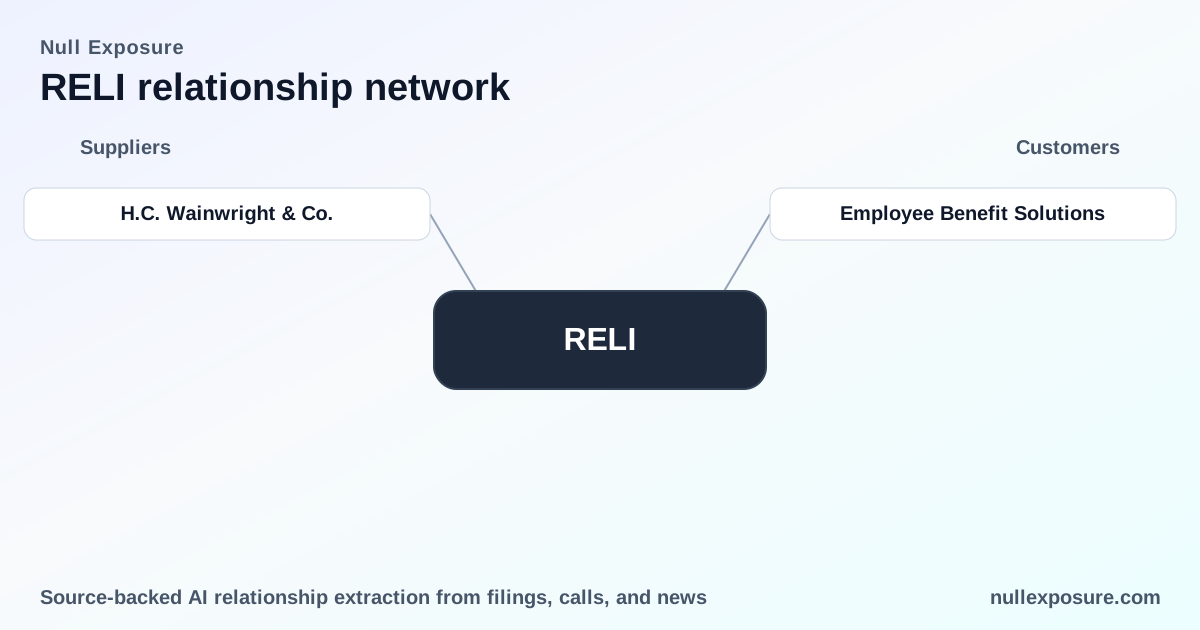
Employee Benefit Solutions — Reliance sold substantially all assets of its Employee Benefits Solutions and US Benefits Alliance insurance brokerage business to Employee Benefit Solutions for $1.05 million in cash, transferring the customer book and servicing responsibilities to the purchaser. This transaction was disclosed in FY2025 and reported publicly on March 10, 2026. (TradingView coverage of the company release, March 2026.)
Risk factors and what to watch next
- Customer transparency. Publicly available customer relationship reporting is sparse; investors should expect limited line-item disclosure on customer concentration unless RELI discloses larger strategic partnerships.
- Execution risk on redeployment. The cash from a small asset sale is limited; watch whether management uses proceeds for deleveraging, tuck-ins, or operational investment — each choice has different implications for earnings volatility.
- Retention and transition risk. Although the buyer assumed the customer book, the true test is client retention post-transfer; loss of customers during handover would remove potential commission recapture and could depress industry goodwill metrics for the sold unit’s cohort.
Bottom line for investors
This transaction is a strategic clean-up move: RELI is exiting a low-scale employee-benefits brokerage unit and converting a discrete set of customer relationships into cash. The sale reflects a company posture that favors focused, higher-return lines over operating small, labor-intensive retail brokerages. For analysts monitoring RELI, the key questions are how management redeploys the proceeds, whether further divestitures follow, and whether the company will disclose more about the remaining customer composition.
For a broader review of RELI’s counterparty relationships and a structured investor brief, visit https://nullexposure.com/.