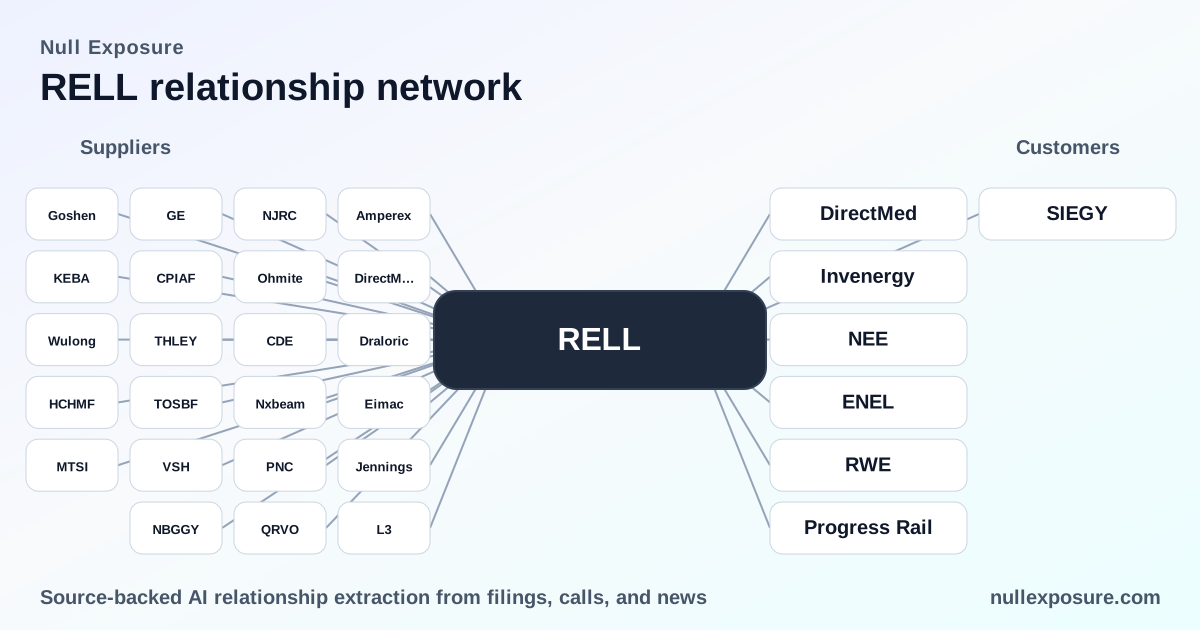
Richardson Electronics (RELL): customer map and commercial implications for investors
Richardson Electronics monetizes through a mix of component manufacturing, repair and aftermarket services across power & microwave technologies, custom display hardware, and green/medical equipment; revenue comes from product sales, long-term supply arrangements, and recurring aftermarket service programs. Key value drivers are specialized manufacturing capabilities (CT tube repairs, energy storage systems) and exclusive service agreements that convert technical know-how into predictable revenue streams. For a deeper look at relationship-level signals and contract structure, see https://nullexposure.com/.
Why customers define the investment case
RELL runs a hybrid commercial model: long-term, exclusive supply for select medical products sits alongside volume-driven, open-account distribution and short-term service contracts in industrial and green-energy segments. This mix produces modest revenue concentration at the company level but acute concentration at the product level—an important distinction for risk and valuation.
- Contracting posture: RELL operates both long-term exclusive arrangements (notably a 10-year supply deal) and standard net-30 open-account terms with distribution customers.
- Concentration: No single customer exceeded 10% of consolidated sales in FY2025, yet discrete product lines (CT tubes) are now sold exclusively to a single counterparty.
- Criticality and maturity: Long-term supply and repair programs (10-year for CT tubes; multi-year service rollouts with turbine owners) raise the criticality of a handful of counterparties while increasing revenue visibility.
- Geography: RELL is global, with ~56% of sales outside the U.S. in FY2025, which diversifies end markets but exposes the firm to international execution and receivables dynamics.
Relationship roll call — what each counterparty buys and why it matters
DirectMed
RELL sold a substantial portion of its Healthcare assets to DirectMed on January 24, 2025 and entered an exclusive 10-year global supply agreement under which RELL manufactures and repairs CT X‑ray tubes and sells them exclusively to DirectMed. This structure shifts the healthcare product line from a diversified customer base to a single-counterparty distribution model and concentrates product-level risk. (Source: FY2025 10‑K filing, May 2025; earnings call transcripts Q2/Q3 FY2026)
SSB
RELL is expanding a turbine-related program into Europe and Asia that includes SSB as a target platform, indicating active international growth of its green-energy product set. The company referenced SSB in its Q3 FY2026 commentary on program expansion. (Source: Q3 FY2026 earnings call transcript, InsiderMonkey, May 2026)
NextEra
NextEra is named among the top owner-operators partnered with RELL on wind-turbine aftermarket programs, reflecting strategic relationships with major renewable asset owners that drive scale in the green-energy segment. (Source: Q2 FY2026 and Q3 FY2026 earnings call transcripts, InsiderMonkey, Mar–May 2026)
Enel
Enel is listed as one of four exclusive owner-operator partners for RELL’s GE wind-turbine program, reinforcing exposure to large European utility-scale customers and the company’s ability to secure strategic OEM relationships. (Source: Q2/Q3 FY2026 earnings call transcripts, InsiderMonkey, Mar–May 2026)
Invenergy
Invenergy appears in RELL’s list of exclusive wind-turbine owner-operator partners, which supports recurring parts and battery program revenue tied to turbine service agreements. (Source: Q2/Q3 FY2026 earnings call transcripts, InsiderMonkey, Mar–May 2026)
RWE
RWE is another top-four owner-operator cited as an exclusive partner for RELL’s GE wind-turbine initiatives, an arrangement that provides scale and a multi-year service runway for battery and electronics offerings. (Source: Q2/Q3 FY2026 earnings call transcripts, InsiderMonkey, Mar–May 2026)
GE
RELL is running a program with GE’s installer and service network to test replacement battery systems that would displace lead‑acid solutions under existing service agreements, positioning RELL as a supplier into GE-maintained turbine fleets. (Source: Q3 FY2026 earnings call transcript, InsiderMonkey, May 2026)
Senvion
Senvion was cited among turbine platforms targeted in RELL’s international expansion, highlighting RELL’s strategy to broaden product compatibility across multiple OEM platforms. (Source: Q3 FY2026 earnings call transcript, InsiderMonkey, May 2026)
Suzlon
Suzlon is named as a target platform in RELL’s international rollout of turbine products for Europe and Asia, signaling exposure to emerging-market turbine operators. (Source: Q3 FY2026 earnings call transcript, InsiderMonkey, May 2026)
Nordex
Nordex is included in RELL’s list of additional turbine platforms being targeted in international expansion, reflecting ongoing business development outside the company’s initial OEM partnerships. (Source: Q3 FY2026 earnings call transcript, InsiderMonkey, May 2026)
Great Lakes Crystal Technology
RELL confirmed shipments of several large microwave generators from Great Lakes Crystal Technology, indicating supplier or co-manufacturer relationships that support the PMT segment’s product delivery. (Source: Q3 FY2026 earnings call transcript, InsiderMonkey, May 2026)
Progress Rail
RELL highlighted prior battery shipments used in EV rail projects and cited Progress Rail’s recent deliveries as validation of that market opportunity, linking RELL’s battery manufacturing capability to rolling-stock electrification demand. (Source: Q2 FY2026 earnings call transcript, InsiderMonkey, Mar 2026)
Siemens / SIEGY
Management noted the healthcare transition following the divestiture and expects margin improvement as ALTA tube production concludes and Siemens repair programs ramp up under the post-sale supply and repair arrangements—Siemens was referenced in market reporting on the FY2026 quarter. (Source: Finviz market summary and commentary referencing FY2026 results, Mar 2026)
What the relationships imply for revenue growth and risk
DirectMed’s 10-year exclusive supply agreement materially alters the risk profile of RELL’s healthcare products: the company converts manufacturing and repair know-how into a single-account dependency for CT tubes, improving revenue visibility for that line but concentrating counterparty risk. Meanwhile, the green-energy and PMT segments are diversified across multiple OEMs and owner-operators (GE, RWE, Enel, NextEra, Invenergy, Nordex, Suzlon, Senvion), providing scale and customer diversification for aftermarket parts and battery systems.
Company-level signals reinforce this mixed posture:
- Long-term contractual maturity exists in targeted product lines (explicit 10-year DirectMed agreement).
- Shorter-term, open-account trade terms are standard in distribution channels (net-30 practices across geographies).
- Global revenue footprint (≈56% outside the U.S. in FY2025) reduces single-country dependence but increases execution complexity.
- Low single-customer concentration historically—no customer >10% of consolidated sales—does not eliminate product-level concentration introduced by the DirectMed sale.
Investment takeaways
- Strength: Proprietary manufacturing and repair capabilities allow RELL to secure exclusive, multi-year contracts that translate technical differentiation into predictable revenue.
- Risk: Product-level concentration (CT tubes sold exclusively to DirectMed) and reliance on a small number of large renewable-asset customers for scaling battery and turbine programs create asymmetric counterparty risk.
- Catalyst: International rollouts with major turbine operators and ramping Siemens repair programs present identifiable growth vectors for FY2027–FY2028.
For a complete map of RELL’s counterparties and contractual signals, visit https://nullexposure.com/ — the relationship view clarifies where revenue is repeatable and where it is concentrated.