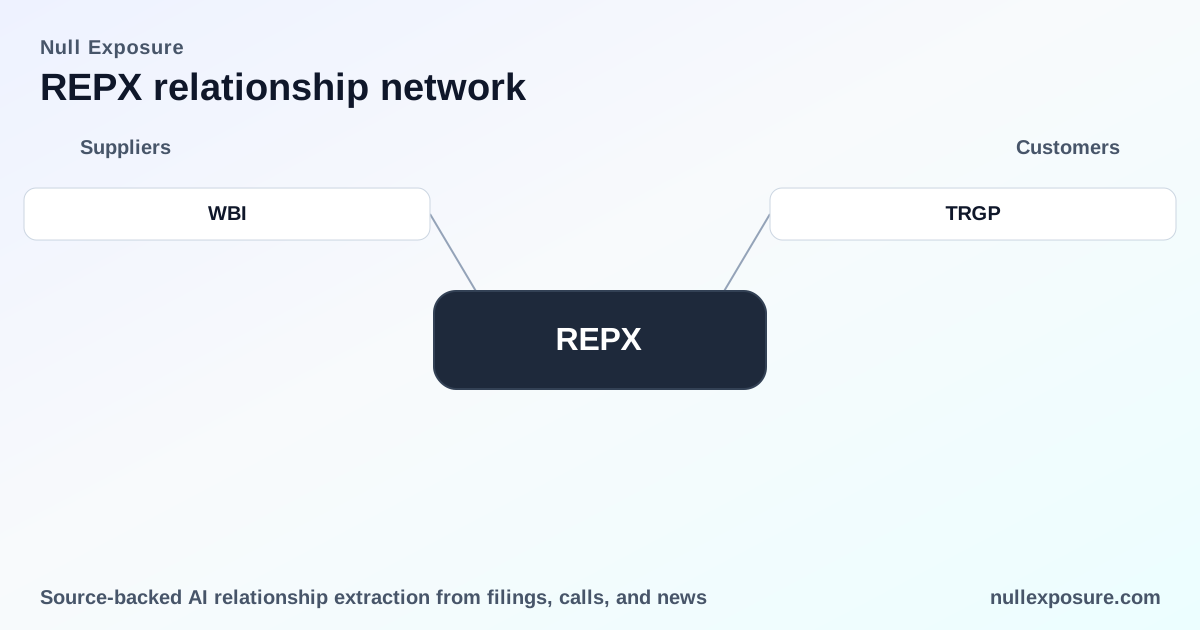
Riley Exploration Permian (REPX): Midstream sale to Targa tightens cash position but customer concentration remains the dominant risk
Riley Exploration Permian is a Permian Basin-focused independent E&P that monetizes through the sale of produced oil, natural gas and NGLs and occasional asset dispositions; the company also generates ancillary revenue from contractual services with related parties. The December divestiture of its New Mexico midstream interest produced a meaningful cash injection and potential earnout upside, but REPX continues to sell production to a small number of counterparties—a concentration profile that creates both stability in contracted volumes and outsized counterparty risk. For a deeper look at the transactional evidence and what it means for investors, visit https://nullexposure.com/.
The transaction in plain language and why it matters to investors
In December REPX sold its New Mexico midstream interest to Targa/affiliated entities for a combination of cash and contingent payments: $123 million cash up-front plus up to $60 million in future earnouts as disclosed on REPX’s Q4 2025 earnings call. That sells off midstream operations, converts infrastructure value into immediately realizable cash and reduces operational complexity, while leaving REPX focused on upstream production and commercial sales. According to third‑party reporting, the acquired entity (Dovetail Midstream, LLC) was described in press coverage as having been purchased for roughly $170 million, indicating the transaction was material to REPX’s asset base and liquidity position (FY2026 press coverage). The sale improves near-term liquidity and preserves upside via earnouts while shifting pipeline and connection risk to the buyer.
Document-level relationship evidence (each reported item)
-
REPX Q4 2025 earnings call — Targa: In the earnings call REPX stated it sold its New Mexico Midstream interest to Targa for $123 million in cash plus $60 million of possible earnouts, describing Targa as a “best‑in‑class” midstream operator; this disclosure was made in REPX’s Q4 2025 call material (first reported March 2026).
Source: REPX Q4 2025 earnings call (filed March 2026). -
REPX Q4 2025 earnings call — TRGP: The same earnings call referenced the acquirer by its ticker TRGP, reiterating the cash plus earnout economics for the December sale and positioning Targa as the counterparty to the midstream transfer.
Source: REPX Q4 2025 earnings call (filed March 2026). -
Simply Wall St coverage (FY2026) — Targa Northern Delaware LLC: Market reporting described that Targa Northern Delaware LLC acquired Dovetail Midstream, LLC from REPX for approximately $170 million, a broader-market summary of the same transaction that conveys market perception of total consideration.
Source: Simply Wall St coverage (May 2026). -
InsiderMonkey transcript (FY2026) — Targa: A published transcript of REPX’s Q4 2025 call mirrored the company’s wording about the sale to Targa, quoting the $123 million cash and $60 million earnout structure and reinforcing the company’s characterization of the buyer.
Source: InsiderMonkey Q4 2025 earnings call transcript (March 2026). -
Simply Wall St (future page, FY2026) — Targa Northern Delaware LLC: A subsequent Simply Wall St reference repeats the Targa Northern Delaware LLC / Dovetail Midstream acquisition narrative, reflecting corroborating third‑party summaries of the deal economics and buyer identity.
Source: Simply Wall St (May 2026). -
InsiderMonkey (FY2026) — TRGP: The transcript entry indexed REPX’s remarks identifying the acquirer with the TRGP ticker, again documenting the cash and contingent consideration and the operational rationale for the divestiture.
Source: InsiderMonkey Q4 2025 earnings call transcript (March 2026).
Operating constraints and what they signal about REPX’s customer posture
REPX’s disclosures and the contract excerpts reveal four structural characteristics that investors should weigh:
-
Long-term contracting where used provides production stability. REPX disclosed a long‑term gas purchase agreement for its New Mexico field with a 15‑year initial term from in‑service date, dedicated acreage provisions and reimbursement obligations for midstream connection costs (subject to a monetary cap of $18.7 million). This signals the company secures predictable offtake for portions of production but does take on limited construction reimbursement exposure.
-
High concentration of revenue with a single purchaser is critical. REPX reported that for the years ended December 31, 2024 and 2023 a single purchaser accounted for 70% of revenue purchased, and another purchaser represented 10% or more, which is a material and critical concentration that magnifies counterparty and pricing risk if either relationship changes.
-
REPX operates primarily as a seller of production, with ancillary service revenues. The company sells production at market prices to a small group of purchasers (the classic upstream commercial model) and also recognizes contract services revenue from master services agreements with related parties, indicating some related‑party service flows in addition to commodity sales.
-
Moderate transactional spend exposure. The disclosed reimbursement cap of $18.7 million places REPX’s construction‑related cash exposure in a $10–100 million band—material on a per‑project basis but bounded by the stated cap.
These signals together imply a company that trades off operational simplicity and liquidity (through asset sales) against ongoing counterparty concentration risk and limited but real construction reimbursement liabilities.
Investment implications: balance sheet, valuation and risk priorities
The midstream sale to Targa is net positive for liquidity: $123 million cash plus earnout potential immediately strengthens the balance sheet and reduces direct midstream operating scope. REPX’s reported metrics—market capitalization around $793 million, EBITDA roughly $235 million, trailing P/E near 4.8 and a dividend yield in the low single digits—paint a picture of a cash‑generative upstream operator that rewards shareholders while retaining material counterparty exposure.
-
Upside drivers: monetization of non-core midstream assets, continued free cash flow from Permian production, and contingent earnout upside if midstream volumes or economics meet agreed milestones.
-
Key risks: one purchaser representing ~70% of revenue is the single largest operational risk; any disruption in that commercial relationship would have immediate revenue and cash‑flow implications. Contractual protections (long‑term offtake agreements) reduce short‑term volatility but do not eliminate concentration exposure.
For investors evaluating REPX’s customer relationships, the transaction demonstrates management’s willingness to monetize infrastructure to prioritize upstream cash flow and de‑risk operations, but due diligence should focus on counterparty credit, the specifics of long‑term offtake pricing, and the mechanics and likelihood of the earnout payments.
If you want a consolidated view of REPX counterparties and how these relationships change the company’s risk profile, see more detailed coverage at https://nullexposure.com/.
Bottom line
The Targa purchase converts midstream value to cash and transfers execution risk to a large midstream operator, but REPX remains commercially concentrated and therefore sensitive to purchaser behavior. Investors should treat the transaction as liquidity‑positive and strategically sensible, while prioritizing counterparty and contractual detail in any investment decision.