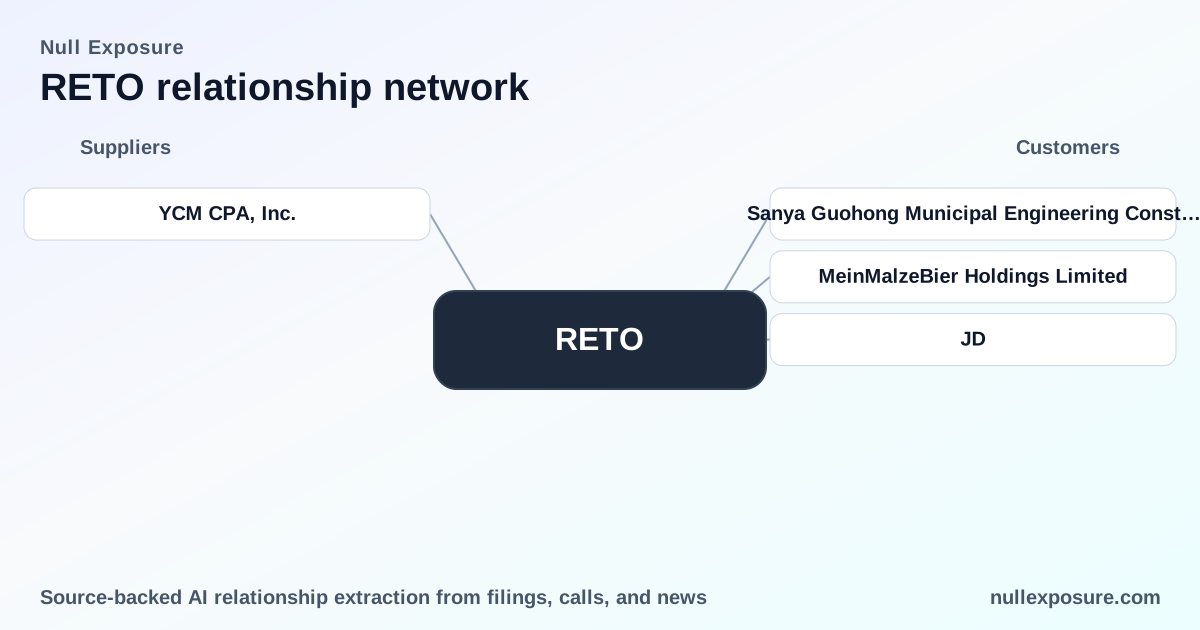
ReTo Eco-Solutions (RETO): Customer relationships that drive a small-cap Chinese building-materials play
ReTo Eco-Solutions manufactures and distributes building materials in China and monetizes through project sales contracts, retail e-commerce channels and targeted acquisitions that extend distribution reach and product breadth. Revenue is driven by contract wins with municipal and construction customers, direct-to-consumer listings on platforms such as JD.com, and strategic acquisitions to accelerate market entry for new product lines. For investors assessing customer risk and growth vectors, the mix of municipal contracts, channel partnerships and recent acquisition activity defines both the upside and the concentration risks.
If you want a concise, sourced read on how ReTo’s customer ties affect valuation and execution risk, read on — or visit https://nullexposure.com/ for broader coverage and tracking of corporate relationship signals.
How ReTo operates in practice: commercial posture and company-level signals
ReTo operates as a manufacturing and distribution business with project-level sales and online retail exposure. The company's financials show micro-cap scale and operating losses: trailing revenue of roughly $3.37 million with negative EBITDA and a large trailing negative EPS, underscoring early-stage profitability dynamics and cash-flow pressure. Institutional ownership is effectively negligible while insider ownership is modest, which translates into thin analyst coverage and elevated governance and liquidity risk for investors.
From an operating-model perspective, observe these company-level signals:
- Contracting posture: sales driven by discrete contracts with municipal or construction firms rather than long-term recurring revenue streams.
- Concentration and maturity: small revenue base and single-figure institutional ownership indicate a concentrated, early-stage commercial profile.
- Channel mix and criticality: a direct-to-consumer presence on JD.com and the use of acquisitions to buy distribution and market experience point to a hybrid channel strategy that combines project sales with retail marketing.
- Execution sensitivity: negative margins and low market cap make revenue delivery and successful integration of acquisitions material to near-term valuation.
These are company-level signals drawn from financials and relationship evidence rather than prescriptive constraints, and they should guide diligence priorities: contract terms, customer concentration, working-capital needs, and post-acquisition integration execution.
Customer and partner relationships: what the record says
Below are all relationships surfaced in the recent coverage and what each one implies for investors. Each entry is sourced to the original report.
Kodak (KODK) — product collaboration that broadens retail visibility
ReTo partnered with Kodak on a palm-sized point-and-shoot camera which sold out on Kodak’s website and was available for pre-order at some affiliated retailers, demonstrating ReTo’s ability to participate in co-branded consumer-product initiatives outside its core building-materials business. According to CNBC (Sept 11, 2025), the Kodak collaboration drove immediate retail demand and inventory sell-through: https://www.cnbc.com/2025/09/11/kodak-vintage-style-toy-camera-chamera.html
Sanya Guohong Municipal Engineering Construction Co., Ltd. — municipal project contract
A ReTo unit, Ruitu Mingsheng Environmental Protection Building Materials (Changjiang) Co., Ltd., won a sales contract valued at RMB 10.71 million from Sanya Guohong Municipal Engineering Construction Co., Ltd., illustrating the company’s project-level municipal sales capability and reliance on discrete construction contracts for revenue. The award was reported in an RTT News item covering the firm’s contract wins (FY2021): https://www.rttnews.com/amp/3175029/stock-alert-reto-eco-solutions-zooms-30-after-winning-contract.aspx
MeinMalzeBier Holdings Limited — acquisition to accelerate new product rollout
ReTo announced the acquisition of MeinMalzeBier to leverage that entity’s sales network and market experience to accelerate adoption of a new product line, signaling a strategy of buying distribution and go-to-market capability rather than building it organically. A company release picked up by Yahoo Finance (FY2025) described the expected synergies between ReTo’s new products and MeinMalzeBier’s sales channels: https://finance.yahoo.com/news/reto-eco-solutions-inc-announces-131500735.html
MeinMalzeBier Holdings — corroborating coverage of the same acquisition (FY2026)
Independent coverage reiterated the strategic rationale: the MeinMalzeBier acquisition is intended to create synergies that speed market penetration for ReTo’s new offerings, reinforcing that acquisitions are a central tactical lever in ReTo’s commercialization approach. Intellectia.ai captured the FY2026 reporting on the transaction and expected synergies: https://intellectia.ai/stock/RETO.O/news
JD — launch of a TO-C (consumer) sales model via JD.com
ReTo launched a direct-to-consumer sales model through JD.com, reflecting a deliberate expansion into mainstream e-commerce to reach retail buyers and diversify beyond institutional construction contracts. The Finviz summary (citing a Business Wire release) identifies JD as the chosen channel for TO-C distribution (FY2018): https://finviz.com/quote.ashx?t=RETO
JD.com — same channel relationship reiterated
A second entry reiterates the JD.com channel launch, confirming that JD.com functions as an active retail route-to-market and contributes to ReTo’s channel diversification strategy away from pure B2B sales. The underlying Business Wire notification is summarized on Finviz for FY2018: https://finviz.com/quote.ashx?t=RETO
What these relationships mean for valuation and risk
- Revenue upside tied to execution of channel expansion and acquisition integration. The Kodak collaboration and JD.com listing demonstrate ReTo’s capacity to reach retail customers; the MeinMalzeBier acquisition shows management’s willingness to buy distribution instead of incubating it. Successful execution of these moves will compress execution risk and unlock multiple routes to revenue growth.
- Earnings and liquidity remain vulnerabilities. With negative EBITDA and a micro-cap market capitalization, ReTo’s valuation is sensitive to single large contracts and integration outcomes. Project-level contracts such as the Sanya Guohong award are material to quarterly performance.
- Concentration and thin institutional ownership elevate governance and liquidity risk. The company-level signals—low institutional stake and modest insider ownership—create a market environment where price action will be volatile and trading liquidity thin.
- Partner quality and contract terms are critical. Investors should prioritize diligence on contractual protections (payment terms, retention, performance bonds) and on the depth of JD.com exposure and Kodak collaboration economics.
If you want to track how these customer signals evolve alongside new contract wins and releases, see broader relationship tracking at https://nullexposure.com/.
Bottom line: relationship-driven story with execution-dependent upside
ReTo’s customer footprint combines municipal contracts, channel partnerships and acquisitions as the primary levers for revenue growth. That structure generates binary outcomes: successful integration and channel scale-up will materially re-rate the stock, while contract delays or poor post-acquisition execution will keep losses and liquidity pressure at the center of the investment thesis. Investors should prioritize contract diligence, receivable and working-capital dynamics, and the performance of the JD.com and Kodak channels when modeling upside or downside scenarios.