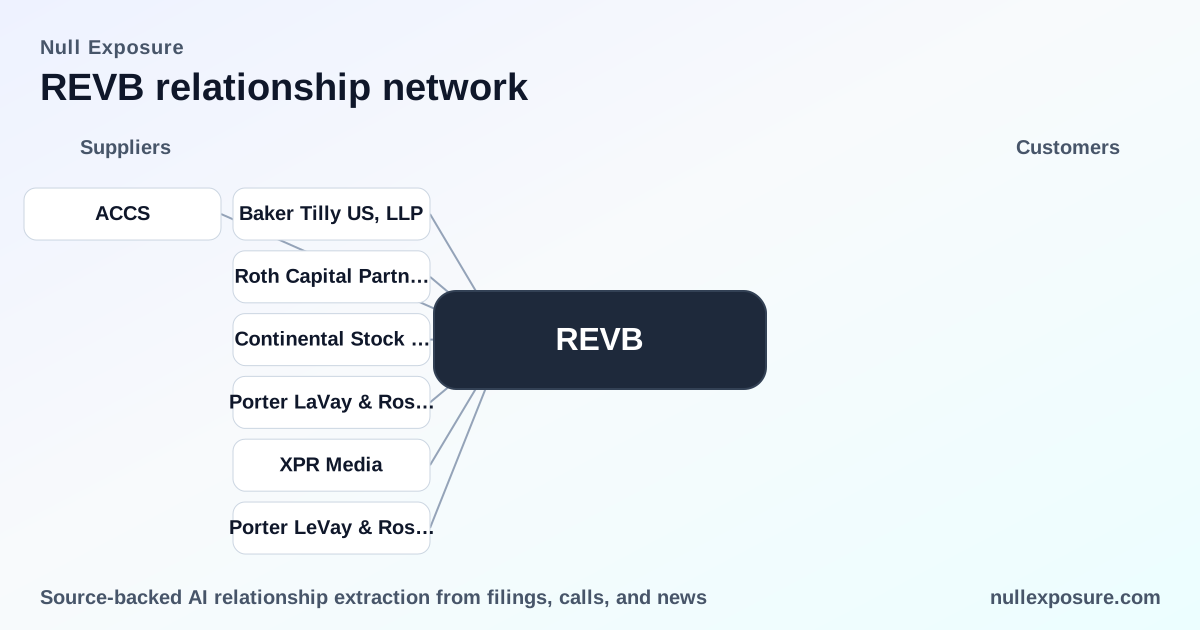
REVB customer map: what three public references reveal about commercial traction
Revel-based customer citations tied to REVB show a focused commercial profile: deployments of a point-of-sale and retail operations stack into multi‑unit restaurant and coffee chains, monetized through software subscriptions, hardware installs and professional services tied to reimage and rollout projects. For investors, the visible evidence points to repeatable enterprise implementations that drive ongoing platform revenue and integration-led stickiness—and also to the typical concentration and contract-awareness risks that accompany a small number of named clients.
For a concise companion to this read, visit the Null Exposure research hub: https://nullexposure.com/
How to read these relationship signals as an investor
The three captured items are not volumetric sales data; they are operating signals. When customers publicly cite a vendor in the context of reimages, POS installs, and analytics, that implies multi‑phase commercial relationships (hardware + software + services) and likely recurring revenue. Such relationships generate predictable cash flow if the vendor secures contractually bound subscriptions and service agreements, but they also create exposure to a few large deployments driving material revenue swings.
No contract‑level constraints were returned in the dataset for REVB, which itself is a telling company‑level signal: there is limited public disclosure on formal contract terms or concentration thresholds in the coverage set, so diligence should prioritize direct contract review and customer-level revenue attribution where possible. Typical operating model characteristics implied by the customer references below include:
- Contracting posture: deployments tied to capital projects (reimages, new builds) plus ongoing subscriptions, implying a hybrid one‑time + recurring revenue mix.
- Concentration: public mentions of sizeable rollouts for individual brands indicate potential revenue concentration by client if rollouts are large relative to company scale.
- Criticality: POS and analytics are mission‑critical to multi‑unit operators, supporting higher switching costs once integrated.
- Maturity: named franchise and coffee‑chain deployments imply enterprise‑grade capability to handle multi‑site rollouts and integrations.
RAVE — a reimage program that explicitly installed Revel POS
RAVE’s FY2026 third‑quarter release states the company invested in reimaging its franchise buffets and the construction of new locations, and that the plan included “the install of Revel point‑of‑sale” as part of that program. This is a direct operational citation of a deployment tied to a capital reimage and new‑store rollout, which typically generates both hardware and services revenue up front and subscription revenue thereafter. (Source: RAVE Restaurant Group Q3 FY2026 press release via Newswire, May 3, 2026 — https://www.newswire.com/news/rave-restaurant-group-inc-reports-third-quarter-results-22028386)
BRCB (Black Rock Coffee Bar) — POS named alongside loyalty and analytics tools
Black Rock Coffee Bar’s FY2026 filing references its technology stack, listing Revel as its POS platform alongside Paytronix (loyalty), R365 (inventory), and 7shifts (labor), and credits this stack with enabling real‑time data visibility and predictive analytics. This mention signals an integrated install where Revel functions as a core transaction engine plugged into a broader analytics and operations ecosystem—strongly suggestive of ongoing product usage rather than a one‑off proof‑of‑concept. (Source: Black Rock Coffee Bar FY2026 SEC filing reposted on StockTitan, March 9, 2026 — https://www.stocktitan.net/sec-filings/BRCB/10-k-black-rock-coffee-bar-inc-files-annual-report-0a4b1a06586b.html)
ACCL — a mismatched underwriting note, not a customer endorsement
A March 2026 item citing book‑running activity states “Craft Capital and Revere acted as joint book running managers for the offering.” That excerpt does not reference a POS product, deployment, or commercial relationship with Revel and therefore does not substantiate a customer relationship in our coverage. Treat this entry as a false positive or an unrelated mention rather than evidence of commercial traction. (Source: Intellectia news collection, March 9, 2026 — https://intellectia.ai/en/stock/ACCL/news)
Commercial takeaways and investable implications
- High operational criticality where present: POS systems cited by operators in the context of reimages and integrated analytics tend to become central to daily operations, making long‑term retention more likely after successful rollouts.
- Revenue mix will be hybrid: the RAVE reference confirms capital projects (hardware, install) are an earnings driver; the BRCB reference suggests recurring subscription and integration revenues as the retention engine.
- Concentration risk is a live factor: public mentions are concentrated to a small number of brand rollouts; investors should quantify revenue exposure to any single large rollout and timeline risk for multi‑store rollouts.
- Disclosure gap on contracts: the datasets returned no contract constraints; this absence is itself a risk vector—investors need access to customer contracts, renewal rates and churn metrics to convert observed citations into reliable revenue forecasts.
For a deeper read into similar customer‑driven intelligence, see our research portal: https://nullexposure.com/
Practical next steps for investors and operators
- Prioritize verification of revenue attribution: confirm whether cited deployments translate to recognized revenue and whether those revenues are recurring.
- Request customer contract samples and renewal schedules to measure concentration and predictability.
- Evaluate implementation timelines and success metrics (uptime, integration completion) for large rollouts such as the RAVE reimage program; delays materially affect near‑term cash flows.
- Monitor public filings and operator disclosures for additional named rollouts; new citations are high‑signal for future topline.
Bottom line
The public record for REVB in this customer sweep shows enterprise deployments of a POS platform into multi‑unit operators—an attractive combination of upfront implementation revenue and recurring subscription economics—balanced against concentration and disclosure risks. Investors should treat the RAVE and BRCB citations as positive operational evidence while discounting the ACCL item as unrelated. Diligence should focus on contract terms, client concentration, and renewal metrics to convert these signals into an investment view.