REX customer relationships: concentrated sales, short-term contracts, and operational levers investors must track
REX American Resources produces and sells ethanol and its by-products while holding equity stakes in downstream/adjacent operations; it monetizes through spot and short-dated fixed-price ethanol sales, long-running marketing arrangements for distillers grains, and incremental value from plant investments and capacity projects. Revenue is highly concentrated among a small set of large commercial buyers, and the company’s earnings profile is driven by short-term commodity pricing, by‑product marketing contracts, and capital deployed into plant expansions and carbon‑intensity reduction projects. For a detailed read on the relationships described below, review REX’s FY2025 Form 10‑K.
Learn more at https://nullexposure.com/.
Why the customer list matters for REX investors
REX is a manufacturing-centric business whose top-line and margin dynamics are set by a handful of structural features disclosed in the FY2025 filing. First, contracting posture is short-term — REX executes fixed‑price ethanol contracts for no more than four months into the future — which makes revenue and margin sensitive to near-term spot energy and corn prices. Second, counterparty concentration is material and operationally critical: ten customers generated roughly 92% of net sales in FY2024, compressing counterparty diversification and elevating single‑buyer counterparty risk. Third, the business runs as a single reportable manufacturing segment with active production (289.7 million gallons sold in the reported period), and uses equity investments to capture upside from adjacent plants and projects.
These signals create a clear operating profile for investors: high revenue concentration, short contract horizons, and dependence on effective by‑product marketing and plant project execution. That combination amplifies both upside in favorable commodity cycles and downside in periods of margin compression.
Constraints that shape the commercial picture
- Short-term contract exposure: REX’s fixed price ethanol contracts generally do not extend beyond four months, translating into earnings volatility tied to near-term commodity swings (FY2025 10‑K).
- Large-buyer concentration and criticality: Ten customers accounted for roughly 92% of revenue in FY2024, which is a material concentration risk and operationally critical to cash flow stability (FY2025 10‑K).
- By‑product marketing commitments: Certain subsidiaries operate with exclusive marketing commitments for distillers grains under one‑year renewable contracts, effectively locking sale channels for significant by‑product output (FY2025 10‑K).
- Single-segment manufacturing posture: The company reports as one segment—ethanol and by‑products—so plant performance and commercial contracts directly map to consolidated results (FY2025 10‑K).
Together these constraints imply REX’s commercial upside is earned in the spot/near‑term commodity cycle, and downside protection depends on the durability of long‑standing buyer relationships and the execution of capacity/CI projects.
Relationship-by-relationship read: what investors need to know
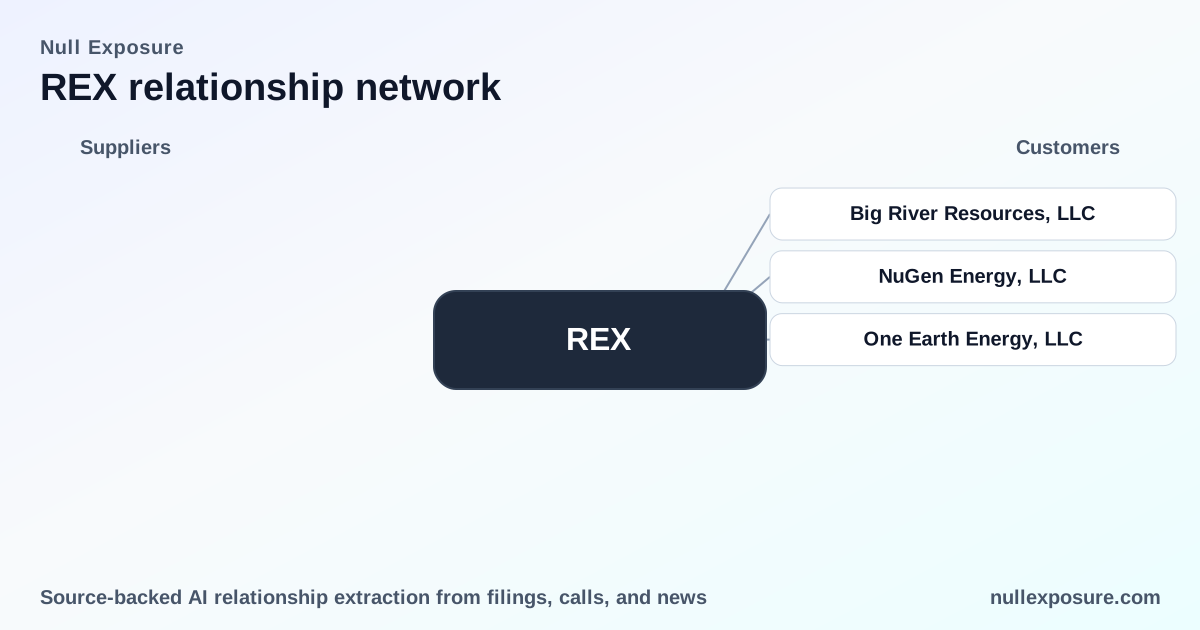
Big River Resources, LLC
REX reports it is invested in Big River Resources as of January 31, 2025, using equity investments, which positions REX to capture operational upside from that entity rather than recognizing direct product sales through it. According to the FY2025 Form 10‑K, REX holds equity stakes in three entities, including Big River Resources, as part of its investment strategy (FY2025 10‑K).
Takeaway: This is an equity investment relationship intended to extend REX’s operational footprint and return profile rather than a traditional customer contract.
NuGen Energy, LLC
NuGen is majority‑owned through REX and its Marion, South Dakota ethanol plant has signed an agreement to be part of Summit Carbon Solutions’ carbon capture and storage pipeline, a strategic move to reduce carbon intensity and support higher value points for low‑CI ethanol. The FY2025 Form 10‑K specifically notes the Marion plant’s agreement to participate in Summit Carbon Solutions’ CCS project (FY2025 10‑K).
Takeaway: NuGen is strategically important for REX’s CI reduction roadmap and potential premium pricing, and its participation in a major CCS pipeline is a catalyst for product differentiation.
One Earth Energy, LLC
One Earth Energy shows direct capital investment and ongoing project commitments: REX disclosed $59.9 million spent since inception and an additional $8.7 million contractually committed to plant capacity expansion and CI‑scoring improvements as of January 31, 2025 (FY2025 10‑K).
Takeaway: One Earth is a capitalized growth asset within REX’s portfolio targeting capacity expansion and lower carbon intensity—both drivers of longer‑term value per gallon.
Important commercial mechanics tied to the relationships
-
One Earth and NuGen each have a contract with an unrelated third party identified as Distillers Grains Marketers to purchase all of their distillers grains production under one‑year renewable agreements; these contracts centralize by‑product sales and reduce marketing risk for that product line (FY2025 10‑K).
Implication: By locking in a buyer for distillers grains, REX stabilizes a material component of by‑product revenue but concentrates counterparty exposure for that revenue stream. -
At the group level, sales recognition occurs upon transfer of control—generally at shipment or rail loading—so logistics, rail availability, and buyer receipt timing are operationally meaningful to revenue realization (FY2025 10‑K).
Investment implications and risk checklist
REX’s commercial relationships and disclosed constraints create a distinct risk/reward profile:
- Price and margin cyclicality: Short contract tenors create sensitivity to near‑term commodity volatility; earnings will expand in favorable corn and energy environments and compress when inputs outpace product pricing.
- Concentration risk: With the top ten customers representing ~92% of revenue, any negotiation or non‑performance event with a large buyer can produce outsized revenue disruption.
- Execution‑dependent growth: Capital commitments to One Earth and participation in NuGen’s CCS project are value drivers—successful execution raises per‑gallon value; delays or cost overruns suppress returns.
- By‑product marketing trade‑off: Exclusive marketing contracts reduce volatility but increase counterparty reliance for material volumes of distillers grains.
Bottom line: REX’s commercial structure is clear: manufacturing scale + short‑term ethanol sales + concentrated buyer base + strategic plant investments. Investors should prioritize monitoring short‑dated contract rollovers, by‑product marketing counterparties, progress on capacity and CI projects, and any shifts in customer concentration.
If you want deeper coverage of REX’s commercial counterparties and how those relationships translate to cash‑flow sensitivity, review the full FY2025 Form 10‑K or reach out for the analyst brief at https://nullexposure.com/.
Final verdict for operators and research teams
For operators benchmarking counterparties or evaluating risk, REX represents a classic commodity manufacturing exposure with an overlay of strategic investments aimed at carbon intensity reduction. The company’s upside is tied to execution on plant projects and the preservation of a small, high‑value commercial buyer group; its primary vulnerability is the short tenor of fixed‑price contracts combined with material customer concentration (FY2025 10‑K). Investors and underwriting teams should price those dynamics into any valuation or counterparty risk assessment.