Rexford Industrial (REXR): Customer Relationships, Contracting Posture, and What It Means for Investors
Rexford Industrial operates and monetizes by owning, leasing and managing industrial real estate concentrated in Southern California infill markets. The business generates cash flow primarily through fixed and variable rental income, supplemented by management fees on third‑party assets and selective property acquisitions; its scale and geographic focus create predictable base rents while exposing results to regional industrial demand cycles. For investors evaluating REXR’s customer relationships, the combination of long‑dated lease economics, meaningful variable rent exposure, and active in‑house property management defines both upside (stable cash yield, renewal-driven rent growth) and operational risk (tenant mix, local market concentration). Learn more on the homepage: https://nullexposure.com/
What the customer evidence tells investors in one paragraph
Rexford’s tenant relationships are predominantly long‑term, active leases with a mix of fixed and variable payments and a high degree of tenant diversity by industry; the company also acts as a property manager and acquirer, so customer touchpoints include pure tenancy, fee‑based management, and transactional asset sales/purchases. According to company disclosures for the year ended December 31, 2025, Rexford recognized substantial fixed rent alongside meaningful variable lease payments and executed a large number of renewals and new leases, signaling operational scale and active portfolio management.
Quick operating and financial context for investors
- Market capitalization: $8.13 billion.
- Revenue (TTM): $995.9 million; EBITDA: $674.1 million.
- Rental income mix (2025): $959.5 million total operating lease income — $787.0M fixed, $172.5M variable.
- Portfolio geography: fully focused on Southern California infill markets, ~51.2 million rentable square feet across wholly‑owned properties as of Dec 31, 2025 (company filing).
These figures underline scale, concentration, and a hybrid revenue model that blends stable base rent with performance‑linked upside.
How Rexford contracts with customers — the constraints that matter
Company disclosures make clear several structural features that drive revenue and risk:
- Long‑term, non‑cancelable leases are the baseline: Rexford reports weighted average lease terms in its disclosures and a preference for non‑cancelable operating leases that include base rent plus expense recoveries, which creates durable cash flows.
- Variable (usage) components are material: in 2025 variable lease payments totaled $172.5 million, so tenant performance and throughput influence near‑term revenue.
- Fee‑based property management: Rexford earns monthly management fees on managed properties calculated as a percentage of tenant cash receipts — this creates a predictable subscription‑style revenue stream that scales with third‑party assets under management.
- Geographic concentration: all properties are in Southern California infill markets, which supports pricing power for last‑mile distribution but concentrates market risk.
- Active portfolio management and maturity: high leasing activity (478 new and renewal leases covering 10.4M rentable sq ft in the year) and a 66.6% retention rate across renewals show a mature, active leasing program that drives rental escalation and reduces vacancy risk.
(These points are drawn from Rexford’s public filings and its year‑end 2025 disclosures.)
Customer relationships: the specifics investors need to know
Below are the discrete customer mentions in the publicly available corpus and what they reveal about Rexford’s tenant and counterparty footprint.
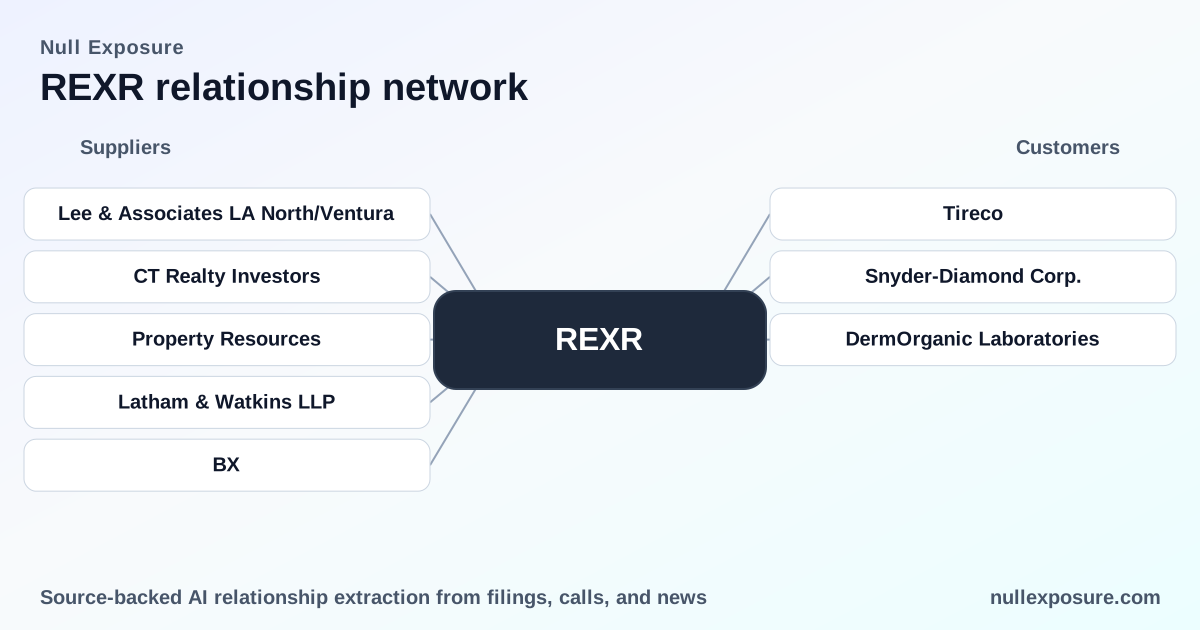
Tireco — strategic anchor tenant and early renewal
Rexford executed an early renewal with Tireco, its largest tenant, which occupies a 1.1 million square‑foot production Avenue property, signaling a commitment from a major occupant and securing a substantial portion of space through an early renewal. This transaction underscores the importance of large, anchor tenants to portfolio stability and the value of proactive renewals; the renewal was discussed on Rexford’s Q4 2025 earnings call on March 7, 2026. (Source: Q4 2025 earnings call, March 7, 2026.)
Snyder‑Diamond Corp. — large distribution lease in Simi Valley
Snyder‑Diamond signed a $13.9 million lease for a 76,000 sq ft warehouse with 6,600 sq ft of offices at 2390 Ward Ave., a property owned by Rexford, representing a textbook distribution customer transaction in an infill market. This lease illustrates Rexford’s exposure to wholesale/distribution tenants and the company’s ability to secure multi‑million dollar commitments for last‑mile logistics assets (reported in a Valley Business Journal article referencing FY2022 leasing activity). (Source: Valley Business Journal, article on Rexford leasing in Simi Valley.)
DermOrganic Laboratories — a tenant dispute with modest exposure
Rexford was involved in litigation with DermOrganic Laboratories over roughly $43,000 in unpaid rent, demonstrating that tenant credit disputes and small‑balance delinquencies can occur even in a diversified portfolio; the matter was reported in The Real Deal in October 2021. While the dollar amount is immaterial at the portfolio scale, the case is a reminder that tenant credit management and legal recourse are routine aspects of landlord operations in this sector. (Source: The Real Deal, Oct 22, 2021.)
Putting these relationships in investor terms — drivers and risks
- Driver — concentrated, high‑quality infill inventory: Rexford’s focus on Southern California last‑mile assets supports consistent leasing demand from distribution and manufacturing tenants, which is reflected in large leases such as Snyder‑Diamond and renewals from large occupants like Tireco (company filings, 2025).
- Driver — hybrid revenue model: fixed base rents provide stability while variable lease components and management fees provide upside as tenant throughput and third‑party cash receipts rise.
- Risk — regional concentration: full exposure to Southern California markets amplifies macro or local shocks (e.g., logistics demand cycles, land‑use regulation) relative to more geographically diversified peers.
- Risk — tenant concentration by space, not rent: although no single tenant accounts for more than 2.4% of total annualized base rent (company disclosure), large single‑occupant facilities (e.g., 1.1M sq ft for Tireco) make physical vacancy events operationally notable.
- Operational signal — active portfolio management: high renewal volume and in‑house leasing/management reduce reliance on third‑party brokers and support faster rent reversion capture.
What investors should watch next
- Track renewal cadence for large‑format tenants and any changes in variable rent receipts that reflect demand shifts in e‑commerce and distribution.
- Monitor retention rates and leasing spreads on new vs. renewed leases for signs of accelerating or decelerating rent momentum.
- Watch for portfolio additions or dispositions that could alter concentration or dilute management fee income.
For a concise dataset of customer relationships and constraints tuned for investment due diligence, visit our research hub: https://nullexposure.com/
Final takeaway
Rexford’s customer relationships are a blend of stable long‑term leases and revenue streams with measurable variable upside, managed through an active, vertically integrated platform focused on Southern California infill markets. The combined profile supports resilient cash flow but requires active oversight of tenant credit, renewal execution, and exposure to regional demand cycles — factors that will determine returns for investors in the near and medium term.