Rexford Industrial (REXR-P-B): Customer Relationships That Underpin a Preferred Income Play
Rexford Industrial Realty operates as a focused owner-operator of industrial real estate across Southern California, monetizing through long-term leasing of infill logistics properties, targeted value‑add development and asset recycling; its 5.875% Series B cumulative redeemable preferred shares offer investors a fixed-income-like claim on that cash flow stream while equity operators capture upside through rental growth and redevelopment. For income-seeking investors evaluating REXR-P-B, the durability of Rexford’s tenant book and the company’s ability to renew and repurpose space are the primary drivers of downside protection and dividend continuity. Learn more about Rexford customer relationships and implications at https://nullexposure.com/.
Why tenants matter for a preferred-stock holder
Preferred holders do not participate in upside the way common equity does, but they are exposed to counterparty and portfolio operational risk when tenant cash flows are impaired. Large, concentrated leases or tenants with strategic importance to the property can materially influence dividend coverage and the probability of preferred redemptions or calls. Rexford’s underwriting and lease renewal behavior determine cash stability; investor focus should be on tenant size, lease tenor, and operational criticality rather than short-term valuation swings.
Customer relationships in focus: three tenants that matter right now
This section reviews every customer relationship surfaced in the latest coverage and links to the source context for each.
Tireco — large-scale renewal reinforces lease stability
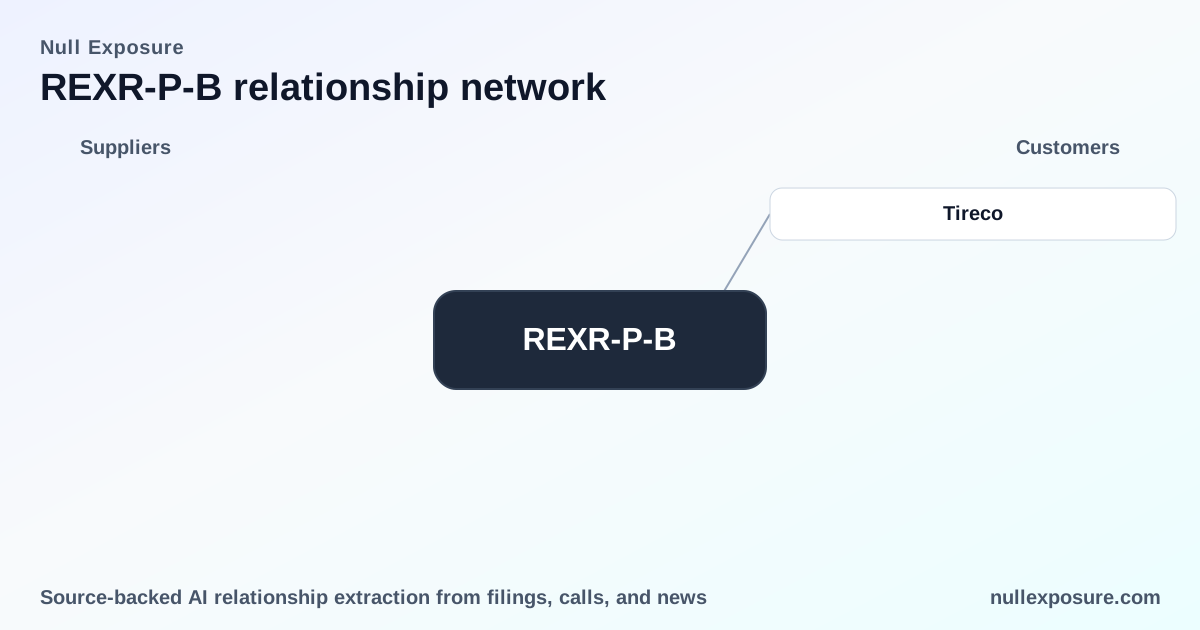
Rexford executed an early renewal with Tireco, which occupies a 1.1 million square foot asset on Production Avenue; management described this as a strategic renewal completed subsequent to year-end. This transaction signals active portfolio management focused on retaining large logistics occupiers that provide steady rent rolls. According to an earnings call transcript cited in March 2026, the renewal was framed as a priority for maintaining occupancy and cash flow at a major asset (InsiderMonkey, Q4 2025 / FY2026).
Herbalife — legacy office asset identified as offline/obsolete in operating commentary
Management called out an obsolete office building leased by Herbalife at 950 West 190th Street as part of a set of assets driving offline impacts to operations, indicating this tenancy is associated with an asset that management considers non-core or subject to repositioning. The mention positions Herbalife in the context of Rexford’s asset renewal and redevelopment pipeline rather than as a core logistics tenant (Investing.com transcript, Q3 2025 / FY2025).
Hertz — specific site cited among operationally impacted assets
Rexford identified a Hertz site at 9000 Airport Boulevard as one of the assets contributing to offline impacts, which suggests localized operational or demand issues at that parcel. Management’s public remarks treated Hertz as a named occupant of a property under transitional or asset-quality pressure, informing short-term cash flow variability at that location (Investing.com transcript, Q3 2025 / FY2025).
Operating model and business‑model constraints — company‑level signals
There are no explicit third‑party constraint entries attached to these customer relationships in the available coverage feed; as a result, the following observations are presented as company‑level signals derived from Rexford’s operating posture and the relationship commentary.
- Contracting posture: Rexford executes long-dated, industrial leases and pursues proactive renewals — the early renewal with a large tenant is consistent with a contracting posture that prioritizes stability of base rents over opportunistic churn.
- Concentration: The presence of a 1.1 million sqft tenant highlights tenant concentration risk at the asset level; large occupiers reduce turnover risk but amplify single‑tenant exposure if a dispute or vacancy occurs.
- Criticality: Industrial infill assets in Southern California are operationally critical for regional logistics networks; occupancy disruptions at key properties can have outsized cash-flow impact compared with dispersed, commodity‑grade industrial portfolios.
- Maturity and asset lifecycle management: References to “obsolete office buildings” and offline impacts reflect active portfolio lifecycle management — Rexford is both dealing with legacy office converts and prioritizing redevelopment or repurposing for industrial use, which is consistent with a mid‑to‑mature platform executing value‑add strategies.
What investors should read into these relationships
- Stability signal: The Tireco early renewal is a clear positive for preferred holders — retaining a large tenant reduces vacancy risk and supports predictable coupon coverage.
- Transition risk: Mentions of obsolete office buildings and offline impacts tied to Herbalife and Hertz represent near-term operational frictions that could compress cash flow at specific properties while assets are repositioned.
- Concentration tradeoff: The portfolio choice to hold large, infill industrial assets drives higher rent resilience but concentrates downside. Preferred investors should prefer clarity on lease covenants, rent payment histories, and the company’s liquidity buffer rather than headline occupancy alone.
Risk checklist for REXR-P-B bond‑style investors
- Large single-asset leases can sustain cash flow but raise downside exposure if a major tenant vacates or renegotiates.
- Asset repurposing (office-to-industrial conversion) introduces timing and capital execution risk; revenue recovery depends on redevelopment pacing and market demand.
- Localized operational issues at particular sites (as described for Hertz and Herbalife assets) can create episodic cash drag even when the overall portfolio is sound.
Practical next steps for valuation and monitoring
- Verify lease terms, maturities, and rent-roll contribution from large tenants during the next investor presentation or 10‑K/10‑Q to assess coupon coverage for REXR-P-B.
- Monitor management commentary on redevelopment timelines for obsolete office buildings to gauge recovery of cash flows tied to Herbalife and Hertz assets.
- Keep an eye on the company’s liquidity and preferred dividend payment history as the clearest lead indicator of preferred security resilience.
For a deeper corporate and customer map that helps you move from headline relationships to actionable monitoring, visit https://nullexposure.com/.
Bottom line
Rexford’s customer mix includes high-quality, large-scale industrial tenants that underpin the preferred share’s income profile, balanced against localized transition risk from legacy office conversions and asset-specific operational issues. For investors in REXR-P-B, the combination of lease renewal activity and execution on redevelopments will determine the reliability of the 5.875% payout; active monitoring of tenant concentration and redevelopment progress is essential.